
If you look up Google in 1998, you'll find a pale homepage, a plain search box, and a short list of blue links with no ads in sight. It looks almost nothing like today's results page, with its AI Overviews, featured snippets, maps, and shopping carousels. Yet the idea behind that early search engine, that a link works as a vote of trust, still sits at the heart of modern link building.
I've spent 8+ years in SEO, and I keep coming back to this period because the fundamentals have held up so well. In this guide, we'll look at what Google looked like in 1998, how it ranked pages, and what has changed since, including the rise of LLM SEO. We'll finish with five lessons you can apply to your content strategy today.
What Google Looked Like in 1998
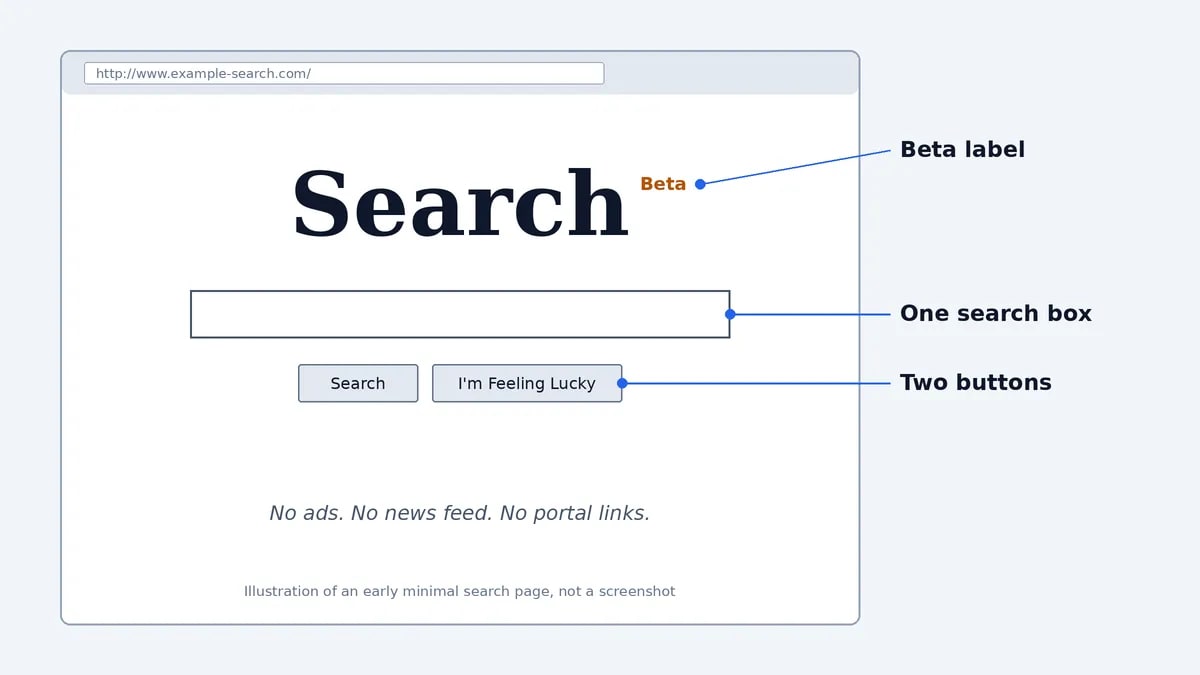
Google began as a Stanford research project called BackRub, built by PhD students Larry Page and Sergey Brin. By 1998 it had become a real search engine, and the company was incorporated that September.
The homepage was strikingly simple. It had a white background, a colorful logo (the earliest version even included an exclamation mark), one search box, and two buttons: "Google Search" and "I'm Feeling Lucky". A small "Beta" label sat under the logo. There were no ads, no news feed, and no portal-style links, which set it apart from rivals that packed their homepages with content.
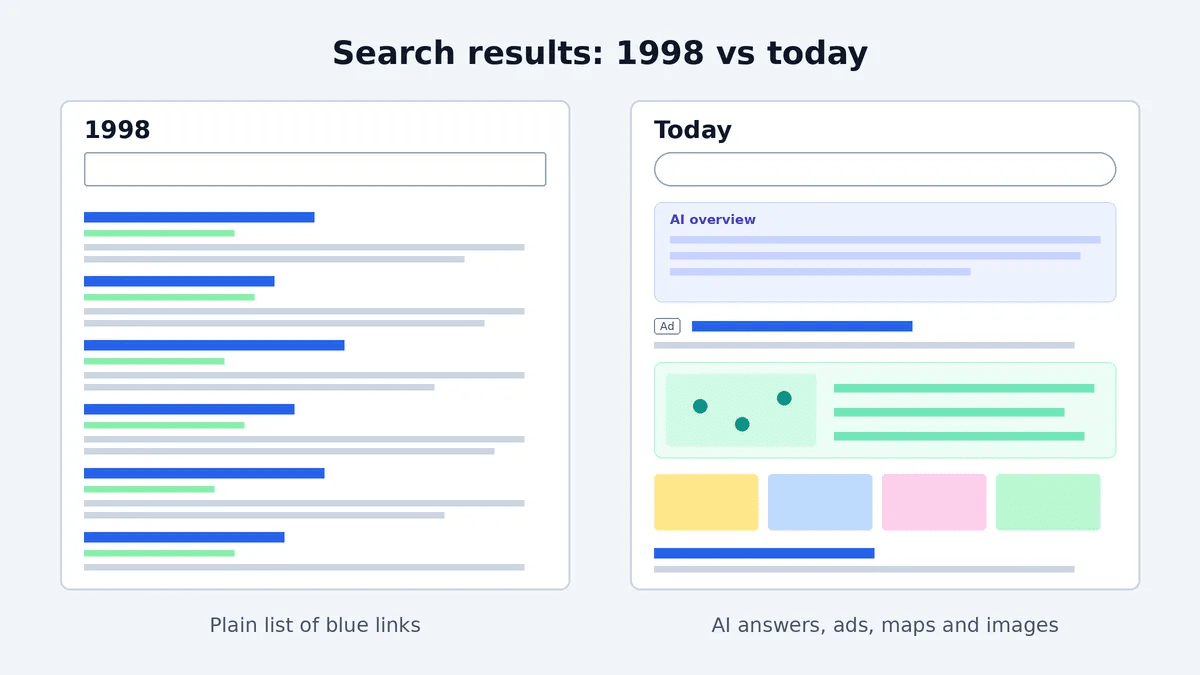
The results pages were just as plain. You got a list of blue links with short text descriptions, and nothing else. There were no featured snippets, maps, images, or AI-generated answers.
That restraint was deliberate. A clean page loaded quickly on slow dial-up connections, and it kept the focus on the result. The same logic holds today: pages that are fast and focused tend to serve users and search engines better, which is why technical SEO and clean on-page SEO still matter.
How Google Ranked Pages in 1998
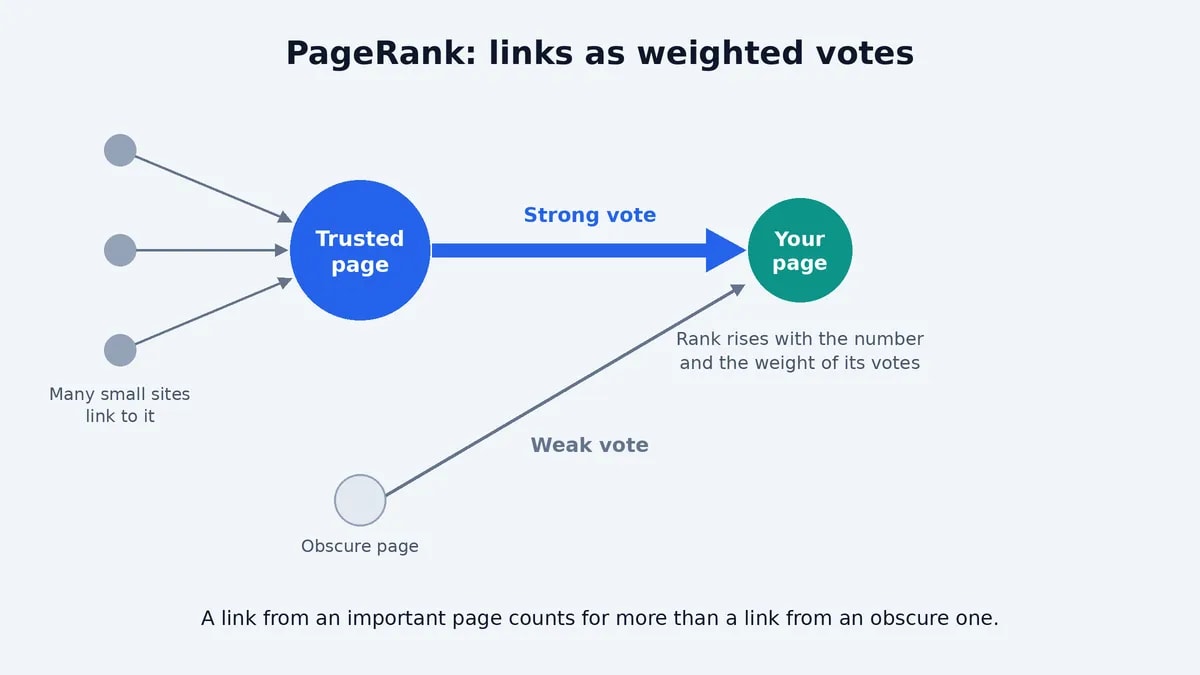
Google's early edge came from a simple idea: treat links as votes. This is PageRank, which the founders described in their 1998 Stanford paper (the algorithm is named after Larry Page). A link from one page to another counts as a vote of confidence, but not all votes are equal. A link from a page that is itself widely linked to carries more weight than one from an obscure page.
This was a big shift. Many search engines at the time leaned heavily on what a page said about itself, such as how often a keyword appeared in the text. That made them easy to game. PageRank added an outside signal that was harder to fake, because it depended on what other sites chose to link to.
Google also used anchor text, the clickable words of a link. The paper describes associating that text with the page it points to, which helped Google understand what a page was about even when the page itself said little.
None of this stayed unexploited. Once people understood that links influenced rankings, link manipulation followed, from link swaps to paid placements, and Google has spent the years since fighting it. That's why a shortcut like backlink outsourcing can still backfire today, and why earning links honestly, as I cover in my link building tutorial, remains the safer route.
The Search Landscape Google Entered
Google didn't launch into an empty field. Users in the late 1990s could choose from Yahoo, AltaVista, Excite, Lycos, and Ask Jeeves, among others. Yahoo was best known as a human-edited directory, while AltaVista and Excite were crawler-based engines. Many of them were also turning their homepages into portals, with news, email, and shopping links packed around the search box.
That mix left room for a cleaner, more relevant alternative. Google focused on result quality and a fast, uncluttered page, and users noticed. If you're curious how another engine from that era approached the problem, I've reviewed the Dogpile search engine, a metasearch tool that pulled results from several engines at once.
Here is how search then compares with search now:
Google in 1998 | Google today | |
|---|---|---|
Homepage | Logo, search box, two buttons | Same core design, plus shortcuts and personalization |
Results page | Plain blue links and short descriptions | Snippets, maps, images, videos, AI answers |
Ranking inputs | Links, anchor text, on-page text | Hundreds of signals, including quality and intent |
Ads | None at launch | Ads integrated into results |
Queries | Short keyword strings | Natural language and conversational questions |
Terms like "anchor text" and "SERP" have been around since this era, and my SEO glossary explains them if you want a refresher.
What Hasn't Changed: Timeless SEO Principles
The interface has changed beyond recognition, but several principles from 1998 still hold.
Links still signal authority. Google's core idea, that a link from a trusted page is a vote of confidence, remains part of how search engines judge pages. Quality matters far more than volume. A handful of relevant, editorially earned links will do more for you than hundreds of low-quality ones. I explain how I approach this in my link building plan.
Links need looking after. Backlinks sit outside your direct control, so they can be lost, broken, or replaced. Checking your profile regularly is part of the job, and I've compared the options in my guide to backlink monitoring tools.
Relevance beats tricks. Early engines were gamed with keyword stuffing and link schemes, and Google has been closing those loopholes ever since. The sites that last are the ones that answer the searcher's question better than anyone else.
Context still matters. Anchor text was a relevance signal in 1998, and the words around a link still help search engines understand what a page is about. Descriptive anchors are better than "click here".
What Has Changed Completely
While the principles above have lasted, almost everything around them has moved on.
The results page is no longer ten blue links. Today's SERP can include featured snippets, local packs, images, videos, shopping results, and AI-generated overviews that answer the question before anyone clicks. Ranking first still matters, but it doesn't guarantee the traffic it once did.
Google fights manipulation far more effectively. Early link tricks have been countered by years of updates, including the Penguin update aimed at spammy links and AI-based spam detection systems such as SpamBrain. Google has also put more weight on quality signals, including experience, expertise, authoritativeness, and trust (E-E-A-T). Large shifts still happen, as I covered in Google's recent deindexing wave.
Search now understands meaning, not just keywords. People ask full questions in natural language, and engines interpret intent rather than matching strings.
AI answer engines are a new discovery channel. Tools like ChatGPT and Perplexity are changing how people find information, which is why I wrote about ChatGPT SEO and offer LLMO, AEO and GEO services.
Five Lessons for SEO Today
Put the old and the new side by side, and a few practical lessons stand out.
Earn links from relevant, trusted sites. One link from a respected page in your field is worth more than a pile of weak ones. Start with the sites your audience already reads.
Keep pages fast and focused. The 1998 homepage did one job and did it quickly. Give each page a single clear purpose, and treat speed as part of the user experience.
Answer the query better than anyone else. Google won by returning more useful results than its rivals. You can compete the same way by improving what you already have, and updating old content is often the fastest win.
Don't build on a single trick. Every shortcut, from keyword stuffing to link schemes, eventually got shut down. Steady habits last longer, as I explain in my guide to SEO tips that support consistent organic traffic.
Measure with data, and know its limits. Rankings alone can mislead you. I've written about why your rankings can improve while traffic doesn't, and it also helps to understand how Ahrefs gets its data before trusting any single number.
Conclusion
Google in 1998 was a plain search box and a list of blue links, but the thinking behind it was sharp: trust is earned, links are signals, and the best result should win. The interface has changed beyond recognition, and the principles have lasted.
If you want to know how your site measures up against them today, I'll review it personally and send a prioritised 90-day plan through my free SEO audit. If you'd rather have hands-on help, see how working with an SEO consultant compares with hiring an agency.
Frequently Asked Questions
What did Google look like in 1998?
The homepage was minimal: a logo, a single search box, and two buttons, "Google Search" and "I'm Feeling Lucky", with a small "Beta" label. Results were a plain list of blue links with short descriptions, without the snippets, maps, or AI answers you see today.
How did Google rank pages in 1998?
Google used PageRank, which treated links from other pages as votes of confidence and gave more weight to links from important pages. It also used anchor text, the clickable words of a link, to understand what the linked page was about.
Who created Google?
Larry Page and Sergey Brin created Google while they were PhD students at Stanford University. It began as a research project called BackRub, and the company was incorporated in September 1998.