
You’ve probably stared at an Ahrefs number and wondered if you should actually trust it.
A competitor’s site shows 80,000 monthly visitors. A keyword shows 12,000 searches. A backlink you built last week still isn’t showing up. Is the data right? Is it outdated? Is Ahrefs just making educated guesses?
These are fair questions, and the answer matters because how you interpret Ahrefs data should depend entirely on where that data comes from.
So let’s get into it. Ahrefs collects its data through three main pipelines: its own web crawler (AhrefsBot), third-party clickstream panels, and Google Keyword Planner. Each one feeds a different part of the tool, and each one has its own strengths and blind spots.
Once you understand the source, the numbers start making a lot more sense, including the ones that seem off.
In this guide:
- The short answer: three data pipelines
- AhrefsBot and the backlink database
- Clickstream data and keyword volumes
- Google Keyword Planner: the volume baseline
- How Ahrefs estimates organic traffic
- How accurate is Ahrefs data, really?
- Ahrefs vs Semrush: who gets data from where?
The short answer: three data pipelines working together

Ahrefs doesn’t get its data from a single source. It never has. The platform runs three separate data collection systems simultaneously, each powering a different part of what you see in the tool.
The first is AhrefsBot, Ahrefs’ own web crawler, which has been crawling the internet around the clock since 2013. It’s the engine behind the backlink database, and it’s what makes Ahrefs’ link data the deepest in the industry.
The second is clickstream data, anonymized browsing behavior collected from millions of real users through third-party panels, browser extensions, and apps. This is how Ahrefs models actual search behavior: what people click, how often, and which keywords drive traffic versus which ones just get impressions.
The third is Google Keyword Planner, used as a baseline for search volume figures, which Ahrefs then refines using clickstream signals to get more granular, accurate estimates.
There’s also a fourth, less-discussed source: YepBot, the crawler behind Ahrefs’ own search engine yep.com, which contributes to their broader web index.
Each system has its own refresh rate, accuracy profile, and limitations. The rest of this guide breaks down all of them.
Check out our latest blog on estoturf.fr: Domain Analysis, Organic Traffic & SEO Insights
AhrefsBot: the web crawler behind the backlink database
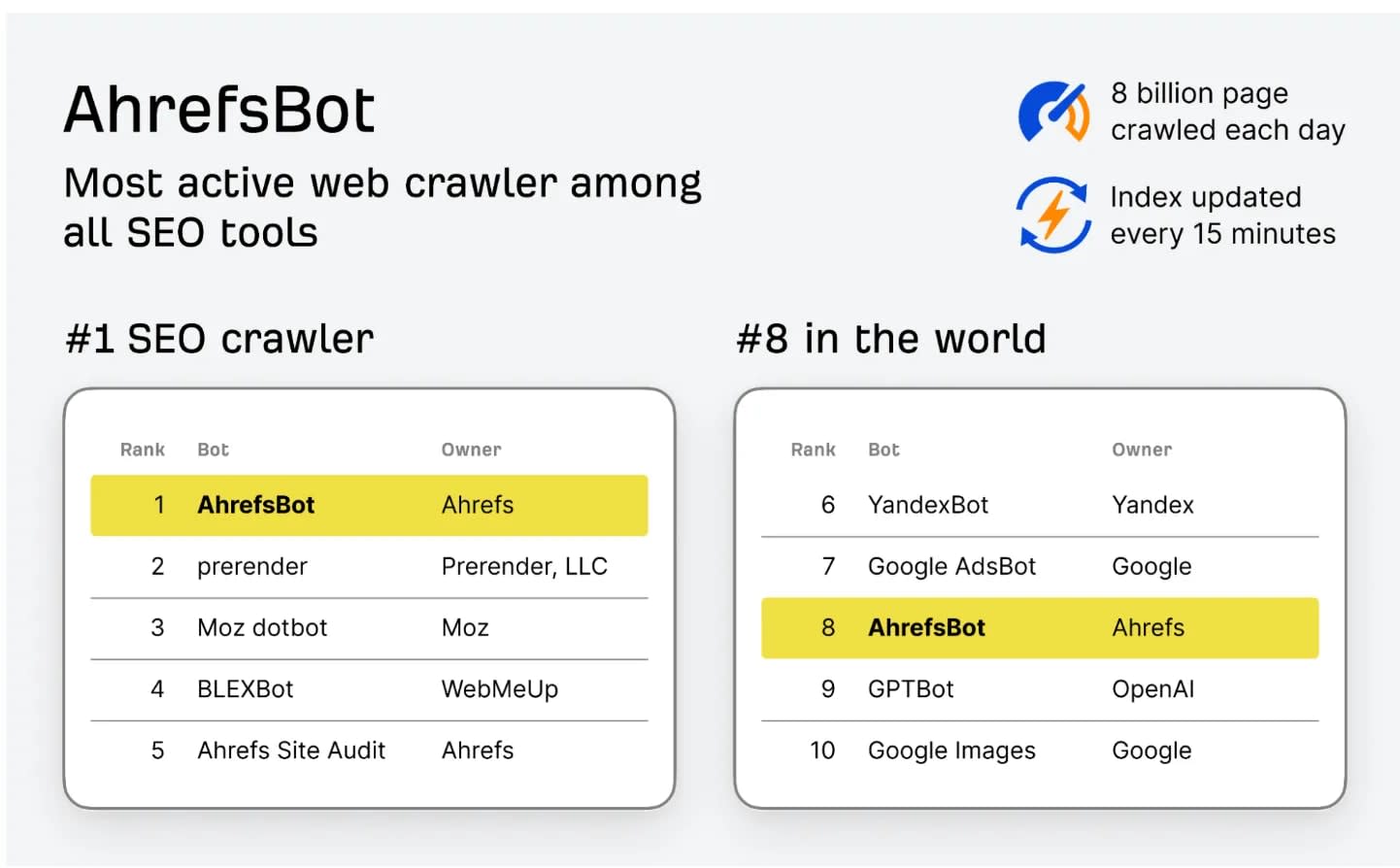
If you’ve ever checked a server’s access logs and spotted an unfamiliar bot crawling your site, there’s a reasonable chance it was AhrefsBot. After Googlebot, it’s the most active web crawler on the internet, and that’s not a coincidence. Ahrefs built it that way deliberately.
Check out our latest blog on veganovtrichy.com: Search Traffic, Rankings & Backlinks
What is AhrefsBot and how does it work?
AhrefsBot works the same way any search engine crawler does. It visits web pages, reads the HTML, follows the links it finds, then moves on to the next page and repeats the process billions of times per day.
What makes it different from a basic scraper is scale and persistence. AhrefsBot crawls over six billion pages every single day. It doesn’t just discover new pages either, it continuously revisits URLs it’s already indexed to check whether links are still live, whether pages have changed, and whether new links have appeared. That’s how Ahrefs maintains a backlink database of over 12 trillion links without it going stale.
The whole operation has been running since 2013. That’s over a decade of continuous crawling, which is a big part of why Ahrefs’ historical backlink data is so difficult for newer tools to compete with, you simply can’t replicate ten years of crawl history overnight.
How big is the Ahrefs backlink index?
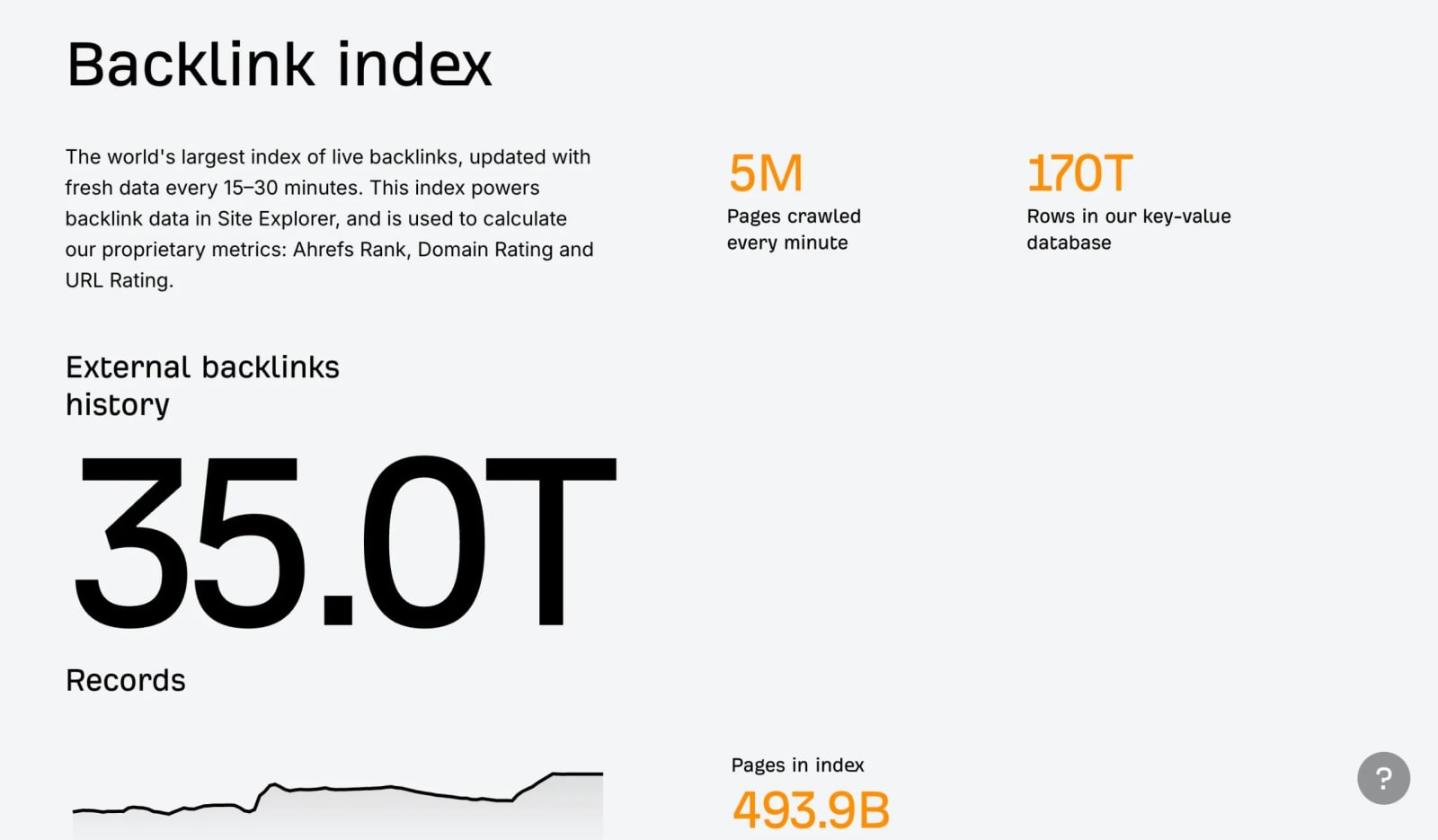
Big enough that Ahrefs had to build its own infrastructure to handle it. The data volumes involved are so large, we’re talking petabytes, that no off-the-shelf cloud solution could keep up. So Ahrefs built most of its processing systems in-house, including a supercomputer called Yep1, which ranks among the top 50 fastest in the world by floating-point operations per second.
That’s not a marketing flex. It’s context for why the backlink data is as comprehensive as it is. When a tool can process that volume of crawl data in near real-time, the index stays fresh in a way that smaller tools, running on standard cloud infrastructure, simply can’t match.
How often is backlink data updated?
This is where Ahrefs genuinely pulls ahead of most competitors. The backlink index refreshes every 15 to 30 minutes. Not daily, not weekly, every half hour or less.
In practice, that means if someone builds a link to your site this morning, there’s a reasonable chance Ahrefs will have already picked it up by this afternoon. It also means that lost or broken links are flagged quickly, which matters if you’re doing any kind of link monitoring or disavowal work.
Ranking data, how keywords are performing in search results, updates daily. Keyword volume estimates refresh on a monthly cycle, which is worth keeping in mind when you’re doing time-sensitive research.
Clickstream data: how Ahrefs tracks real search behavior
Backlinks are relatively straightforward to collect: you crawl the web, find the links, and store them. Keyword data is harder. Search volumes aren’t publicly available. Google doesn’t publish a live feed of how many times people search for “best running shoes” each month. So how does Ahrefs know?
The answer is clickstream data, and it’s worth understanding properly because it’s what sets Ahrefs’ keyword metrics apart from a simple export of Google Keyword Planner numbers.
What is clickstream data?
Clickstream data is a record of what real users actually do online. Every page they visit, every link they click, every search they run. It’s collected through browser extensions, apps, ISP-level agreements, and opt-in research panels, all with user consent and anonymized before it reaches a tool like Ahrefs.
Ahrefs doesn’t collect this data itself. It buys access to aggregated, anonymized clickstream panels from third-party data providers. Those panels represent millions of real users across different devices, browsers, and locations. Once the data is in, Ahrefs strips out anything that could identify an individual and works purely with the aggregate patterns.
Think of it like a massive, anonymous survey of the internet, not what people say they search for, but what they actually searched for and clicked on.
How does Ahrefs use clickstream for keyword volumes?
Here’s where it gets genuinely useful. Google Keyword Planner, which most tools use as their volume baseline, has a well-known problem: it merges keyword variants together. Search for “running shoes” and “shoes for running,” and GKP will often report the same volume for both, because from Google’s advertising perspective, they’re the same intent, the same audience, the same bid.
For keyword research, that’s a problem. They’re not the same keyword.
Clickstream data lets Ahrefs pull those variants apart. Because it’s tracking actual individual searches rather than aggregated ad auction data, it can see that “running shoes” gets searched far more often than “shoes for running,” even if GKP lumps them together. The result is keyword volume data that’s more granular and, in many cases, closer to reality.
It’s also why you’ll sometimes see Ahrefs report a noticeably different volume than GKP for the same keyword. That’s not a bug or an error. It’s the two systems measuring slightly different things.
How does clickstream power Ahrefs’ CTR estimates?
This is the part most people overlook. Ahrefs doesn’t just use clickstream data to estimate how often a keyword is searched; it also uses it to estimate how often those searches result in a click.
That’s where the “clicks” metric in Keywords Explorer comes from. A keyword like “what time is it in Tokyo” might get 50,000 monthly searches, but most people get their answer directly from the search result page without clicking anything. The actual click volume might be closer to 8,000. GKP has no way of knowing that. Ahrefs does, because clickstream data captures what happens after the search, not just the search itself.
For content strategy, this distinction matters enormously. Chasing a high-volume keyword with near-zero clicks is a waste of effort. Clickstream is what makes that visible.
Google Keyword Planner: the search volume foundation
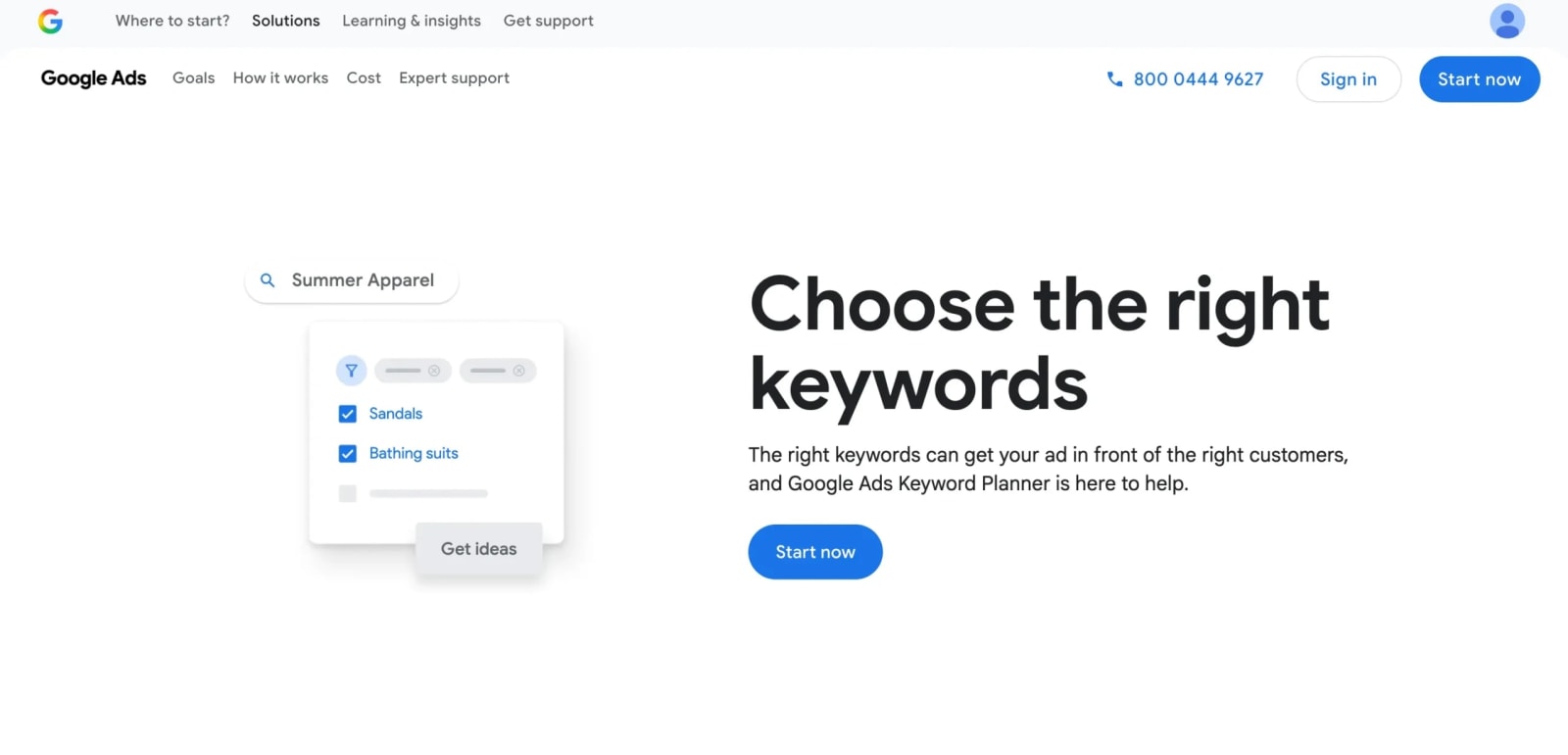
At this point, you might be wondering, if clickstream data is so powerful, why does Ahrefs use Google Keyword Planner at all?
Fair question. The honest answer is that clickstream panels, no matter how large, have coverage gaps. They’re strong on popular keywords with high search volume, but thin on low-volume, niche, or emerging queries where the sample size of observed searches is too small to model reliably. GKP fills that gap. It’s not perfect, but it’s the most comprehensive source of keyword existence data available. Google sees every search, and GKP is the closest thing to a public window into that.
Why do most SEO tools use Google Keyword Planner?
Because there’s no better alternative for raw keyword discovery. GKP tells you that a keyword exists, roughly how competitive it is in paid search, and a broad volume range. That’s genuinely useful as a starting point, even if the numbers themselves are imprecise.
Every major SEO platform, including Ahrefs, Semrush, and Moz, uses GKP as part of its keyword data foundation. This is worth knowing because it means that, at the base level, these tools all look at the same source material. What differentiates them is what they do with it afterward.
How does Ahrefs blend GKP data with clickstream?
Think of it as a two-step process. GKP provides the skeleton, the list of keywords that exist, and a rough volume range for each. Clickstream then adds the muscle, real observed search behavior that lets Ahrefs sharpen those broad ranges into more specific estimates, split merged variants into separate keywords, and attach click-through data that GKP doesn’t have at all.
The result is more useful than either source alone. GKP alone gives you blunt, advertiser-focused numbers updated on a monthly lag. Clickstream alone has holes in its coverage. Together, they produce something closer to what you actually need for keyword research decisions.
One thing worth keeping in mind: because GKP updates monthly and uses rolling annual averages, there’s always some lag in Ahrefs’ volume data. A keyword that exploded in popularity last week won’t yet show up in the numbers. For trend-sensitive research, that’s a real limitation and it’s why Ahrefs surfaces Google Trends integration alongside its volume data rather than pretending the monthly figures tell the whole story.
How Ahrefs estimates organic traffic (and why it differs from GA)

At some point, almost every Ahrefs user has had the same jarring moment. You pull up your own site in Site Explorer, look at the organic traffic estimate, and it’s nowhere near what Google Analytics is reporting. Sometimes it’s double. Sometimes it’s half. Occasionally, it’s so far off you start questioning whether Ahrefs is broken.
It isn’t. But understanding why the numbers diverge is important, because if you misread what Ahrefs is actually showing you, you’ll use it wrong.
The formula: rankings × search volume × CTR
Ahrefs doesn’t have access to your actual traffic data. Only you do, through GA or Google Search Console. What Ahrefs does instead is build an estimate from the outside in, using three inputs it has access to:
- The keywords your site ranks for, pulled from its own SERP tracking
- The search volume for each of those keywords, from the GKP and clickstream pipeline described above
- An estimated click-through rate for each ranking position, modeled from clickstream behavior
Multiply the volume by the CTR for each keyword, sum it all up across every keyword your site ranks for, and you get the organic traffic estimate. Ahrefs runs this calculation daily for each page, then averages across days to produce weekly and monthly figures.
It’s a model. A well-constructed one, built on real data, but a model nonetheless. And like any model, it’s only as accurate as its inputs.
Why Ahrefs traffic estimates don’t match Google Analytics
There are several reasons the numbers rarely line up exactly, and none of them mean that something is wrong.
The first is keyword coverage. Ahrefs tracks the keywords it knows about, the ones in its database. If your site ranks for highly niche, low-volume, or brand-specific queries for which Ahrefs has thin data, that traffic simply doesn’t make it into the estimate. The actual traffic exists; Ahrefs just can’t see it.
The second is CTR modeling. The click-through rates Ahrefs applies to each ranking position are averages drawn from clickstream panels. Your site’s actual CTR will vary based on your title tags, meta descriptions, whether you have rich results, how strong your brand recognition is, and a dozen other factors that a population-level model can’t account for individually.
The third is what GA counts that Ahrefs doesn’t and vice versa. GA counts sessions, which can include direct traffic, email clicks, and social referrals that get misattributed to organic. It also counts bot traffic unless you’ve filtered it out. Ahrefs estimates purely organic search clicks. These are measuring genuinely different things.
The right way to use Ahrefs traffic data isn’t as a replacement for GA; it’s as a competitive lens. You don’t have access to your competitor’s GA account. You do have access to their Ahrefs estimate. And because the same model applies to everyone, the relative comparison is meaningful even when the absolute numbers aren’t perfectly precise. If Ahrefs says a competitor gets 40,000 monthly visits and you get 12,000, that gap is real, even if both numbers are somewhat off in absolute terms.
That’s the use case Ahrefs traffic estimates were built for. Hold them to that standard, and they’re genuinely useful. Hold them to GA-level precision, and you’ll constantly be disappointed.
How accurate is Ahrefs data? An honest breakdown
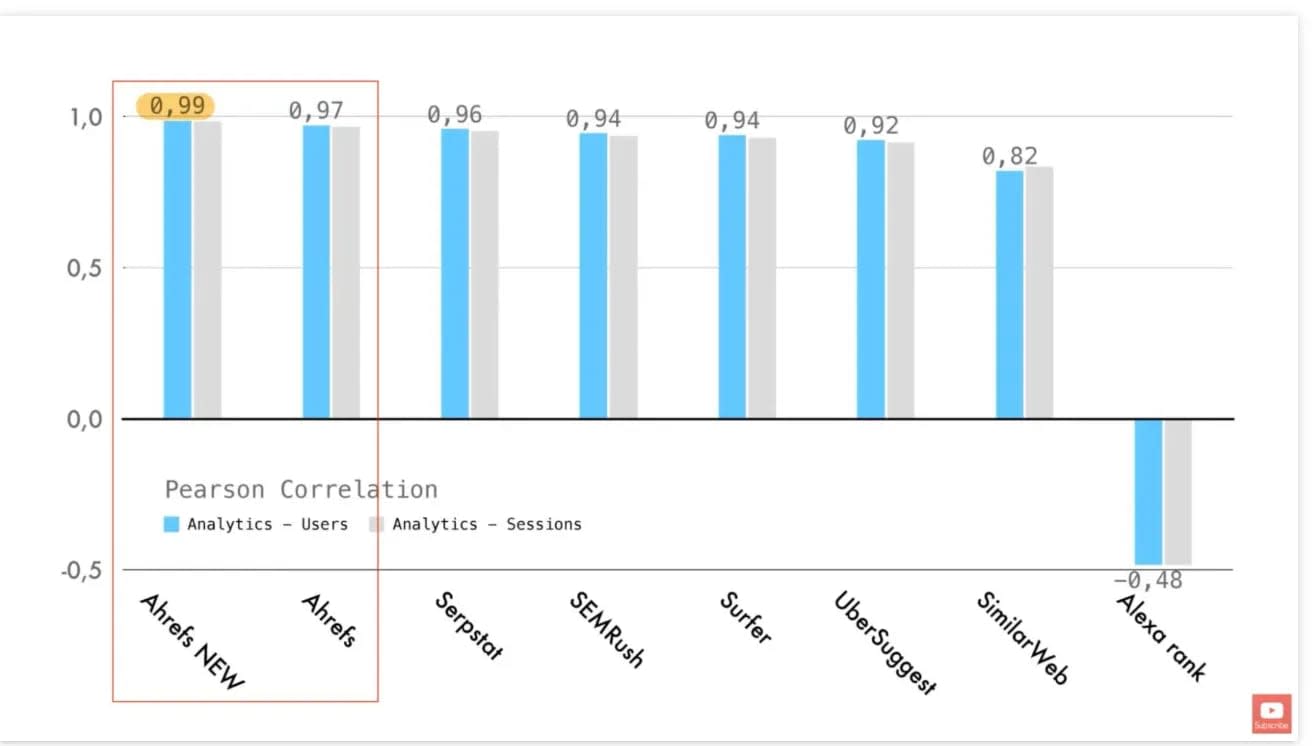
Most articles that cover Ahrefs accuracy are either written by Ahrefs (obviously favorable) or by a competitor (obviously not). What’s harder to find is a straight answer from someone who uses the tool regularly and has no stake in the outcome.
So here it is, what Ahrefs gets right, where it falls short, and how to calibrate your expectations so you’re working with the data correctly rather than fighting it.
Where Ahrefs data is most reliable
Backlinks are where Ahrefs is at its strongest, and it isn’t particularly close to them. The combination of a crawler that’s been running since 2013, an index of over 12 trillion links, and a refresh rate of every 15 to 30 minutes puts it ahead of every other tool in this category. If a link exists and the page it lives on has been crawled recently, Ahrefs will find it. For link prospecting, competitor backlink analysis, and monitoring your own link profile, this is the most dependable data Ahrefs produces.
Keyword rankings are also highly reliable. Ahrefs tracks rankings by querying search results; it’s not modeling or estimating your position; it checks the results directly. For keywords you’re actively tracking in Rank Tracker, the data is as close to ground truth as a third-party tool can get.
Keyword difficulty scores are consistent and useful for relative comparisons, understanding whether a keyword is harder or easier to rank for than another. They’re less useful as absolute benchmarks, but within the Ahrefs ecosystem, they’re applied consistently, which matters for prioritization decisions.
Where Ahrefs data is less reliable
Traffic estimates are the area where expectations most often diverge from reality, and the previous section explains why. They’re built on a model with real limitations, CTR averaging, keyword coverage gaps, and the fundamental challenge of estimating something from the outside that you can only measure accurately from the inside. Use them directionally, not literally.
Search volume for niche and low-volume keywords is where the clickstream model gets noticeably shakier. When a keyword gets only a few hundred searches per month, the sample in Ahrefs’ clickstream panels is tiny. Small samples produce noisy estimates; a keyword might show 200 searches when it actually gets 600, or vice versa. The lower the volume, the wider the margin of error you should mentally apply.
New and emerging keywords have a lag problem. Because volume data is anchored to GKP’s monthly update cycle, a keyword that starts trending this week won’t show accurate volume for weeks or more. If you’re doing research in a fast-moving niche, AI tools, crypto, and breaking news topics, treat volume figures with extra skepticism and cross-reference with Google Trends.
Brand and navigational queries for smaller brands are often missing or significantly underreported. Clickstream panels skew toward common behavior patterns. Searches for a niche brand name or a specific product that most panel participants have never heard of will be underrepresented in the data.
How to use Ahrefs data correctly, relative vs absolute
The mistake most people make with Ahrefs and with SEO tools generally is treating the numbers as ground truth rather than as signals. They’re not a spreadsheet of facts. They’re a model of reality, built from real data but filtered through estimation at every layer.
The practical implication is simple: use Ahrefs for directional decisions, not precise measurements. Is keyword A harder to rank for than keyword B? Ahrefs will tell you reliably. Does your competitor get exactly 47,320 monthly visitors? Nobody can tell you that, Ahrefs included.
Where Ahrefs earns its subscription is in the consistency and coverage of its model. Because the same methodology applies to every site, every keyword, and every link in its database, comparisons are meaningful even when absolute values aren’t perfect. That internal consistency is what makes it genuinely useful and understanding it is what separates SEOs who get real value from the tool from those who spend half their time arguing with the numbers.
Ahrefs vs Semrush: who gets their data from where?
This question comes up constantly, and the answer is more nuanced than most comparison articles let on. The two tools aren’t operating from completely different data universes; they share more methodology than either company tends to advertise. But there are real differences, and they show up in predictable places.
| Particulars | Ahrefs | Semrush |
|---|---|---|
| Web crawler | AhrefsBot, 2nd most active on the web | SemrushBot, significantly less active |
| Keyword volume baseline | Google Keyword Planner | Google Keyword Planner |
| Clickstream data | SemrushBot is significantly less active | Yes, third-party panels |
| Backlink index size | 12+ trillion links | Smaller, less frequently cited |
| Index refresh rate | Every 15–30 minutes | Daily |
What they have in common
Both tools start from the same place for keyword volume, Google Keyword Planner. Both layers clickstream data on top of that baseline to refine their estimates and model click behavior. Both run their own web crawlers. Both produce traffic estimates using roughly the same outside-in methodology described earlier in this article.
Which means that at a foundational level, the reason their keyword volume figures are often similar isn’t a coincidence; it’s because they’re both refining the same raw material with comparable methods.
Where they genuinely differ
The meaningful gap is in backlink data, and it comes down to crawler activity. AhrefsBot is the second-most-active crawler on the internet, after Googlebot. SemrushBot operates at a fraction of that scale. The practical result is that Ahrefs tends to find backlinks faster, maintain a larger live index, and catch link changes, new links, lost links, and redirected links more quickly than Semrush does.
For anyone doing serious link building, competitive link analysis, or digital PR work where timeliness matters, this difference is real and it compounds over time. A tool that refreshes its backlink index every 15 minutes is showing you a fundamentally different picture than one that updates daily, especially in active niches where link profiles change quickly.
Keyword data is closer to a draw. Both tools produce estimates that are directionally useful and similarly imprecise at the edges. Semrush has historically had a broader keyword database by raw count, while Ahrefs has argued, with some justification, that database size matters less than data quality. In practice, for most keyword research workflows, either tool will surface what you need.
The honest verdict
If backlink analysis is central to how you work, Ahrefs is the stronger choice and the data advantage is genuine. If you need a broader marketing platform, PPC research, social tracking, and content marketing tools, Semrush covers more ground. Most professionals who use both tools seriously end up using Ahrefs for link work and leaning on Semrush for broader competitive intelligence.
What neither tool will tell you is that for the core keyword research use case, the data is similar enough that the choice often comes down to workflow preference rather than data quality. That’s not a knock on either platform; it’s just an honest reflection that they’re drawing from the same well.
The bottom line
Ahrefs isn’t a black box. It’s three data systems working in parallel, a crawler that never sleeps, clickstream panels that model real search behavior, and Google Keyword Planner data refined into something more useful than its raw form. Once you understand which system produces which metric, the tool stops feeling like something you have to trust blindly and starts feeling like something you actually understand.
The practical takeaway is this: stop treating every Ahrefs number as ground truth and start asking which pipeline produced it. A backlink count? Trust it, that’s AhrefsBot doing what it does better than almost anyone. A traffic estimate for your own site? Treat it as a directional signal, not a measurement. A keyword volume for a niche query with 300 monthly searches? Give it some margin of error; the clickstream sample is thin at that scale.
The SEOs who get the most out of Ahrefs aren’t the ones who trust it most. They’re the ones who know exactly where it’s strong, where it’s shaky, and how to adjust their decisions accordingly. That’s not skepticism, it’s just using the tool the way it was designed to be used.
Key takeaways:
- Ahrefs backlink data is the most reliable metric in the tool, refreshed every 15 to 30 minutes from the second most active web crawler on the internet
- Keyword volumes are a blend of GKP baselines and clickstream refinement, useful directionally, imprecise at low volumes
- Traffic estimates are a model built from the outside in, invaluable for competitor research, not a substitute for GA
If this piece raised questions about how to actually apply Ahrefs data in your workflow, the next logical read is how to do keyword research in Ahrefs without getting misled by the numbers, which is a different skill than understanding where the numbers come from.
FAQs
Partly. Ahrefs uses Google Keyword Planner as a baseline for search volume estimates, but that’s where the relationship ends. Its backlink database, web index, and traffic estimates are built entirely from its own crawler and third-party clickstream panels, not from Google’s search index or any Google product.
It depends on the data type. Backlinks refresh every 15 to 30 minutes, the fastest update cycle of any major SEO tool. Keyword rankings update daily. Search volume figures run on a monthly cycle, inherited from Google Keyword Planner’s update schedule, which is worth keeping in mind for trend-sensitive research.
No. GSC data is private; only the verified site owner can access it. Ahrefs has no visibility into your GSC. Its traffic and ranking estimates are built entirely from external sources: its own crawler, clickstream panels, and SERP tracking. The two tools measure different things and will rarely report identical numbers.
Because they’re measuring differently. GKP merges keyword variants that share the same search intent. “Running shoes” and “shoes for running” may report identical volumes. Ahrefs uses clickstream data to split variants, producing more granular estimates. Neither is wrong exactly; they’re just answering slightly different questions about the same keywords.
For competitive benchmarking, yes, they’re reliable enough to understand how your site compares to others. For internal performance tracking, use Google Analytics or Search Console instead. Ahrefs estimates are built from a model, not your actual data, so they’ll rarely match GA precisely. That’s not a flaw, it’s just the wrong tool for that specific job.