
If you’ve been in SEO long enough, like I have, you know one thing:
According to BrightEdge data, nearly 68% of online experiences start with a search engine, and organic search drives more than 50% of total website traffic across industries. On top of that, research by Backlinko shows that the #1 result in Google captures roughly 27–30% of all clicks, while the second- and third-place results get significantly less.
That click gap is massive.
When rankings stagnate after publishing content and building links, it’s tempting to look at tools that promise faster results.
That’s exactly why I started looking into SearchSEO.io.
The pitch is simple:
Instead of waiting months for organic traction, you can buy search-based traffic that simulates real users searching your keyword and clicking your result. The theory? Higher CTR and engagement signals may improve your rankings.
But as someone who cares about long-term SEO (not just short-term spikes), I had questions:
- Does this actually work?
- Is it safe?
- Is it sustainable?
- Or is it just another risky shortcut?
In this post, I’ll break down:
- How SearchSEO.io works
- The real pros and cons
- The risks most people don’t talk about
- When it might help
- And when you should absolutely avoid it
If you’re considering buying website traffic, read this first.
Check out our latest blog on Mobile Catering Van Insurance Explained for Food Businesses
What is SearchSEO.io?

SearchSEO.io is a platform that allows you to buy search-based website traffic designed to simulate real organic visits.
When I first came across it, the positioning was clear: this isn’t random bot traffic or pop-up junk traffic. Instead, it claims to send users who:
- Search for your target keyword
- Find your website in Google results
- Click your listing
- Stay on your page for a certain duration
In simple terms, it mimics organic user behavior.
How It Presents Itself
SearchSEO.io markets itself primarily to:
- SEO agencies
- Affiliate marketers
- Local businesses
- Website owners are struggling to improve CTR
The core idea behind the platform is that click-through rate (CTR) and engagement signals influence rankings. So if your page is already ranking on page 1 but stuck in position 5–8, increasing clicks might push it higher.
That’s the theory.
Check out our latest blog on How to Advertise Your Business That Gets Leads
What You’re Actually Buying

From what I’ve seen, you’re essentially purchasing:
- Keyword-targeted search traffic
- Geo-targeted visits (country-specific)
- A set number of daily clicks
- Simulated dwell time and on-site behavior
This is important:
You’re not buying random visitors. You’re buying behavioral signals.
Now, whether those signals truly influence rankings long-term, that’s where things get interesting.
Check out our latest blog on Lyft Accident Lawyer: Higher Payout Strategies
Why People Buy Website Traffic in the First Place
Before judging SearchSEO.io, I always like to step back and ask:
Why is this even a thing?
If people are willing to pay for search traffic, there’s a pain behind it.
1. Rankings Stuck on Page 1 (But Not Moving)
This is the most common scenario I’ve seen.
A page ranks at position 5–8.
It has backlinks.
Content is solid.
But it just doesn’t move.
According to data from Backlinko, the jump from position #5 to #1 can mean a 2–3x increase in clicks. That’s a huge revenue difference for competitive keywords.
So the logic becomes:
“If CTR is a ranking factor, what if I increase it artificially?”
That’s where tools like SearchSEO.io come into play.
2. The SEO Waiting Game Is Slow
Organic SEO compounds, but it is slow.
- Content takes time to rank
- Backlinks take time to build
- Authority takes time to grow
For affiliate marketers or in competitive niches, waiting 6–12 months isn’t attractive.
Buying traffic feels like accelerating the signal.
3. Testing CTR Hypothesis
Some advanced SEOs treat this as experimentation.
They don’t see it as “buying traffic.”
They see it as:
- Testing whether CTR influences ranking for that keyword
- Testing volatility in competitive SERPs
- Testing algorithm sensitivity
In other words, it’s less about traffic, more about data.
4. Local SEO Pressure

For local businesses, small ranking improvements can mean:
- More calls
- More leads
- More booked appointments
In hyper-competitive cities, even a 1-position bump can have a financial impact.
That’s why CTR manipulation tools are frequently marketed heavily toward local SEO agencies.
But here’s the critical shift in thinking:
Buying traffic is not about traffic.
It’s about influencing behavioral signals.
And that’s exactly where the pros and cons become serious.
The Pros of Using SearchSEO.io
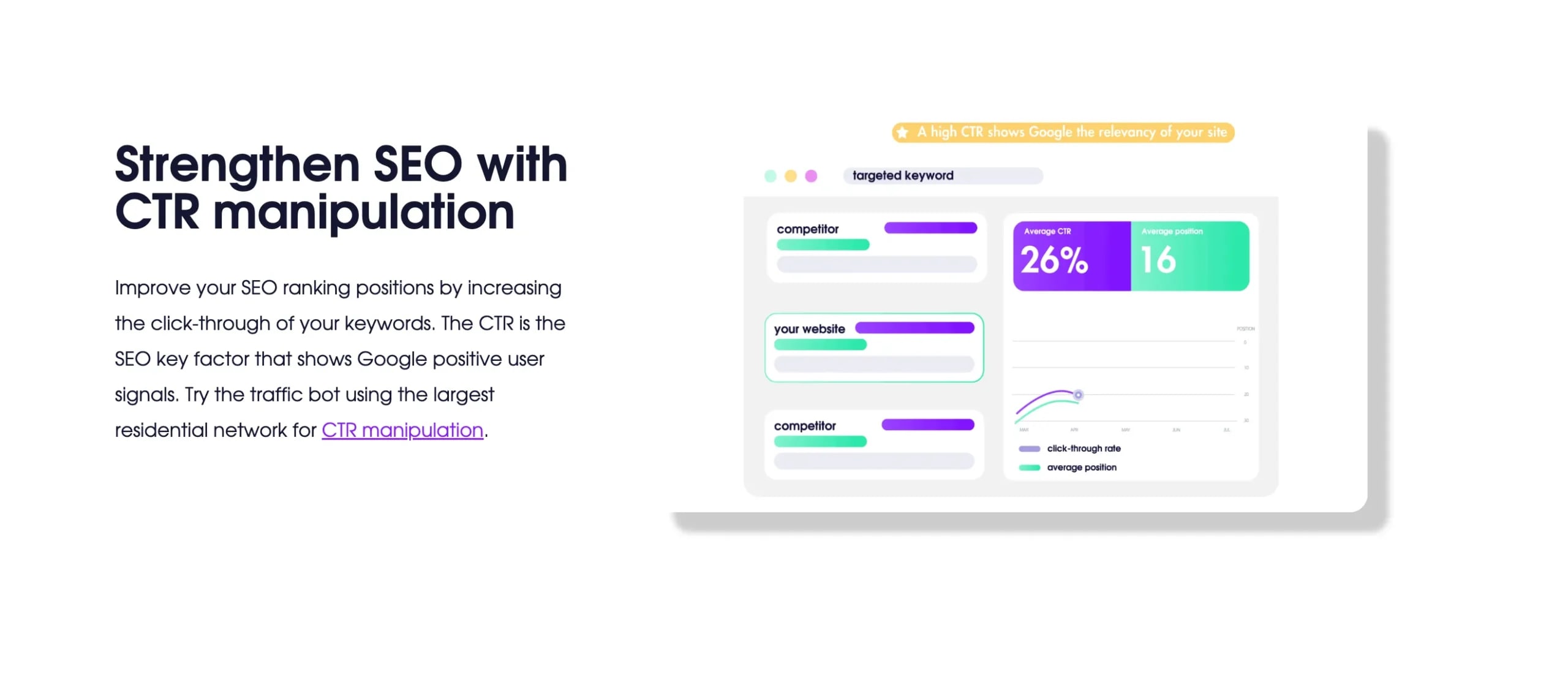
I don’t look at tools like SearchSEO.io emotionally.
I look at them strategically.
There are possible advantages, but they only make sense in particular contexts.
1. It Can Accelerate Testing
If I want to test whether CTR affects a keyword at positions 4–7, waiting months for organic changes to take effect is inefficient.
Using controlled traffic lets me observe:
- Ranking volatility
- SERP movement speed
- Algorithm sensitivity
For experimental SEOs, that’s useful.
It turns SEO from guessing to measurable testing.
2. Geo-Targeted Signal Control
One thing I find interesting is location control.
If I’m targeting the US, UK, or a specific country, I can align search signals with that geography.
Since rankings are location-sensitive, this offers more precision than generic traffic sources.
3. Possible Short-Term Ranking Lift
In competitive niches, rankings can sometimes be extremely close in terms of authority metrics.
When pages are comparable, behavioral signals might tip the balance.
I’ve seen cases (across the industry) where pages move 1–3 positions after CTR improvements.
The important word is might.
This is not guaranteed.
4. Useful for SERP Entrants
If a page just entered page 1 but has low visibility, boosting early clicks can, in theory, strengthen its initial performance signals.
Instead of sitting invisible at position 8, it receives interaction data.
Whether Google fully trusts that data is another debate, but strategically, that is the angle.
5. It Forces You to Think About CTR
Ironically, even considering buying traffic makes you evaluate:
- Is my title compelling?
- Is my meta description weak?
- Am I underperforming compared to competitors?
Many SEOs ignore CTR completely.
This tool forces you to pay attention.
Here’s the reality.
Every shortcut in SEO comes with trade-offs.
This is where the conversation becomes more serious.
The Cons (And Real Risks) of Using SearchSEO.io
Now let’s talk about the part most “reviews” avoid.
When I evaluate a tool like SearchSEO.io, I don’t just ask “Can this work?”
I ask:
“What happens if this stops working?”
Because that’s where long-term SEO decisions are made.
1. You’re Relying on Artificial Signals
At the core, you are artificially influencing behavioral metrics.
Google’s algorithms are built to detect patterns.
And unnatural patterns tend to leave footprints:
- Sudden CTR spikes
- Repetitive search behavior
- Non-linear engagement growth
Even if it works temporarily, sustainability is uncertain.
That alone makes this a calculated risk, not a growth strategy.
2. Results Are Often Temporary
Let’s assume rankings improve.
What happens when you stop paying?
If rankings are boosted mainly by CTR signals, once those signals disappear, positions can revert.
I’ve seen cases where the traffic drops just as quickly as it rose.
That creates dependency.
And dependency in SEO is dangerous.
3. It Doesn’t Fix Core SEO Weaknesses
If your page has:
- Weak content
- Poor internal linking
- Low authority
- Weak backlinks
Buying traffic doesn’t fix those problems.
It only tries to amplify perceived relevance.
Long-term rankings are still built on fundamentals.
4. Financial Compounding Cost
Buying traffic isn’t a one-time cost.
It becomes a recurring expense.
And unlike content or backlinks (which compound), paid CTR signals stop the moment you stop paying.
So you’re trading compounding assets for recurring stimulus.
That’s a tactical decision and not always a smart one.
5. Algorithm Risk (Even If Rare)
No one outside of Google truly knows how much CTR is weighted.
But one thing is clear:
Google does not endorse manipulation.
If a system is detected as artificially influencing search behavior, outcomes could include:
- Ignored signals
- Devalued effect
- Potential ranking suppression
Even if the risk is low, the downside remains asymmetric.
And asymmetric risk matters in SEO.
Here’s how I personally summarize it:
SearchSEO.io is not a magic growth engine.
It’s a behavioral experiment tool with financial and algorithmic risk.
Does SearchSEO.io Actually Work?

This is the only question that really matters.
And my answer is:
It depends on context.
When I look at tools like SearchSEO.io, I don’t ask whether they “work” in isolation. I ask whether they work within a strong SEO foundation.
Because that’s the difference.
When It Might Work
From a strategic standpoint, CTR-based traffic manipulation has a higher probability of impact when:
- The page is already ranking on page 1 (positions 3–8)
- Competing pages have similar authority metrics
- The keyword has real search demand
- The content already satisfies search intent
In these scenarios, rankings can be sensitive to movements in engagement.
If Google sees more users consistently choosing your result, it may adjust its positioning, especially when multiple pages are closely matched.
This is situational.
It is not universal.
When It Likely Won’t Work
It won’t magically push:
- A page from page 3 to page 1
- Weak content above authoritative competitors
- Brand-new domains in competitive SERPs
If your page lacks:
- Backlinks
- Topical authority
- Strong content depth
Then behavioral signals alone rarely move the needle.
Search is still primarily authority-driven.
The Bigger Reality
Even if rankings move:
- Was it the traffic?
- Was it algorithm volatility?
- Was it a normal ranking fluctuation?
SEO rarely provides clean causation.
This means any improvement after buying traffic could be a coincidence, not proof.
That’s why I see this as:
A short-term positioning lever, not a ranking strategy.
And long-term SEO is about strategy.
Who Should (And Shouldn’t) Use SearchSEO.io
This is where nuance matters.
I don’t believe in blanket statements like “never use it” or “this is the future of SEO.” Tools like SearchSEO.io sit in a grey zone. Whether they make sense depends entirely on your goals, risk tolerance, and stage of growth.
If I’m running controlled SEO experiments, I can see a tactical use case. For example, let’s say I have a page ranking at position 5 for a commercial keyword. The content is strong, backlinks are comparable to competitors, and the only visible gap is the click-through rate. In that scenario, I might treat CTR manipulation as a short-term test to see whether engagement signals move the page. Not as a dependency. Not as a core strategy. But as a data point.
Agencies that specialize in competitive niches sometimes operate this way. They are not buying traffic because they lack fundamentals. They are buying it to test volatility at the margins. When the difference between position 3 and position 1 is tens of thousands of dollars in revenue, even small experiments can be financially justified.
It may also appeal to affiliate marketers who operate in shorter time horizons. If the goal is to rank, monetize, and exit rather than build a 10-year brand asset, the risk profile changes. In that context, short-term gains can outweigh long-term stability.
However, if I’m building a long-term brand, I personally would hesitate.
For business owners who rely on stable organic traffic, local service providers, SaaS companies, and e-commerce brands, volatility is dangerous. If your rankings fluctuate because behavioral signals stop or are devalued, your revenue will follow suit. That’s not a position I’d want to operate from.
Beginners should especially avoid this path. If someone is new to SEO, the fundamentals should be the focus: content quality, search intent alignment, internal linking, backlinks, and technical structure. Introducing artificial signals before mastering the basics creates confusion. You won’t know what actually caused the ranking movement, good optimization, or synthetic engagement.
There’s also the psychological risk. Once you see rankings move from purchased signals, it’s easy to become reliant on them. Instead of building assets that compound over time, like authoritative content or link equity, you begin funding recurring stimuli. That’s not how sustainable SEO is built.
So my take is this:
If you are experienced, understand algorithm volatility, and treat it as an experiment with controlled expectations, you might extract insight from it.
If you’re building something meant to last, I would focus on strengthening the core rather than manipulating the surface.
In SEO, shortcuts rarely become foundations.
Better Alternatives to Buying Website Traffic
Whenever I analyze a tool like SearchSEO.io, I ask myself a simple question:
If the goal is to improve rankings and increase clicks, is there a safer way to achieve the same outcome?
In most cases, the answer is yes.
Buying website traffic attempts to influence behavioral signals from the outside. But sustainable SEO improves those signals organically by making your results genuinely more attractive and credible.
Here’s how I approach it instead.
First, I look at CTR optimization the right way. Before even thinking about artificial clicks, I audit my title and meta description. Are they actually compelling? Are they aligned with search intent? Are they clearer or more benefit-driven than competitors? Small title rewrites alone can increase CTR significantly without introducing risk. In many cases, underperformance isn’t about rankings, it’s about positioning.
Second, I strengthen internal linking. Internal links are one of the most underrated ranking levers. By deliberately funneling authority from high-performing pages to pages stuck at position 4–8, I can often create measurable movement. This method builds up over time and carries no algorithmic risk.
Third, I focus on content depth and alignment of intent. If a page isn’t breaking into the top 3, I ask: Does it truly deserve to be there? Does it cover the topic comprehensively? Does it answer secondary queries? Does it provide unique insight? Improving content quality not only helps rankings, it also increases real engagement, which naturally influences CTR.
Fourth, I invest in relevant backlinks. Authority still matters. Even if behavioral signals play a role, they don’t replace link equity. One high-quality contextual backlink often does more for long-term ranking stability than months of artificial click stimulation.
Finally, I optimize for branded demand. Instead of simulating searches, I work on increasing real searches for my brand or domain. When users intentionally search for your brand and click your result, those are powerful, authentic signals that compound rather than disappear.
The difference between these approaches and buying traffic is simple:
One builds assets.
The other rent signals.
If I’m building something sustainable, I choose assets every time.
Final Thoughts
Buying website traffic from SearchSEO.io can generate short-term traffic, but it’s not a substitute for solid SEO foundations. It may work as a controlled experiment, especially for pages already competing on page one. However, it doesn’t replace content quality, authority, or long-term strategy.
If you’re building a sustainable brand, focus on assets that compound, not signals that disappear. In SEO, shortcuts can temporarily boost rankings, but fundamentals are what keep them there.