
A bottled water business can be highly profitable when well planned and executed. With growing demand among households, offices, hotels, and institutions, packaged drinking water is now a necessity. This reliable demand makes bottled water one of the most stable manufacturing opportunities for new and small-scale entrepreneurs.
Many businesses fail not due to market conditions, but because they underestimate legal requirements, setup costs, quality standards, and distribution planning. Licenses, water-source approval, plant location, machinery selection, and branding are all critical to ensuring lasting success. Neglecting any of these areas can result in losses or closure.
This guide explains how to start a bottled water business from scratch, covering market research, licensing, manufacturing, investment, profit margins, and scaling. Whether you plan a small setup or a commercial plant, you will find a clear, step-by-step roadmap to begin successfully.
The Bottled Water Business
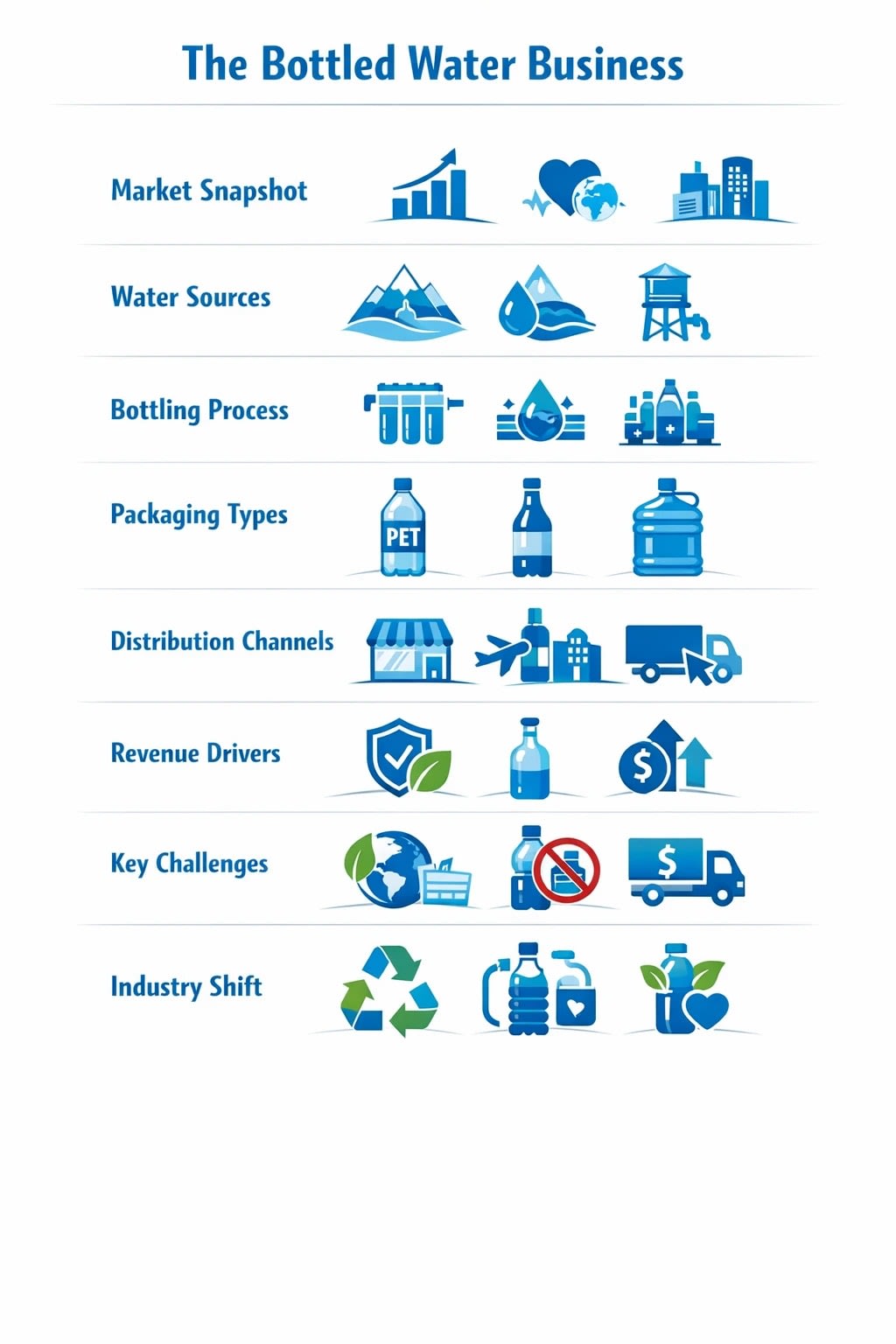
A bottled water business treats raw water, packages it in hygienic containers, and sells it. Water quality, safety, and consistency are essential, as both consumers and regulators enforce strict standards.
Broadly, bottled water businesses fall into three main categories:
1. Packaged Drinking Water (RO-based):
This is the most common and affordable model. Water is purified using RO, UV, and ozone treatment and sold in small bottles, jars, or bulk containers. It requires lower investment and is ideal for startups.
2. Mineral Water:
Mineral water must contain naturally occurring minerals and comply with stricter standards. This setup requires a specific water source and higher capital, making it not as suitable for beginners.
3. Bulk Water Supply:
In this model, water is supplied to offices, factories, and institutions in large jars or tankers. Margins are steady, and logistics are more important than branding.
Decide whether to operate a small-scale local business or a commercial-scale brand. Small setups serve nearby areas with limited product lines, while larger plants focus on broader distribution, branding, and dealer networks. This choice directly affects licensing, investment, machinery, and marketing strategy.
Check out our latest blog on How to Advertise Your Business That Gets Leads
Market Research & Business Planning
Before investing in machinery or applying for licenses, you need a clear understanding of who will buy your water and why. The bottled water business may look simple from the outside, but profitability depends heavily on demand, pricing, and distribution in your target area.
Begin by studying local demand. Assess residential areas, offices, schools, hospitals, hotels, event organizers, and industrial zones. Note which brands sell the most, the most popular bottle sizes, and the delivery frequency to understand consumption patterns.
Analyze your competition by distinguishing between both national brands and local suppliers. Local firms often compete on price and delivery speed, while larger brands focus on branding and retail presence. This analysis helps you decide whether to compete on price, service, quality, or niche offerings.
At this stage, decide on your business model:
- Retail-focused (200 ml, 500 ml, 1L bottles)
- Bulk supply (20L jars for offices and homes)
- Institutional and B2B supply (hotels, factories, events)
- Mixed model (retail + bulk)
Once you have chosen a model, create a simple business plan. An outline is sufficient at this stage:
- Initial investment and monthly expenses
- Expected selling price and margins
- Daily production capacity
- Break-even timeline
A clear plan helps control costs, set realistic targets, and avoid early over-investment. It is also valuable when working with banks, partners, or suppliers.
Read More On: B2B SEO Agency for Scalable Business Growth
Legal Requirements & Licenses
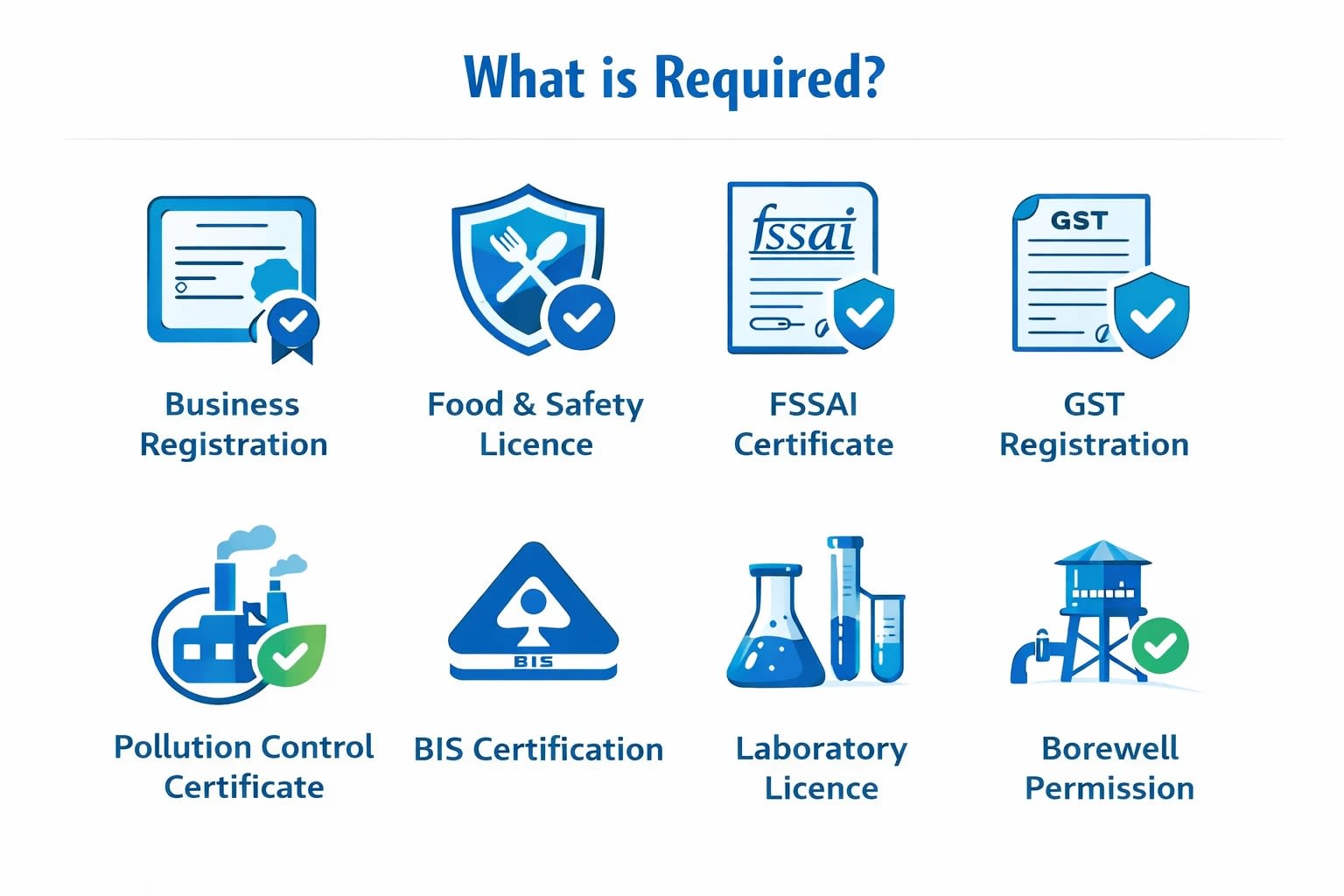
The bottled water industry is highly regulated because it directly affects public health. Before you start production or sales, you must obtain the required licenses and approvals. Skipping this step can result in heavy penalties or permanent closure.
First, register your business entity. Depending on your scale and future plans, you can choose:
- Sole proprietorship (small-scale setup)
- Partnership or LLP
- Private Limited Company (recommended for scaling)
Next, obtain a packaged drinking water certification. In India, bottled water production must comply with BIS standards, guaranteeing your water meets safety, hygiene, and quality requirements.
You will also need:
- Food Safety License (FSSAI) for manufacturing and distribution
- Water source approval, especially if using a borewell or groundwater
- Local municipal or factory license from the local authority
- Pollution control clearance for wastewater disposal
- GST registration for sales and invoicing
In addition, your plant must follow strict hygiene, testing, and labeling guidelines, including batch numbers, manufacturing dates, and license details on every bottle.
Licensing may be time-consuming, but it protects your business in the long term. Authorities, distributors, and bulk buyers prefer licensed suppliers, and compliance builds buyer trust.
Choosing the Right Location
Choosing the right location for your bottled water plant is critical, as it affects licensing, operating costs, and distribution effectiveness. A poor location can increase expenses and cause compliance issues, regardless of product quality.
Set up your plant in an area zoned for commercial or industrial activity. Residential zones typically do not permit manufacturing, so check local zoning rules before completing the site. Industrial or approved commercial zones are safer choices.
Key factors to consider when choosing a location:
- Reliable water source: Easy access to a borewell or municipal water supply
- Power availability: Consistent electricity for RO plants and machinery
- Drainage system: Proper wastewater disposal is mandatory
- Connectivity: Close to your target market to reduce transport costs
- Space requirements: Adequate area for machinery, storage, and movement
Even small-scale setups require space for raw water storage, treatment units, bottling, packaging, finished goods, and quality testing. A basic setup typically needs 1,000–2,000 sq. ft., while larger plants require more.
Choose a location that allows for future expansion. Relocating a plant later is costly and disruptive, so plan for growth from the beginning.
Read More On: Truth About Business in a Box: Insights by Shahid Shahmiri
Water Source & Treatment Process
The quality of your bottled water depends on the source and treatment process. Regardless of branding or marketing, inconsistent or poor-quality water will harm your reputation and attract regulatory issues.
Most bottled water plants use one of the following water sources:
- Borewell (groundwater)
- Municipal water supply
- Treated surface water (less common for small setups)
Before finalizing any source, the water must be tested in a certified laboratory. Authorities will check parameters such as TDS levels, pH balance, microbial content, and chemical contaminants. Approval of your water source is mandatory before production begins.
Once approved, the water goes through a multi-stage treatment process, typically including:
- Pre-filtration to remove physical impurities
- Reverse Osmosis (RO) to reduce dissolved solids
- UV treatment to eliminate bacteria and viruses
- Ozonation to preserve freshness and shelf life
This treatment ensures the water is safe, tasteless, odorless, and compliant with standards. Regular testing during production is required to preserve consistency and statutory compliance.
Proper storage is as important as treatment. Store treated water in food-grade tanks, making sure all pipelines are hygienic and sealed to prevent contamination.
Bottled Water Manufacturing Process

The bottled water manufacturing process follows a structured workflow to preserve hygiene, efficiency, and quality. After treatment and storage, attention turns to bottling and packaging.
Here’s how the procedure usually works:
1. Bottle Production or Procurement
Bottles are purchased from suppliers or produced in-house using bottle-blowing machines. Most small and medium plants use pre-made bottles to cut initial investment.
2. Bottle Washing & Sterilization
Before filling, bottles are washed and sterilized with treated water to remove dust, residues, and contaminants.
3. Filling Process
Purified water is filled into bottles using automatic or semi-automatic machines, assuring accurate volume and minimal human contact.
4. Sealing & Capping
Bottles are sealed with tamper-proof caps to ensure protection and prevent leakage. Cap quality is critical, as loose seals can cause contamination.
5. Labeling & Batch Coding
Each bottle is labeled with brand details, manufacturing date, batch number, and license information, as required for traceability and compliance.
6. Packaging & Storage
Finished bottles are packed in cartons or shrink wraps and stored in a clean, covered area before dispatch.
Quality checks are conducted at multiple stages to ensure safety standards are met. Strict hygiene throughout the process is necessary for regulatory approval and customer confidence.
Machinery & Equipment Required
Selecting the right machinery is a key investment. Equipment quality, capacity, and reliability directly affect production efficiency, operating costs, and compliance.
For a standard bottled water setup, you’ll need the following core equipment:
Water Treatment Equipment
- Raw water storage tanks
- Sand filter and carbon filter
- Reverse Osmosis (RO) plant
- UV disinfection system
- Ozone generator and contact tank
Bottling & Packaging Equipment
- Bottle rinsing machine
- Filling machine (manual, semi-automatic, or automatic)
- Capping machine
- Labeling machine
- Shrink wrapping or carton packaging machine
Supporting Equipment
- Food-grade pipelines and valves
- Quality testing instruments
- Power backup (generator or inverter)
- Air compressor (if required)
When selecting machinery, consider production capacity, maintenance, and after-sales support. While low-cost machines may appear appealing, it’s advisable to invest in equipment that supports future upgrades. According to RO Service Point, affordable RO plants designed for startups feature modular units, making it easier to scale production as your business grows without replacing the entire system.
Investment & Setup Cost Analysis
The investment required depends on your scale, capacity, and location. While you can start small, proper budgeting is essential to avoid cash flow issues in the initial months.
Here’s a realistic breakdown of major cost components:
1. Plant & Machinery Cost
This includes the RO system, filters, bottling machines, storage tanks, and packaging equipment. In small-to-medium setups, machinery is typically the largest investment.
2. Licensing & Legal Expenses
Costs include business registration, quality certifications, water testing, and compliance approvals. These are unavoidable one-time or periodic expenses.
3. Infrastructure & Setup Cost
This covers plant construction or rent, electrical wiring, plumbing, drainage, flooring, and storage areas that meet hygiene standards.
4. Raw Materials & Packaging
Expenses include bottles, caps, labels, cartons, and water treatment chemicals. These are recurring costs and should be budgeted monthly.
5. Working Capital
You will need funds for salaries, electricity, water, transportation, and maintenance during the initial months before cash flow stabilizes.
A basic bottled water plant requires moderate initial investment, with costs rising as capacity and automation increase. Plan for at least 3–6 months of operating expenses.
Staffing & Daily Operations
Even with automation, a bottled water business needs trained staff to ensure effective operations and consistent quality. Hiring the right people and determining clear roles helps prevent delays and compliance issues.
A typical small-to-medium plant usually needs:
- Machine operators for treatment and bottling
- Quality control personnel for testing and hygiene checks
- Helpers for packaging and loading
- Delivery staff and logistics support
Daily operations include water treatment, bottling, quality testing, and dispatch. Strict cleanliness protocols are required, including regular cleaning of equipment and the use of protective clothing by employees.
Routine water testing is essential to maintain standards. Keep records of production batches, test results, and service logs, as these are often reviewed during inspections.
Productive scheduling, preventive maintenance, and inventory tracking reduce wastage and downtime. As the business grows, invest in process automation and standard operating procedures to improve consistency and output.
Branding, Pricing & Packaging Plan
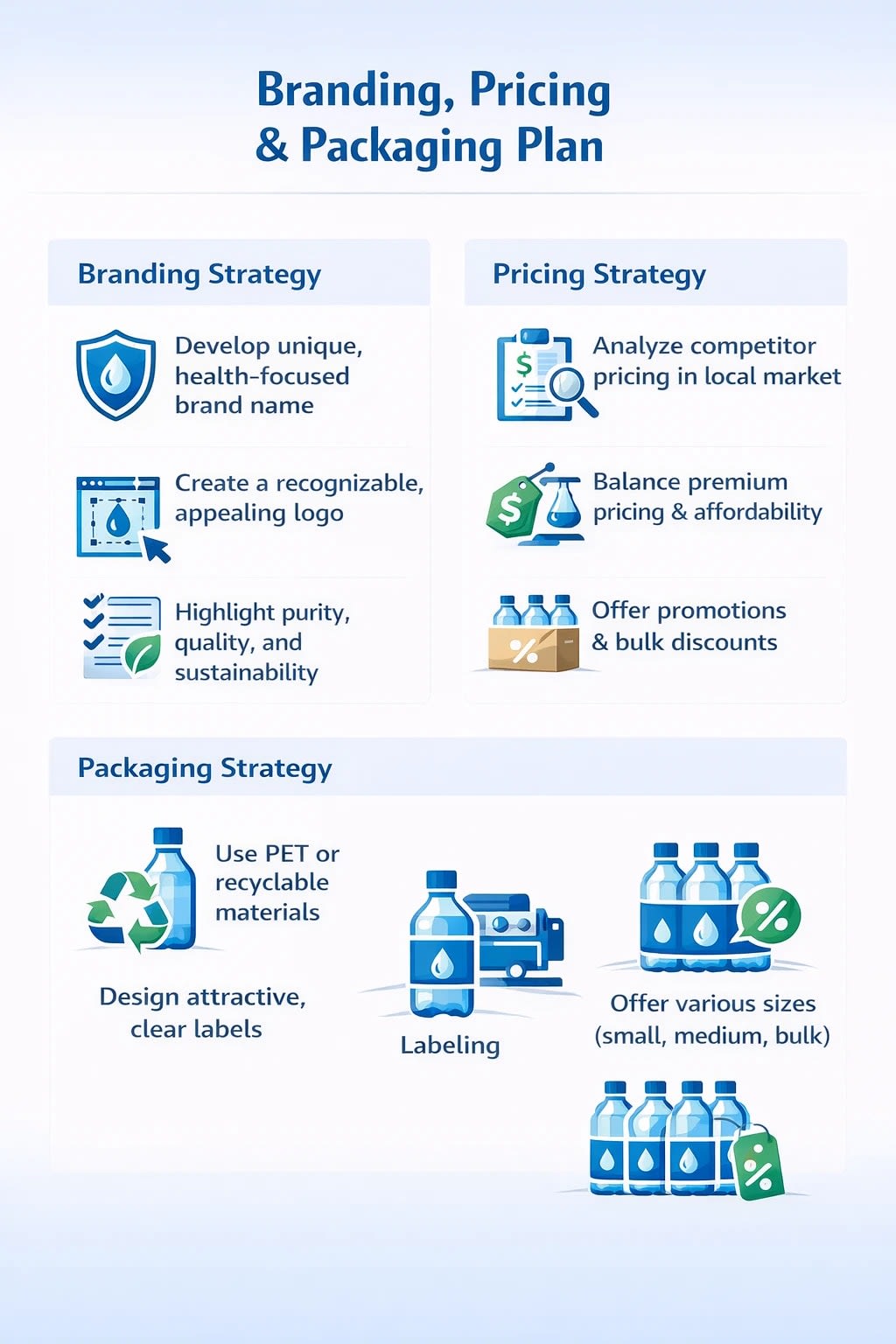
Within a crowded market, branding and pricing are key to gaining traction. Although water is a commodity, customers prefer brands they trust and recognize.
Create a simple, professional brand identity. Choose an easy-to-remember name and a logo that communicates purity and safety. Give priority to clarity over complex designs.
Base packaging decisions on customer demand:
- Small bottles for retail and events
- Medium bottles for travel and hospitality
- Large jars for offices and homes
Labels must include all required details, such as license numbers, batch codes, manufacturing dates, and contact information. Non-compliant labeling can result in penalties or product rejection.
Pricing should be competitive and sustainable. Study local market rates and calculate your cost per bottle, including production, packaging, and delivery. Avoid underpricing, as it often leads to losses.
Focus on consistent quality and timely delivery. In this industry, reliability is often more important than aggressive marketing.
Distribution & Sales Channels
A strong distribution system turns production into revenue. Even high-quality bottled water will not sell if it is not available when and where customers need it.
Commence by identifying the most practical sales channels for your scale:
- Local retail stores and supermarkets
- Offices, corporate spaces, and co-working hubs
- Hotels, restaurants, and cafes
- Schools, hospitals, and institutions
- Event organizers and bulk buyers
For small and medium businesses, direct supply and local dealers are often more effective than large retail chains, which typically require higher margins and longer payment cycles.
Delivery is critical for customer retention. Reliable vehicles, fixed schedules, and swift response times help secure long-term contracts, especially with bulk and institutional clients.
Offering subscription-based supply to offices and residential societies creates predictable monthly revenue. Clear invoicing, flexible payment terms, and consistent service provide an advantage over informal suppliers.
Once distribution is stable, scaling is easier through new routes, distributors, or expanded territories.
Marketing Strategies for a Bottled Water Business
Marketing a bottled water business does not require a large advertising budget, especially early on. Local visibility, trust, and consistency are most important.
Begin with ground-level marketing. Branded delivery vehicles, uniforms, and face-to-face visits to local offices or retailers can generate leads. Reliable service encourages word-of-mouth referrals.
A digital presence is also helpful. A basic website, Google Business Profile, and local listings make it easier for customers to find you. Highlight trust signals such as licenses, quality standards, and timely delivery.
For B2B and bulk clients, focus on personal outreach. Email, phone calls, and in-person meetings with facility managers, hotels, and institutions are more effective than generic ads.
Consistency is fundamental. Regular supply, clean packaging, and responsive service often outperform discounts. These factors help establish your brand as a dependable local supplier.
Profit Margin & ROI Expectations

The bottled water business can be profitable, but margins depend on scale, efficiency, and control over distribution. This is a volume-driven model where consistency is more important than quick gains.
On average, the cost per bottle includes raw water treatment, packaging, labor, electricity, transportation, and maintenance. Small bottles usually carry lower margins but higher volumes, while bulk jars and institutional supply offer steadier returns with predictable demand.
Most small-to-medium plants aim to break even within the first 12–24 months, depending on utilization and operating discipline. Plants that secure long-term contracts with offices, hotels, or institutions often reach break-even faster due to stable monthly orders.
Profitability improves significantly when:
- Production capacity is utilized consistently
- Distribution costs are controlled
- Packaging wastage is minimized
- Repeat customers form a large share of sales
As volumes increase, fixed costs are more efficiently distributed, improving margins. Reinvesting early profits into better machinery or expanded distribution accelerates growth.
Common Mistakes to Avoid
Many bottled water businesses fail not from a lack of demand but from avoidable mistakes during setup and early operations. Awareness of these issues can save time, money, and regulatory trouble.
A common mistake is ignoring compliance and quality standards. Cutting corners on licenses, testing, or hygiene may reduce costs initially, but can lead to penalties, shutdowns, or loss of buyer trust.
Poor cost planning is another mistake. Underestimating expenses like electricity, packaging, transportation, and maintenance often leads to cash flow problems early on.
Choosing the wrong location or over-investing in machinery too soon can hurt profitability. Start with a capacity that fits demand and scale as orders grow.
Many businesses also fail by neglecting distribution and service quality. Inconsistent delivery, poor communication, and unreliable supply quickly drive customers to competitors.
Avoiding these mistakes helps you build a stable foundation and concentrate on sustainable growth.
Lastly,
Starting a bottled water business from scratch calls for careful planning, strict compliance, and consistent quality control. While the setup entails multiple steps, a well-executed operation can deliver reliable demand and lasting profitability. Focus on doing the basics right, and scale only after building a reliable distribution and customer base.
FAQs
The investment depends on scale, location, and automation level. A small-scale setup requires moderate capital, while larger commercial plants require a higher investment in machinery, compliance, and distribution.
Yes, the bottled water business can be profitable with reliable demand and proper cost control. Profitability improves when production capacity is utilized fully and long-term bulk customers are secured.
You need business registration, food safety approval, packaged drinking water certification, water source approval, pollution clearance, and GST registration before starting operations.
Most bottled water businesses break even within 12 to 24 months, depending on sales volume, pricing strategy, and operational functionality.
Yes, many entrepreneurs start small by focusing on bulk supply or local distribution. This technique reduces risk and allows gradual expansion as demand grows.
Preserving consistent quality, managing operating costs, meeting compliance requirements, and building a reliable distribution network are the main challenges.
Editorial Note:
This article was created with the assistance of AI to support research, structure, and clarity. All information has been reviewed, edited, and contextualized to secure accuracy, originality, and practical relevance for readers. Human monitoring was applied throughout the publishing process.