
I’ve sat through more business pitches than I can count, some from founders raising capital, some from agencies trying to win clients, and some from people still figuring out what their idea even is.
And almost every time, I notice the same thing: most people think the purpose of a business pitch is to impress.
It’s not.
The main purpose of developing a business pitch isn’t to design slides, memorize a script, or sound confident in front of investors. It’s something much simpler and much harder. A pitch forces you to clarify what you’re building, who it’s for, and why it deserves to exist.
That’s why this question matters.
Because when you misunderstand the purpose of a pitch, you waste time polishing the presentation instead of sharpening your thinking. And I’ve seen businesses struggle not because their idea was weak, but because their thinking wasn’t clear.
In this post, I want to break down what the real purpose of a business pitch is, who it’s actually for, and why developing one properly changes how you build your business, not just how you talk about it.
Check out our latest blog on Mobile Catering Van Insurance Explained for Food Businesses
The Short Answer: What Is the Main Purpose of Developing a Business Pitch?
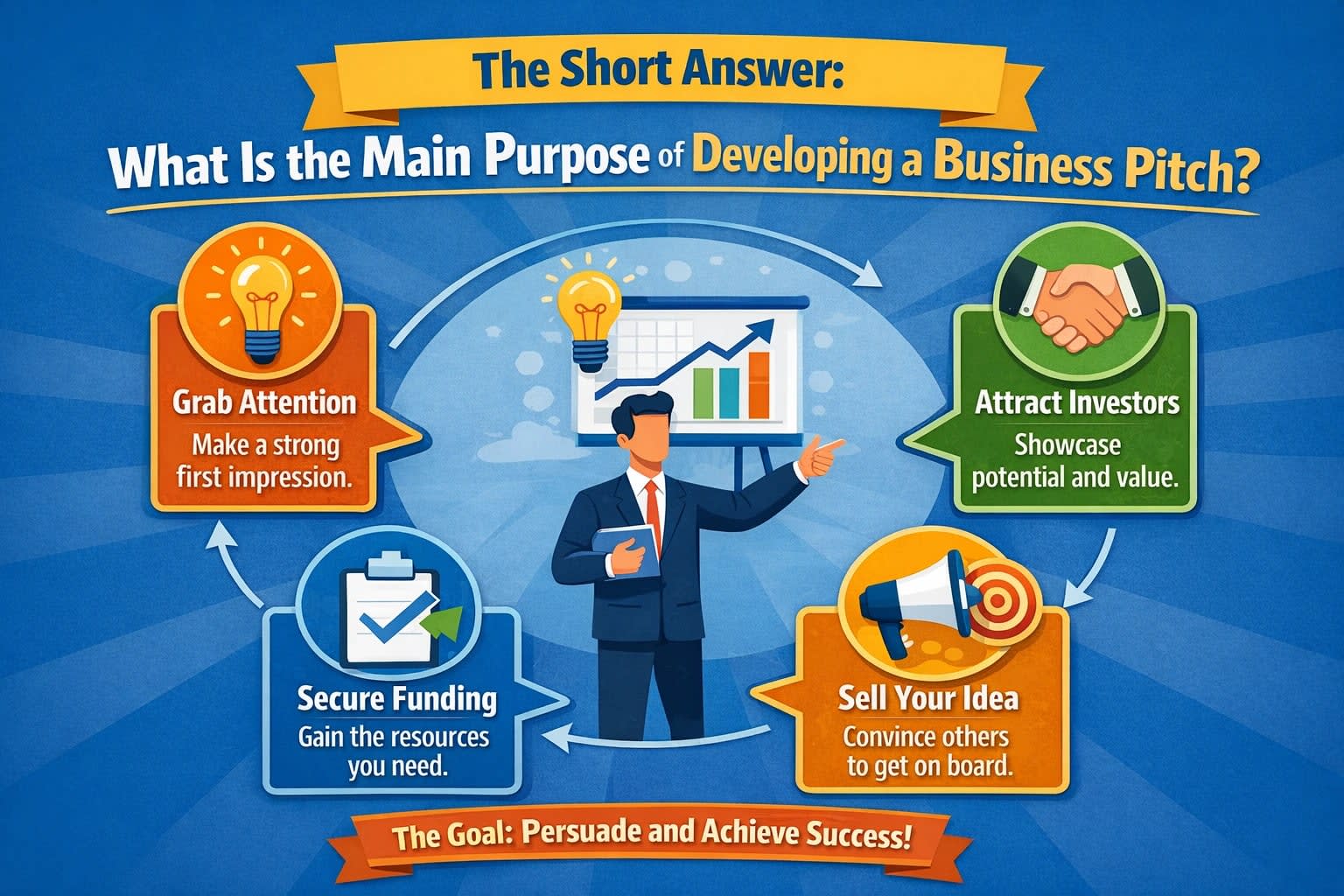
The main purpose of developing a business pitch is to clearly communicate the value of your idea to a specific audience and persuade them to take action.
That action might be investing.
It might be buying.
It might be partnering.
Or sometimes, it’s simply continuing the conversation.
At its core, a business pitch exists to do three things:
Clarify the problem you’re solving
Explain why your solution matters
Create enough confidence for someone to move forward
It’s not about slides. It’s not about charisma. And it’s definitely not about sounding impressive.
When I develop a pitch, whether for investors, clients, or a new initiative. I treat it as a clarity tool first and a persuasion tool second. If the value isn’t obvious in a few minutes, no amount of design or delivery will fix it.
That’s the real purpose:
to compress your business into its most convincing, understandable form.
Read More On: B2B SEO Agency for Scalable Business Growth
What a Business Pitch Is Actually Designed to Do
Once I stopped treating a pitch like a presentation and started treating it like a strategic tool, everything changed.
A business pitch isn’t just meant to “explain your idea.” It’s designed to do specific work.
1. Create Clarity
The first job of a pitch is to be clear.
If you can’t explain your business simply, what problem it solves, who it serves, and why it’s different, then the issue isn’t the audience. It’s the thinking.
I’ve found that developing a pitch often exposes gaps I didn’t see before. Weak positioning. Undefined audiences. Vague value propositions. A pitch forces those to surface.
And that’s uncomfortable, but necessary.
2. Communicate Value Quickly
Attention is limited.
Whether you’re talking to an investor, a potential client, or even a partner, they’re trying to answer one question fast:
“Why should I care?”
A strong business pitch respects that. It doesn’t drown people in features or background. It highlights the core value and makes the relevance obvious.
Check out our latest blog on Fast Auto Clicker for Chromebook: 5 Methods That Work
3. Reduce Uncertainty
Every business idea carries risk.
A pitch helps reduce perceived uncertainty by showing:
You understand the problem
You understand the market
You understand how execution will happen
It doesn’t eliminate risk but it builds confidence that you’ve thought things through.
4. Spark Action
At the end of the day, a pitch is incomplete if it doesn’t move something forward.
That “something” could be:
A second meeting
A trial project
An investment discussion
A partnership conversation
If nothing changes after the pitch, it wasn’t effective, no matter how polished it looked.
When I think about developing a business pitch today, I don’t ask, “How can I make this impressive?”
I ask, “Is this clear enough that someone can confidently say yes?”
That shift alone changes the entire purpose.
Use Our Business EMI Calculator | Calculate Business Loan EMI Online Instantly
Who You’re Really Pitching To (It’s Not Just Investors)

One of the biggest misconceptions I see is this:
People think a business pitch is only for investors.
That’s a narrow view and it limits how useful a pitch can be.
In reality, I’ve used pitches in far more situations than fundraising.
1. Clients
When I pitch a service or strategy to a client, I’m not just selling deliverables. I’m selling a direction.
The purpose here shifts slightly, it’s less about equity and more about trust. But the foundation is the same: clarity, value, confidence.
If a client can’t clearly understand the problem I’m solving and why my approach makes sense, the deal doesn’t move forward.
2. Partners
Partnership pitches are different.
Here, the goal is alignment. You’re showing how two sides benefit. It’s less about persuasion and more about shared opportunity.
A weak pitch in this context usually fails because it focuses only on what you gain, not what the other side gains.
3. Co-Founders and Team Members
This is the one people overlook.
Sometimes, the most important pitch you develop isn’t external at all. It’s internal.
If your team doesn’t fully understand what you’re building and why it matters, execution becomes fragmented. A clear pitch creates alignment. It gives everyone the same mental model.
4. Yourself
This might be the most underrated audience.
When you sit down to build a pitch and struggle to articulate the value, that’s a signal. It means something isn’t sharp yet.
I’ve had moments where developing a pitch forced me to rethink positioning entirely. The act of pitching exposed flaws in strategy that day-to-day work didn’t.
That’s why I don’t see a business pitch as just a sales tool. It’s a thinking tool.
And depending on who you’re pitching to, the tone changes but the purpose stays consistent: clarity that leads to action.
Check out our latest blog on How to Advertise Your Business That Gets Leads
The Real Purpose: Forcing Strategic Clarity
If I had to reduce the purpose of a business pitch to one core function, it would be this:
A pitch forces you to think clearly.
Most ideas feel strong in your head. They sound convincing in casual conversation. But the moment you try to structure them, problem, solution, market, differentiation, traction, weaknesses start to show.
That’s not a flaw in pitching. That’s the benefit.
When I develop a business pitch, I’m not just preparing to present. I’m pressure-testing the business itself.
Questions start surfacing:
Is the problem actually painful enough?
Is the target audience too broad?
Is the value proposition obvious or assumed?
Can this be explained simply, or does it require too much context?
If I struggle to answer those cleanly, the issue isn’t communication. It’s a strategy.
I’ve seen founders obsess over slide design, animations, and storytelling while ignoring unclear positioning. But clarity isn’t cosmetic, it’s structural.
A strong pitch doesn’t decorate the idea. It distills it.
And that distillation process is what makes the exercise valuable, even if you never present the deck publicly.
In many cases, the biggest return from developing a business pitch isn’t the meeting you land. It’s the strategic refinement you gain as you build it.
Check out our latest blog on Lyft Accident Lawyer: Higher Payout Strategies
What a Business Pitch Is Not
Sometimes the easiest way to understand the purpose of a business pitch is to define what it isn’t.
Over time, I’ve seen people confuse pitching with several things it was never meant to be.
1. It’s Not a Company Summary
A pitch is not your “About Us” page.
It’s not a timeline of how you started, what inspired you, or every milestone you’ve hit. Context matters, but dumping information isn’t clarity.
A pitch should highlight only what supports the decision you want the audience to make.
2. It’s Not a Product Demo
Features don’t sell ideas, outcomes do.
I’ve watched pitches derail because the founder got lost explaining functionality instead of explaining value. The audience doesn’t need to understand every button or workflow. They need to understand why it matters.
Details come later. The pitch earns the right for that deeper conversation.
3. It’s Not a Funding Guarantee
Even a strong pitch doesn’t guarantee investment, partnership, or a deal.
The purpose of a pitch is to move the process forward, not to close everything in one sitting. Expecting it to do more than that only overloads it with information and pressure.
4. It’s Not Hype
Confidence is important. Exaggeration is dangerous.
A pitch that overpromises might create short-term excitement, but it weakens credibility. I’ve learned that measured confidence lands better than dramatic claims.
Clarity builds trust. Hype builds doubt.
When you remove what a pitch isn’t, what remains becomes clearer:
It’s a focused communication tool designed to align thinking, demonstrate value, and create forward momentum.
That’s it.
When You Actually Need a Business Pitch
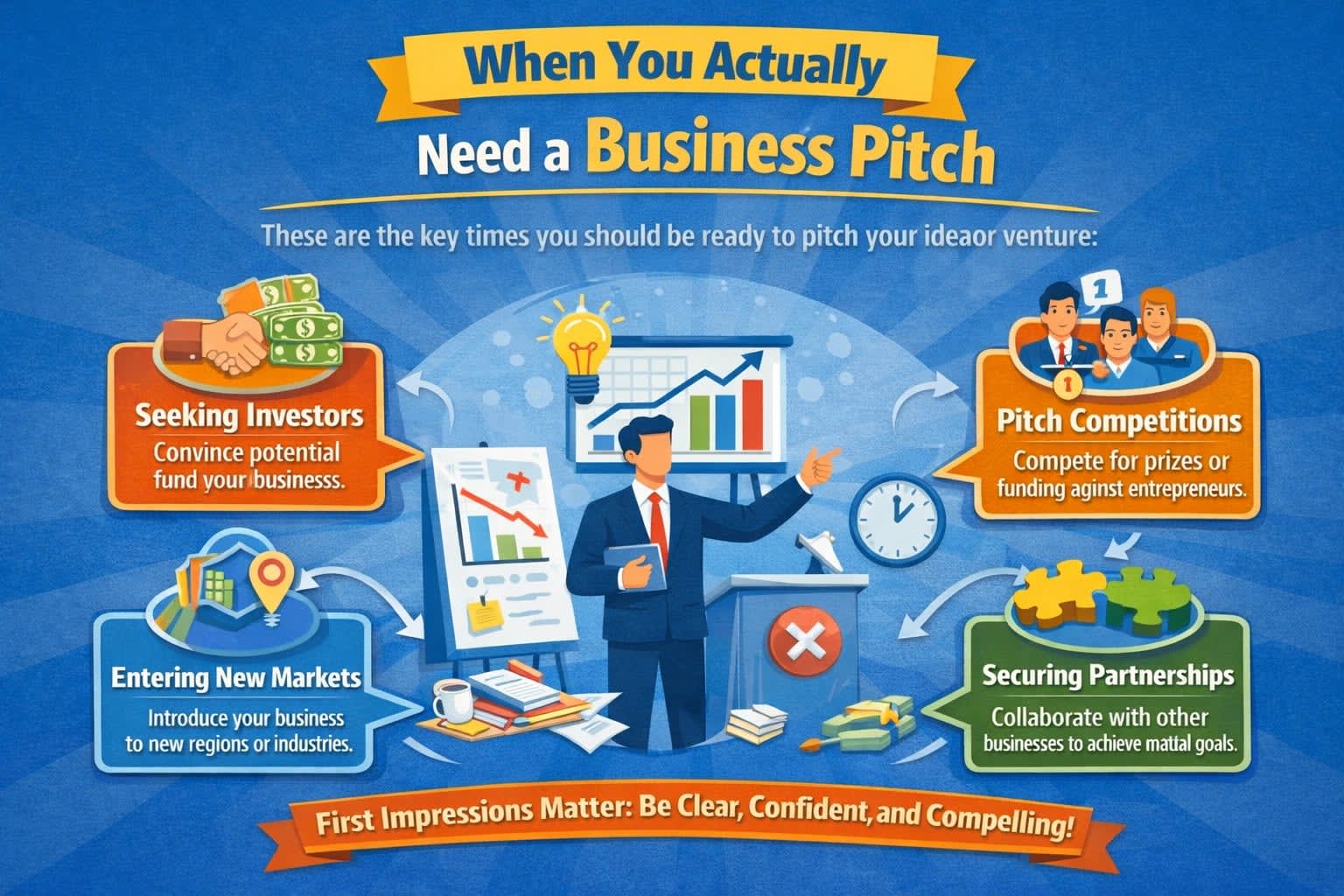
Not every business situation requires a formal pitch deck. But many more situations require a clear pitch than people realize.
Over time, I’ve learned that if I can’t articulate the idea clearly in a pitch format, I probably don’t understand it well enough yet.
Here are the moments when developing a business pitch becomes essential.
1. Early-Stage Ideas
When an idea is new, it feels exciting, but it’s usually unstructured.
Building a pitch forces you to define:
The problem
The audience
The value
The differentiation
Even if you’re not presenting to anyone yet, developing the pitch clarifies whether the idea is viable or just interesting.
2. Fundraising
This is the obvious one.
Investors don’t just invest in ideas; they invest in clarity, conviction, and execution logic. A pitch organizes your thinking so that they can evaluate it quickly.
Without it, conversations drift.
3. Sales Conversations
If you sell services, products, or consulting, you’re pitching constantly, whether you call it that or not.
A structured pitch makes sales conversations smoother because:
You control the narrative
You highlight value early
You reduce confusion
Clarity shortens decision cycles.
4. Strategic Partnerships
When you approach another business for collaboration, they need to understand what’s in it for them fast.
A pitch helps you frame mutual value instead of making vague partnership requests.
5. Team Alignment
This is underrated.
If your team doesn’t share a clear understanding of what the business stands for and where it’s going, execution fragments. A refined pitch gives everyone the same story and the same direction.
In my experience, the earlier you develop a pitch, the stronger your foundation becomes.
Not because you’ll present it everywhere, but because you’ll think better as a result.
Common Mistakes I See in Business Pitches

Over time, I’ve noticed that weak pitches don’t usually fail because the idea is bad. They fail because the thinking is messy.
Here are the mistakes I see repeatedly.
1. Too Much Information
People try to explain everything.
Market data, product features, roadmap details, background stories, all in one go. The result? Overwhelm.
A pitch isn’t about proving how much you know. It’s about making the core idea easy to grasp.
If it takes ten minutes just to understand what you do, something’s off.
2. No Clear Problem
This is surprisingly common.
The pitch jumps straight into the solution without clearly defining the pain point. Without a strong problem, the solution feels unnecessary.
If the audience doesn’t feel the tension, they won’t care about the release.
3. Vague Target Audience
“Small businesses.”
“Startups.”
“Professionals.”
These aren’t target audiences, they’re categories.
The clearer you are about who you’re serving, the more believable your pitch becomes. Specificity signals focus.
4. Talking Features Instead of Outcomes
Features describe what your product does. Outcomes describe what changes for the customer.
People don’t invest in features. They invest in results.
When I review pitches, I often see technical explanations where impact statements should be.
5. Trying Too Hard to Impress
Over-polished slides, buzzwords and dramatic projections usually mask uncertainty rather than strength.
Confidence is built through clarity, not theatrics.
The strongest pitches I’ve seen were simple, focused, and grounded in reality.
Most of these mistakes come from misunderstanding the purpose of a business pitch. When you think the goal is to impress, you overcomplicate it. When you understand that the goal is clarity and alignment, everything tightens naturally.
Lastly,
If there’s one thing I’ve learned about developing a business pitch, it’s this:
The biggest beneficiary isn’t the audience. It’s the founder.
A good pitch doesn’t just persuade others, it sharpens your own thinking. It forces you to define the problem clearly, commit to a target audience, articulate your value, and confront weak assumptions.
That kind of clarity compounds.
When you know exactly what you’re building and why it matters, decisions become easier. Marketing becomes sharper. Sales conversations become smoother. Team alignment improves. Even product development gets cleaner.
The pitch isn’t the end goal. It’s a compression exercise.
You’re distilling your business into its most essential, convincing form. And in doing that, you remove noise, tighten strategy, and expose what actually matters.
So if you’re developing a business pitch, don’t focus only on how it sounds.
Focus on what it reveals.
Because the real purpose of a business pitch isn’t just to secure investment or win a deal.
It’s to make your business clearer, stronger, and more intentional.