
A page can rank well for months or even years and still lose visibility without any obvious warning. Organic traffic starts declining, important keywords move down the search results, and a page that once generated consistent leads gradually stops performing as well.
This is often a sign of SEO content decay.
SEO content decay happens when an existing page gradually loses organic search performance. The decline can appear through lower rankings, fewer impressions, fewer clicks, declining traffic, or fewer conversions. The cause can be outdated information, changing search intent, stronger competitors, technical SEO problems, weak internal linking, or declining authority.
The good news is that a declining page does not always need to be deleted. In many cases, the page already has useful information, backlinks, rankings, and historical value. With the right analysis and updates, it may be possible to recover some of its lost visibility.
In this guide, I’ll explain how to identify SEO content decay, understand why a page is losing performance, and decide whether to update, consolidate, improve, or remove it.
What Is SEO Content Decay?
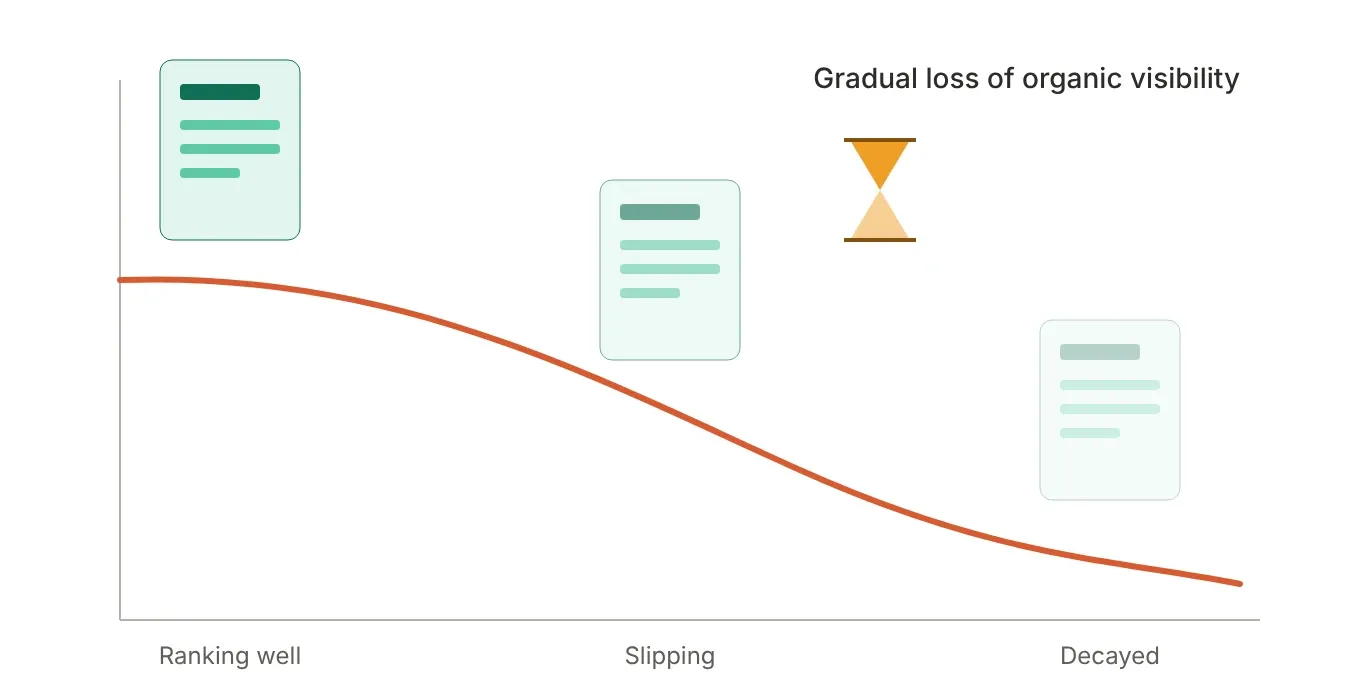
SEO content decay is the gradual loss of organic search performance from a page that previously attracted traffic, rankings, impressions, or conversions.
The important word is gradual.
A temporary ranking fluctuation does not necessarily mean content decay. Search rankings naturally move because of competition, seasonality, algorithm changes, changes in search demand, and other factors.
Content decay is more likely when a page shows a sustained decline and the underlying reason can be connected to relevance, freshness, competition, authority, or technical problems.
For example, imagine an article that ranked in Google's top five results for several years. It generated consistent organic traffic and earned several backlinks. Over time, newer competitors publish more detailed resources, the information in your article becomes outdated, and the search results begin favoring a different type of content.
Your article may still be factually correct, but it is no longer the strongest result for the search.
That is content decay.
This is also where content maintenance becomes important. My updating old content approach focuses on improving existing pages instead of automatically creating new ones. Updating content can include refreshing information, improving readability, optimizing on-page elements, and strengthening internal links.
SEO Content Decay vs. a Temporary Ranking Drop
Do not classify every traffic decline as content decay.
A page can lose traffic for a week because of seasonality or temporary changes in search behavior. A major search algorithm update can also cause short-term volatility across many pages.
Look for a longer trend.
Compare the page's current performance with a previous period and examine whether the decline affects multiple SEO metrics. If clicks, impressions, rankings, and conversions have all declined over time, the page deserves a deeper investigation.
The objective is not simply to find pages with fewer visits. It is to find pages whose search visibility or business value is declining and determine why.
How to Identify SEO Content Decay
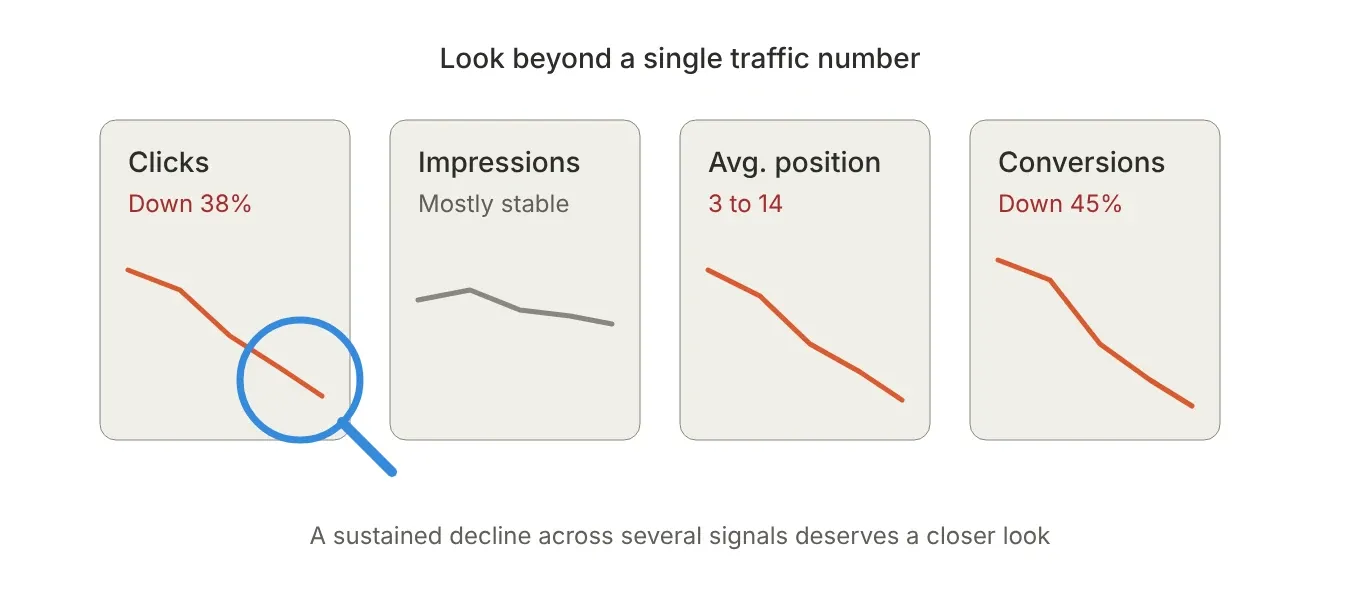
Finding SEO content decay starts with looking beyond a single traffic number.
A page might lose organic visits while maintaining strong rankings and conversions. Another page might maintain impressions while its average ranking position steadily declines.
You need several signals to understand what is actually happening.
Check Organic Traffic and Search Performance
Start by identifying pages that previously performed well but now show a sustained decline in organic traffic.
Use a meaningful comparison period. Depending on your website, that could mean comparing the last three months with the previous three months, or comparing the same period year over year when seasonality affects demand.
Google Search Console can help you examine clicks, impressions, click-through rate, average position, and queries associated with individual pages.
If you want to improve your broader on-page analysis, see my On Page SEO services, where I cover title tags, content depth, internal links, technical elements, and other page-level factors.
Look for Ranking Declines
Traffic is only one part of the picture.
Review the keywords that previously brought visitors to the page. If an important keyword moved from position three to position twelve, that change can have a significant impact even if the page still receives some traffic.
Look at secondary keywords too.
Sometimes the primary keyword remains stable while a group of related queries gradually disappears. That can indicate that competitors are providing broader topical coverage or that your page no longer satisfies the full intent behind the search.
This is where semantic keyword grouping can provide useful context. Grouping related queries by meaning and intent can help you understand whether your page still covers the topic comprehensively.
Check Impressions, Clicks, and CTR
Search Console data can help you determine what changed.
If impressions are falling, the page may be appearing for fewer searches or losing visibility for important queries.
If impressions remain relatively stable but clicks are declining, the issue could involve click-through rate, search intent, SERP features, or how the page is presented in the search results.
Review your title and meta description as part of the investigation.
Your On Page SEO elements can influence how clearly a page communicates its relevance to both users and search engines. Title tags, meta descriptions, headings, content structure, and internal links should all support the page's target intent.
Watch for Conversion Declines
Traffic should never be the only metric used to decide whether content is valuable.
A page can lose 30 percent of its organic traffic while remaining one of your most valuable pages if the visitors it does receive continue to generate leads or sales.
The opposite can also happen. A page can attract thousands of visitors but generate little business value.
Review conversions alongside organic traffic and rankings.
Depending on your website, that could include contact form submissions, product sales, demo requests, newsletter sign-ups, or other meaningful actions.
This gives you a better basis for deciding what to do with a declining page.
Why Does SEO Content Decay Happen?
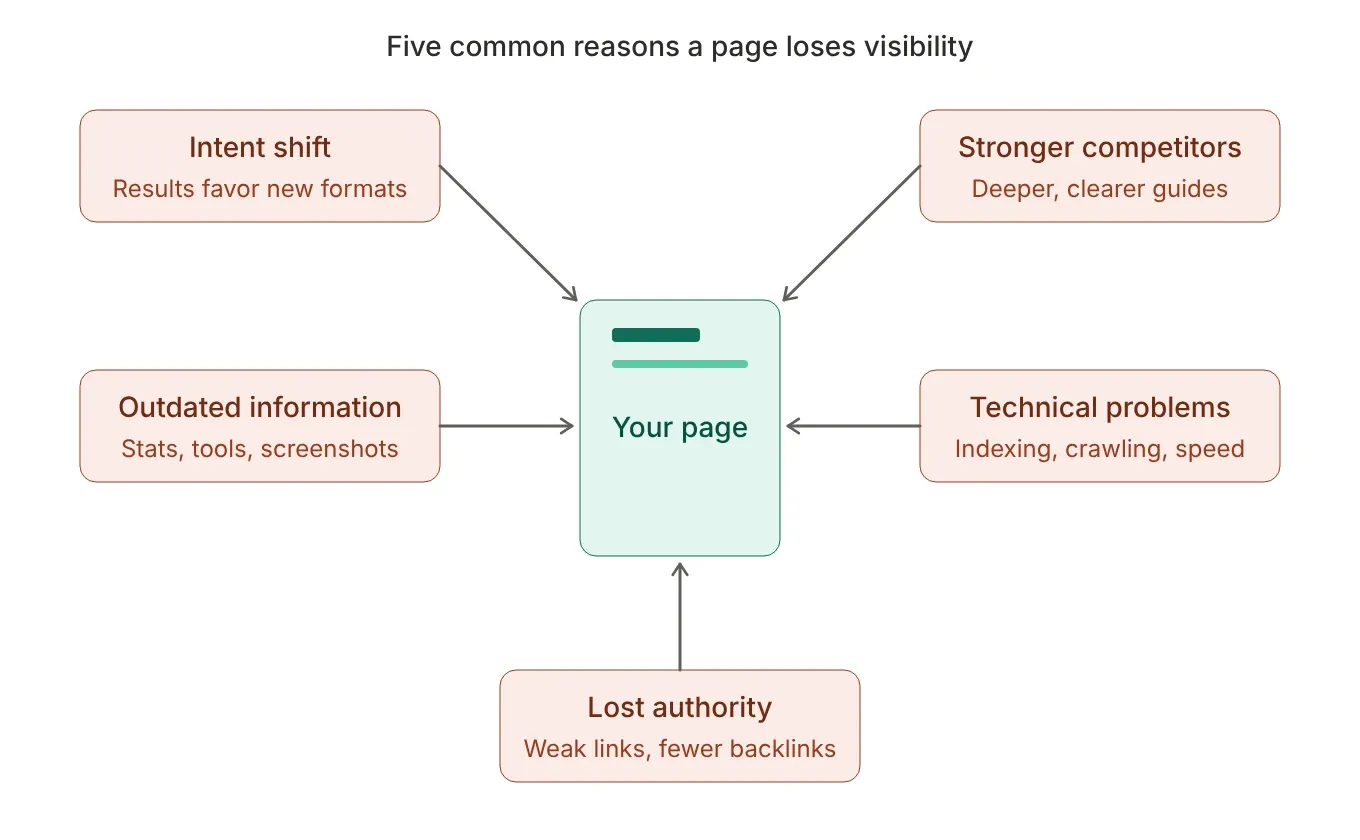
Once you identify a declining page, the next question is why it lost visibility.
There is rarely one universal cause. Several factors can combine to weaken a page's performance over time.
Search Intent Has Changed
Search intent can change even when the target keyword stays the same.
A keyword that once produced mostly informational articles might gradually become dominated by tutorials, comparisons, product pages, or detailed guides.
If your page no longer matches what users expect to find, rankings can decline even if the information remains accurate.
Search the keyword again and study the current results.
Look at the type of pages ranking, the questions they answer, the format they use, and the level of detail they provide.
Then compare those results with your page.
If users now expect a practical guide and your page only provides a short overview, the problem may not be freshness. It may be intent alignment.
Competitors Publish Better Content
Your rankings can decline when competing pages provide a better answer.
That does not necessarily mean they have more words.
A competing page may have stronger examples, clearer explanations, better research, more current information, stronger topical coverage, or a better structure.
Compare your declining page against the results currently ranking above it.
Look for information that those pages provide but yours does not.
These differences create potential content gaps.
My content strategy approach focuses on keyword research, search intent, competitor gap analysis, topical maps, content clusters, and internal linking. Those same elements are useful when diagnosing why an older page has become less competitive.
Your Information Has Become Outdated
Information naturally becomes outdated.
Statistics change. Tools introduce new features. Interfaces are redesigned. Recommendations become obsolete. Links stop working. Industry practices change.
An article that was accurate two years ago may no longer provide the best answer today.
Review older content for outdated statistics, screenshots, examples, tools, recommendations, and references.
Do not update an article simply by changing the publication date. The goal should be to make the page genuinely more accurate and useful.
Your Keyword Targeting Has Changed
Keyword targeting can become less effective when search behavior changes or when several pages on your own site begin targeting similar intent.
Keyword cannibalization is particularly relevant here.
If two pages target substantially similar queries and provide similar information, they may compete with each other instead of building a clear topical structure.
Review the keywords associated with the declining page and compare them with other URLs on your website.
If two pages overlap heavily, you may need to differentiate them, consolidate them, or change their targeting.
Technical SEO Problems Affect the Page
Sometimes the content is not the problem at all.
Technical issues can affect how search engines access, understand, or index a page.
Check for broken links, incorrect redirects, indexing issues, crawl problems, canonical problems, page speed issues, and other technical SEO factors.
This becomes especially important when several pages experience a decline at approximately the same time.
A site-wide problem should not be treated as individual content decay.
The Page Has Lost Authority
A page can also lose visibility when competing pages develop stronger authority.
Backlinks remain important when several pages are competing for the same search terms. Review the page's backlink profile and compare it with competing URLs.
Also review your internal links.
When an important page earns authority, internal links can help connect that page with related content across your website.
My link building plan explains how I approach authority building, content that attracts links, homepage versus inner-page links, and the role of internal linking in distributing value across a site.
How to Fix SEO Content Decay
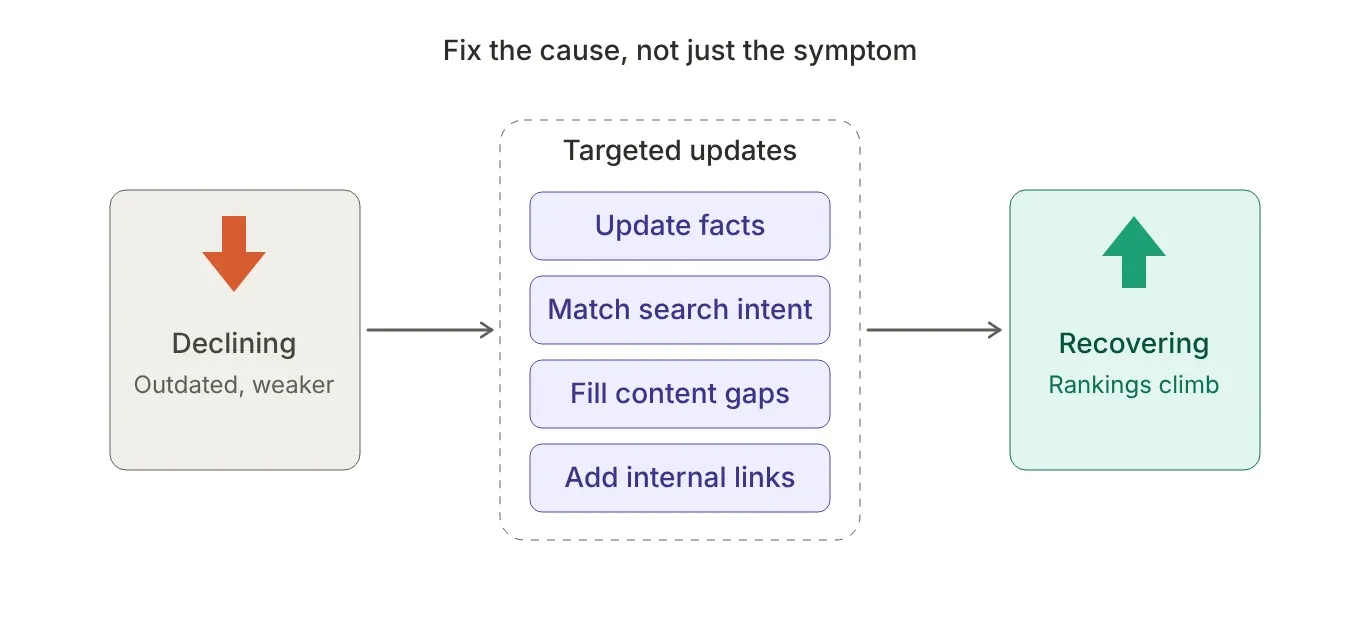
Once you understand why a page is declining, you can choose the right recovery strategy.
The solution is not always a complete rewrite.
Update the Existing Content
If the topic remains valuable but the information is outdated, update the existing page.
Replace old statistics, improve examples, remove obsolete recommendations, refresh screenshots, fix broken references, and add information readers now expect.
Review the page's title, headings, keyword targeting, and structure at the same time.
A meaningful update should improve the page rather than simply change its publication date.
Improve the Page for Search Intent
If search intent has changed, updating a few facts will not be enough.
Compare your page with the current search results and identify what users now expect.
If the results favor detailed tutorials, make your content more actionable.
If the results favor comparisons, improve the comparison itself.
If users want direct answers, move important explanations higher on the page.
The objective is simple: make the page a better answer to the query than it was before.
Fill Important Content Gaps
Use competitor research to identify useful information missing from your page.
This could include questions, examples, statistics, processes, comparisons, or supporting concepts.
Do not copy competing pages.
Instead, use the gaps as a guide for improving your own resource.
A strong content update should increase usefulness, not just word count.
Improve Internal Linking
Review both the internal links pointing toward the declining page and the links leaving it.
Connect the page with closely related resources using descriptive anchor text.
For example, a page about content decay could naturally connect to resources about on-page SEO, content strategy, semantic keyword grouping, link building, or updating old content.
Internal links should help readers discover related information while creating clearer relationships between pages.
This approach is also consistent with my broader content strategy approach, where internal links are mapped as part of topic clusters and content architecture.
Build Relevant Backlinks
If the content is strong but competing pages have substantially greater authority, link acquisition may become part of the recovery strategy.
First make the page worth linking to.
Then promote it through relevant outreach, editorial opportunities, useful resources, or content that naturally attracts references.
Avoid treating backlinks as a replacement for weak content.
My manual outreach link-building guide explains a more focused approach based on personalized outreach and relevant relationships rather than mass emails or low-quality placements.
Consolidate Competing Pages
Sometimes the best solution is consolidation.
If two pages cover substantially the same topic and search intent, compare their traffic, rankings, backlinks, conversions, and overall quality.
If one page is clearly stronger, consolidating useful information into that URL may create a more focused resource.
Make sure the overlap is genuine before doing this. Similar keywords do not automatically mean that two pages should become one.
Should You Update, Consolidate, or Delete Decaying Content?
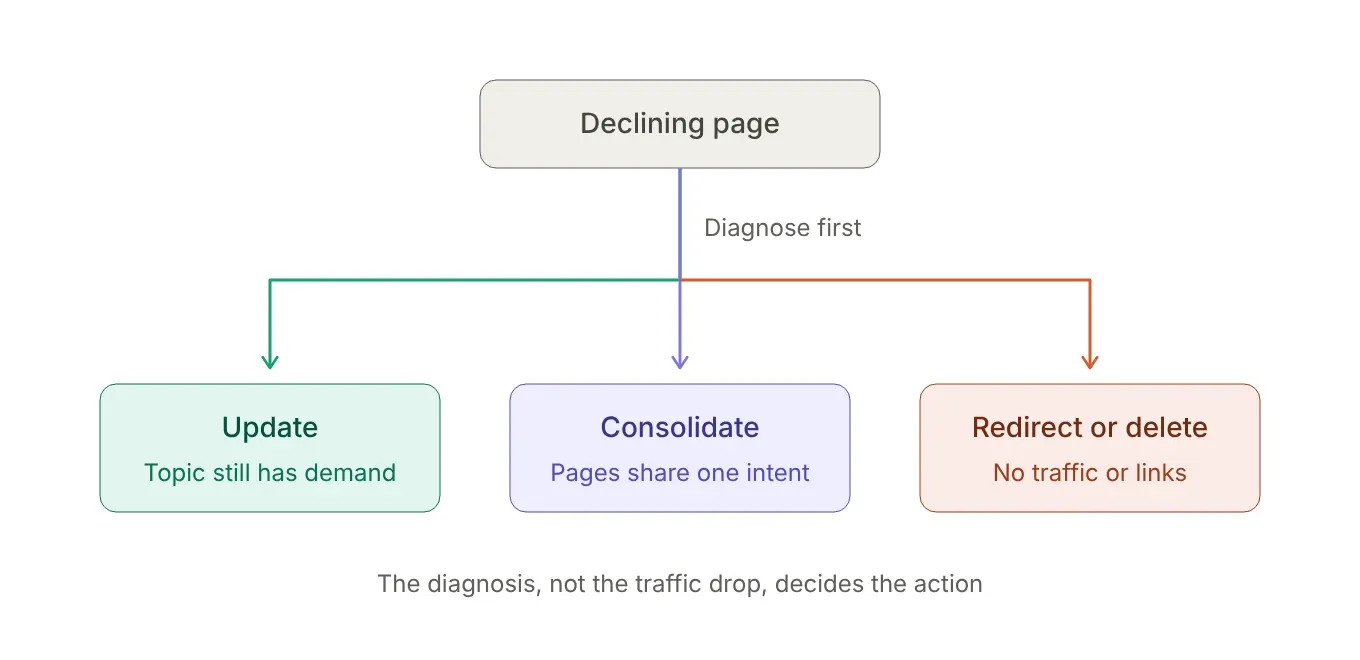
This is one of the most important decisions in a content decay audit.
A declining page should not automatically be updated, and it should not automatically be deleted.
Update the Page When
The topic still has search demand, the page has existing authority, and the information can be improved.
This is usually the best option when the content is outdated but still serves a valuable search intent.
Consolidate the Page When
Two or more URLs cover substantially the same topic and search intent.
If one page is stronger, combining the useful information into that page can create a more comprehensive resource while reducing overlap.
Redirect the Page When
The old URL has meaningful SEO value but there is a genuinely relevant replacement.
A redirect should point users and search engines to the most appropriate alternative, not simply the homepage.
Delete the Page When
The topic no longer provides meaningful value, the page has little traffic or business value, it has no important backlinks, and there is no strong reason to preserve it.
The goal is not to keep every URL on your website.
The goal is to maintain a useful collection of pages that deserve to rank.
Example: A Page That Falls From Position 3 to Position 14
Imagine you have an article that ranked third for an important keyword and generated around 2,000 monthly organic visits.
A year later, the page ranks fourteenth and receives only 650 monthly visits.
You investigate the decline and find five changes:
The information is partly outdated.
Competitors have published more comprehensive guides.
The current search results favor practical, step-by-step content.
Several related queries that previously generated traffic have disappeared.
The page has few internal links from newer relevant articles.
This is a clear recovery opportunity.
Instead of deleting the page, you could update outdated information, restructure the article around current search intent, fill important content gaps, strengthen internal links, and review its title and SERP presentation.
If the page has strong backlinks and commercial value, you can also consider relevant link acquisition.
The important point is that the traffic decline itself does not tell you what to do. The diagnosis does.
How to Prevent SEO Content Decay
Fixing decaying content is useful, but prevention is more efficient.
Search intent changes. Competitors publish new resources. Information becomes outdated. Your own website grows and creates new internal linking opportunities.
A content maintenance process helps you identify these changes before they become major ranking problems.
Create a Content Review Schedule
Do not wait for a traffic collapse before reviewing important pages.
Set a review schedule based on how quickly the topic changes and how valuable the page is to your business.
Fast-changing SEO, technology, and product-related content may need more frequent reviews than evergreen educational resources.
During each review, check accuracy, search intent, rankings, traffic, conversions, competitors, and internal links.
Monitor Pages That Generate Business Value
Prioritize pages that generate leads, sales, sign-ups, or other meaningful business outcomes.
Also prioritize pages that rank for commercially valuable keywords or have strong backlinks.
This prevents your content maintenance process from becoming a simple traffic report.
Keep Content Aligned With Search Intent
Search the primary keyword periodically.
Look for changes in the type of content ranking and the questions competitors are answering.
If the search results have changed substantially, your page may need to change as well.
Build Internal Links as You Publish New Content
Every new article creates opportunities to strengthen existing pages.
When publishing new content, review older relevant pages and add useful contextual links.
At the same time, update older pages so they link to genuinely useful new resources.
This creates a stronger content network instead of leaving every article isolated.
Track Changes After Content Updates
Record important metrics before making substantial changes.
Track rankings, impressions, clicks, organic traffic, and conversions.
Then compare performance after the update.
Do not judge the result after only a few days unless you are investigating a technical issue. Give the page enough time to be recrawled and for performance trends to become meaningful.
SEO Content Decay Audit: A Practical Workflow
You can turn everything above into a repeatable process.
Step 1: Find Declining Pages
Identify URLs with sustained declines in organic traffic, impressions, clicks, rankings, or conversions.
Step 2: Confirm the Decline
Check historical data and rule out seasonality, temporary fluctuations, and other short-term factors.
Step 3: Review Search Performance
Examine important queries, rankings, impressions, clicks, CTR, and conversions.
Step 4: Check Search Intent
Search the target keywords and compare your page with the results currently ranking.
Step 5: Analyze Competitors
Identify missing information, weak sections, outdated material, and other content gaps.
Step 6: Check Technical SEO
Make sure the page is crawlable, indexable, accessible, and technically healthy.
Step 7: Review Internal and External Links
Check internal links, backlinks, and the page's authority compared with competing results.
Step 8: Choose the Right Action
Decide whether to update, expand, improve, consolidate, redirect, or remove the page.
Step 9: Measure the Outcome
Track performance after the changes and compare it with your original baseline.
This process prevents you from rewriting every declining article without understanding the reason behind the decline.
Final Thoughts
SEO content decay is not a reason to delete every page that loses traffic. It is a signal that the page deserves investigation.
Start by identifying sustained declines in organic traffic, impressions, clicks, rankings, or conversions. Then determine what changed. Search intent may have shifted, competitors may have published stronger content, your information may be outdated, or the page may have technical, internal linking, or authority problems.
Once you understand the cause, choose the appropriate response.
Update valuable content. Improve search intent alignment. Fill meaningful content gaps. Strengthen internal links. Build relevant authority. Consolidate overlapping pages. Remove content that no longer serves a useful purpose.
The bigger lesson is that SEO content should not be treated as finished the moment it is published. Valuable pages need to be monitored, maintained, and improved as search behavior and competition change.
If you want help identifying content decay opportunities, improving existing pages, or building a stronger organic search strategy, contact Shahid Shahmiri to discuss your project.
Frequently Asked Questions
What is SEO content decay?
SEO content decay is the gradual decline of a page's organic search performance. It can appear as falling rankings, impressions, clicks, traffic, or conversions.
How do I know if my content is decaying?
Look for a sustained decline rather than a short-term fluctuation. Compare historical traffic, rankings, impressions, clicks, CTR, and conversions to determine whether the page has genuinely lost performance.
What causes SEO content decay?
Common causes include outdated information, changing search intent, stronger competitors, keyword targeting problems, technical SEO issues, declining authority, weak internal linking, and keyword cannibalization.
How do I know whether to update or delete old content?
Update the page when the topic remains valuable and the content can be improved. Consolidate it when multiple pages target the same search intent. Remove or redirect it when it no longer provides meaningful value and there is a relevant alternative.
How often should I review old SEO content?
There is no universal schedule. Review fast-changing topics more frequently and evergreen content less often. The most important pages should receive regular performance and relevance checks.
Can internal links help recover declining rankings?
Internal links can improve site navigation, help search engines understand relationships between pages, and distribute authority across relevant content. They should be added naturally and only when they provide genuine value.
Can updating old content recover rankings?
It can, when the update addresses the reason the page lost visibility. Updating outdated information, improving search intent alignment, filling content gaps, and strengthening internal links can make an existing page more competitive.