
I get this question more often than people admit publicly:
“Can I sell backlinks without getting into trouble?”
The short answer is: it depends. Most articles stop there or dance around the issue.
I’m writing this because selling backlinks is full of half-truths. Some blogs make it sound like a guaranteed income stream. Others treat it like an automatic Google penalty waiting to happen. Neither tells the full story.
Over the years, I’ve seen websites quietly monetize links without issues, and I’ve seen sites wreck their trust in months by doing it wrong. The difference was never luck. It was intent, execution, and restraint.
This post isn’t encouraging anyone to sell links blindly. It’s also not pretending link selling doesn’t happen. It does, every day across blogs, publishers, SaaS sites, and media networks.
What I want to do here is explain the reality:
how backlink selling actually works, where the risks are, what Google cares about, and what smarter alternatives look like if long-term SEO matters to you.
No scare tactics. No “get rich quick” promises. Just a precise breakdown from someone who’s seen both sides of this play out.
What “Selling Backlinks” Actually Means (And Why the Term Is Misleading)

When people say they want to sell backlinks, they’re often talking about very different things, even though they use the same phrase.
Some mean selling a contextual link inside an existing article.
Some mean paid guest posts.
Some mean niche edits.
Some mean straight-up link insertion on demand.
Lumping all of this under one label is where confusion and bad decisions start.
In my experience, the risk isn’t in money changing hands. The risk is in how obvious, repetitive, and disconnected from value the link becomes. Google doesn’t see invoices, but it does see patterns.
A backlink stops being “natural” the moment it exists only because someone paid for it, with no editorial judgment, relevance, or restraint. That’s the line most people cross without realizing it.
Another thing most guides won’t tell you:
Many site owners sell links without calling it “selling backlinks.” They frame it as sponsorships, partnerships, content contributions, or editorial placements. Sometimes that’s just semantics. Sometimes it genuinely changes how the link is handled.
The problem starts when selling links becomes the site’s business model rather than a byproduct of publishing. Once every article exists to host paid links, quality drops, relevance blurs, and trust erodes for both users and search engines.
So before asking “Can I sell backlinks?”, the more important question is:
What kind of links are we actually talking about and why would they exist without payment?
That distinction matters more than most people think.
Google’s Official Stance vs How the Web Actually Works
If we go strictly by Google’s documentation, the answer is simple:
selling backlinks that pass PageRank violates their guidelines.
That’s the official position. It hasn’t changed in years.
But anyone who’s spent real time in SEO knows the web doesn’t operate in neat binaries. Paid links exist everywhere, on blogs, media sites, SaaS publications, and even outlets people consider “authoritative.” Pretending otherwise doesn’t help anyone make better decisions.
What Google actually enforces isn’t payment; it enforces manipulation at scale.
In practice, sites don’t get hit because they sold a link once. They get hit because patterns emerge:
- Paid links with no editorial discretion
- Repetitive anchor text across unrelated sites
- Pages created primarily to host links
- Outbound links that don’t match the site’s topic or audience
When selling backlinks becomes obvious, systematic, and careless, it stops looking like publishing and starts looking like a network. That’s when things fall apart.
Another nuance that’s often ignored: Google doesn’t need to catch everything. It only needs to catch enough patterns to devalue trust. In many cases, there’s no penalty; links just quietly stop counting.
That’s why you’ll see sites that “sell links” continue to exist, while others lose rankings and traffic without a clear explanation. The difference usually lies in restraint, relevance, and the extent to which link selling is central to the site’s identity.
So yes, Google says don’t sell links.
But the real-world risk isn’t binary. It’s contextual.
Understanding that gap allows site owners to make well-informed decisions rather than operate on fear or false confidence.
When Selling Backlinks Becomes Risky

Selling backlinks usually doesn’t go wrong all at once. It goes wrong gradually, through small decisions that add up.
The first red flag is volume without discretion. When every inquiry turns into a “yes,” editorial judgment disappears. Links stop being about relevance and start being about filling slots. That’s when outbound link patterns become obvious.
The second issue is anchor text control. Allowing buyers to dictate exact-match anchors repeatedly is one of the fastest ways to signal manipulation. It doesn’t matter how good the site is; unnatural anchors at scale are easy to spot.
Another risk factor is topical drift. A site that starts linking out to unrelated industries, crypto one week, gambling the next, SaaS after that, slowly erodes its own identity. Even if individual links look harmless, the overall profile stops making sense.
Then there’s content intent. Pages created or updated mainly to insert paid links tend to have shallow value. When too many pages exist just to host links, quality drops, crawl value weakens, and trust fades quietly.
Finally, there’s repetition. Selling links to the same buyers from similar pages in similar formats creates detectable patterns. Google doesn’t need certainty; it needs probability. Once trust drops, recovery is slow.
The common thread in all of this isn’t payment. It’s predictability. The more mechanical link selling becomes, the more fragile the site’s SEO becomes.
That’s why some sites sell links for years without issues and others don’t last six months.
Why Some Sites Get Away With Selling Backlinks (And Others Don’t)
This is the part that confuses most people and, honestly, fuels bad decisions.
You’ll see one site selling links openly for years with no visible damage, while another quietly loses rankings after a few months. From the outside, it looks random, but it isn’t.
The sites that “get away with it” usually share a few traits.
First, link selling isn’t their primary purpose. They publish real content, attract real audiences, and earn organic mentions independent of paid placements. Selling links is occasional, not core to their model.
Second, they maintain editorial control. Not every request is accepted. Not every anchor is allowed. Not every industry fits. That discretion matters more than people realize.
Third, they have strong inbound signals. When a site earns links genuinely, has brand searches, and gets mentioned without trying, Google is more forgiving of occasional noise in the outbound profile.
On the other hand, struggling sites tend to make link selling central to their model. Pages exist mainly to host links. Outbound links outnumber inbound ones. Content updates happen only when a buyer requests an insertion. At that point, the site stops behaving like a publisher.
Another overlooked factor is time. Some sites haven’t been hit yet, not because they’re safe, but because patterns take time to surface. Whenever trust erodes, it often happens quietly through devaluation rather than dramatic penalties.
That’s why copying what “seems to work” elsewhere is dangerous. You don’t see the full picture, just a snapshot.
Selling backlinks isn’t a switch you flip. It’s a spectrum of risk, and where you land depends on how you operate over time.
Less Risky Alternatives to Selling Backlinks

If your goal is to monetize your site without slowly undermining its trust, there are better options than selling backlinks directly.
I’m not saying these are risk-free. Nothing is. But they give you more control, more value, and fewer obvious signals than direct link selling.
Sponsored Content (With Real Editorial Standards)
Sponsored posts get a bad reputation because most are thin and obvious. Done properly, they’re one of the safest monetization paths.
The key difference is intent.
A sponsored post should:
- Exist as a standalone piece of content
- Provide value to readers beyond the link
- Be relevant to your audience and niche
- Give you full editorial control
When the content stands on its own, the link feels contextual instead of transactional. Whether you mark it as sponsored or use nofollow or sponsored attributes is a business decision, but content quality is what protects you long term.
Partnerships and Cooperations
Some of the cleanest links I’ve seen come from partnerships that don’t look like link deals at all.
This includes:
- Co-authored content
- Product or service collaborations
- Case studies
- Joint research or data pieces
Money may still change hands indirectly, but the link exists because of the collaboration, not the other way around.
Selling Exposure, Not Links
Another approach is shifting the offer away from “links” entirely.
Instead of selling:
“a dofollow backlink”
You’re selling:
- Exposure to your audience
- Placement in a resource section
- Inclusion in a comparison or roundup
When the value is framed around visibility and relevance, links become secondary. This reduces pressure on anchor text and placement, two major risk factors.
Read More On: How to Start a Bottled Water Business From Scratch
Building a Product or Service Layer
This is slower, but it builds over time.
Many publishers eventually move away from link monetization by:
- Offering consulting
- Running a newsletter
- Launching a community
- Selling tools, templates, or audits
Once revenue isn’t tied to outbound links, decision-making improves. Editorial standards go up. SEO gets easier, not harder.
If You Still Choose to Sell Backlinks: Practical Guardrails
I know some site owners will still choose to sell backlinks, whether occasionally or as part of their monetization mix. If that’s the path you take, the goal shouldn’t be to eliminate risk completely. It should be to control it.
These are the guardrails I’d personally stick to.
First, never outsource editorial judgment. The moment buyers decide on anchor text, placement, or page selection without resistance, you’ve crossed into dangerous territory. I’d always reserve the right to rewrite anchors, choose pages, or decline requests outright.
Second, limit frequency. Selling links occasionally is different from selling them routinely. When outbound links grow faster than inbound signals, the imbalance becomes obvious. Scarcity isn’t just good business; it’s protection.
Third, stay topically strict. If a link doesn’t naturally belong on the site, it doesn’t belong there at all. I’d rather turn down money than dilute topical relevance. Once that slips, everything else follows.
Fourth, avoid patterns. Repeated formats, similar placements, and predictable structures make detection easier. Variation isn’t a trick; it’s how real publishing works.
Fifth, don’t build pages for links. Updating an existing article thoughtfully is one thing. Creating or reviving pages just to insert paid links is another. That’s usually at which quality collapses and trust erodes.
Sixth, be prepared to say no, often. The healthiest sites I’ve seen treat link selling as optional, not necessary. The ability to walk away is a signal in itself.
Finally, I’d keep this question in mind at all times:
Would this link still make sense if money weren’t involved?
If the answer is no, it’s likely not worth the long-term cost.
Selling backlinks isn’t an on/off switch. It’s a sliding scale of decisions, each one nudging a site closer to or further from risk. Guardrails don’t make it safe, but they make it survivable.
Should You Sell Backlinks?
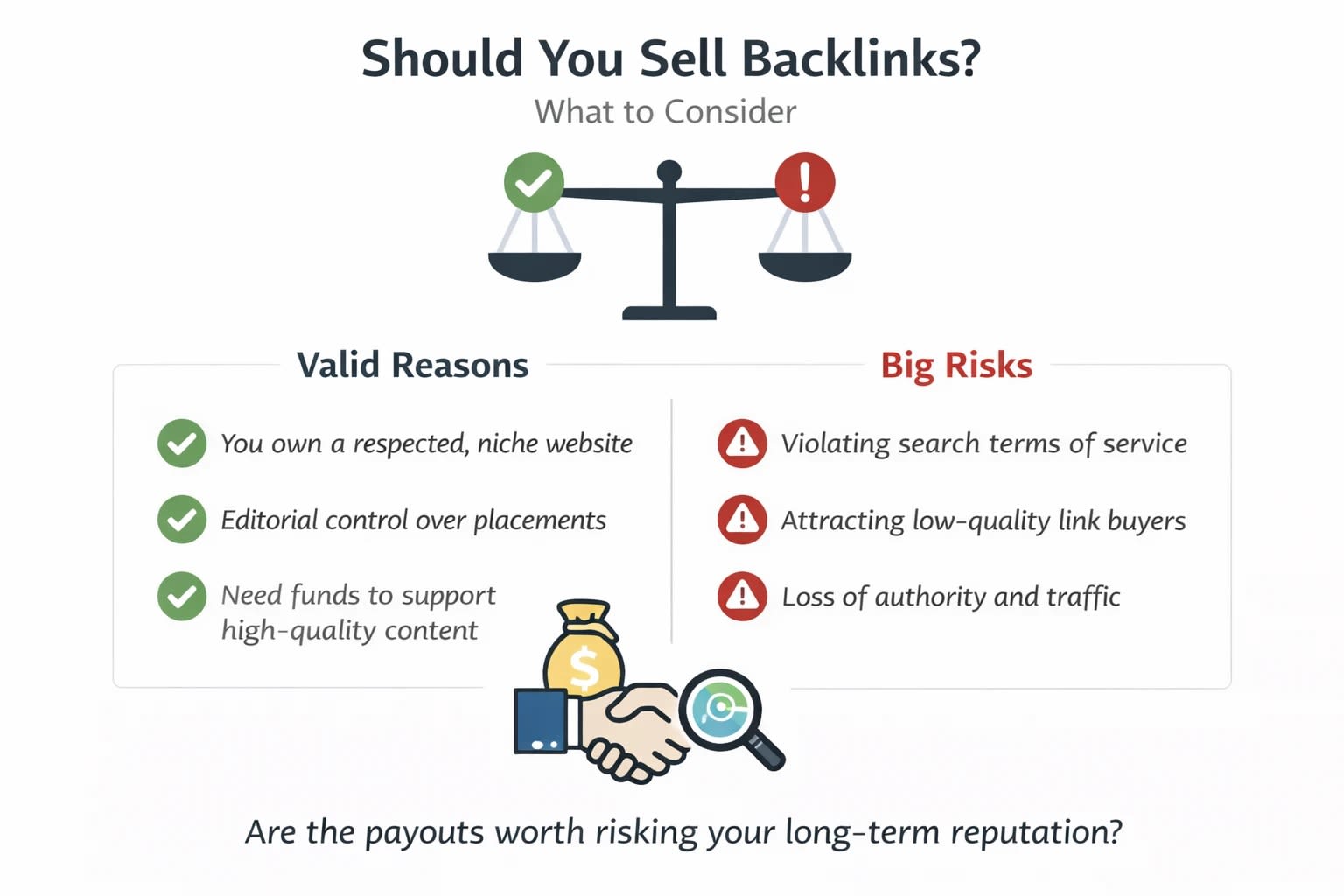
If you’re looking for a simple yes-or-no answer, here it is:
Selling backlinks is not a sustainable strategy for most sites.
That doesn’t mean it never works. It works solely under specific conditions, usually for sites that already have strong authority, clear editorial standards, and the discipline to say no far more often than yes.
For newer or growing sites, selling backlinks is often a shortcut that creates long-term drag. The money comes early. The cost shows up later, often in ways hard to trace to a single decision.
If you rely on selling links to survive, you’re forced to compromise: relevance slips, patterns form, and editorial control weakens. At that point, you’re no longer publishing for an audience, but for buyers. Search engines eventually catch up to that reality.
On the other hand, if link selling is rare, selective, and secondary to real publishing, the risk is lower, but never zero. Anyone saying otherwise is oversimplifying the trade-off.
My honest take is this:
If long-term SEO, brand trust, and flexibility matter to you, there are better ways to monetize a site. Selling backlinks can generate income, but it rarely builds value.
The safest position isn’t pretending link selling doesn’t exist.
It’s understanding exactly what you’re trading when you choose it.
That clarity alone puts you ahead of most people working through this space.
FAQs
Not always. In many cases, Google simply ignores paid links instead of issuing a penalty. Problems usually arise when link selling becomes frequent, obvious, or central to how a site operates.
There’s no completely “safe” way, but risk can be reduced through restraint, relevance, editorial control, and avoiding patterns. Selling backlinks at scale significantly increases risk over time.
Generally, yes. Sponsored content that delivers authentic value and aligns with the site’s audience is less risky than direct link insertion, especially when editorial standards are maintained.
For most sites, no. While it can generate short-term income, it often limits long-term SEO growth and brand trust. Many publishers eventually move to safer monetization models.
From Author:
This article is based on first-hand experience, independent analysis, and actual observations. Writing assistance was used to help structure and clearly convey the ideas, but all opinions, conclusions and judgments reflect the author’s own perspective and experience.