
AI crawlers are changing how the web is read.
For years, only search engines like Google and Bing crawled websites at scale. Today, large language models are doing the same thing. They crawl content for training models, retrieve answers, and power AI search systems.
That shift’s created a new file that many websites are now adding: llm.txt.
Some believe it will become the robots.txt of AI.
Some assert it will influence rankings in ChatGPT and Google SGE.
But most explanations online are incomplete.
What exactly is llm.txt?
Why was it created?
And more importantly, does it actually help SEO?
In this guide, you’ll learn what llm.txt is, how it works, which AI systems use it today, and whether adding it to your site can improve visibility in AI search.
By the end, you’ll know exactly when llm.txt matters and when it doesn’t.
Read More On: Best AI Video Generator Tools in 2026 (Top 7 Compared)
What is llm.txt?

llm.txt is a proposed standard that allows website owners to control how large language models access and use their content.
In simple terms, it is a permissions file designed specifically for AI systems.
Just like robots.txt tells search engine crawlers which pages they are allowed to crawl and index, llm.txt tells AI crawlers whether they are allowed to collect content for training, retrieval, and answer generation.
The file is placed in the root of a website, usually at:
https://example.com/llm.txt
When an AI crawler visits a site, it can read this file before collecting any data. The file communicates what the system is allowed to do with the content on that domain.
This includes whether the content can be used to train AI, whether it can be retrieved for live answers, and whether certain sections of the site are restricted.
Read More On: How to Start a Bottled Water Business From Scratch
What Does “LLM” Mean in llm.txt?
LLM stands for Large Language Model.
These are the AI systems behind tools like ChatGPT, Google Gemini, Claude, and Perplexity. They are trained to read and generate human-like text using huge datasets collected from the web, licensed publishers, and proprietary sources.
As these systems became more widely deployed, they began crawling websites at scale. Not only to retrieve information for answers, but also to collect data for training and fine-tuning.
llm.txt was created to give website owners a way to communicate rules directly to these systems.
Read More On: What is LLM SEO? A Complete Guide to AI Search Optimization
What llm.txt Is Designed to Control
Unlike robots.txt, which only controls crawling and indexing, llm.txt focuses on how content is used after it is collected.
It can declare whether AI systems are allowed to:
Use the content for training new models.
Store the content in internal datasets.
Retrieve content to answer user questions.
Access only certain sections of a website.
This distinction is important.
robots.txt answers the question:
“Can you crawl and index this page?”
llm.txt answers a different question:
“Can you use this content to train systems or generate answers?”
What llm.txt Is Not
llm.txt is not a ranking file.
It does not influence Google rankings.
It does not improve indexing.
It does not raise visibility in AI search.
Its purpose is governance, not optimization.
It exists to give publishers control and legal transparency, not to provide an SEO advantage.
This point is critical, because much of the current discussion around llm.txt incorrectly treats it as a ranking signal.
It is not.
Why llm.txt Was Created
llm.txt was created because the existing web standards were not built for artificial intelligence.
For decades, robots.txt was enough. It controlled how search engines crawled and indexed websites. It answered a simple question: which pages can appear in search results?
But large language models introduced a completely different use case.
AI systems weren’t just indexing pages. They were collecting massive amounts of text for training models, storing it in internal datasets, and reusing it to generate answers in commercial products.
robots.txt had no way to control any of that.
The Rise of Uncontrolled AI Crawling
As tools like ChatGPT, Bard, and Claude became popular, publishers began noticing something new.
Their content was appearing inside AI answers.
Their articles were being paraphrased without attribution.
Their paywalled and licensed material was being cited indirectly.
In many cases, this happened without consent and without any technical way to opt out.
Unlike search engines, AI training pipelines did not always respect robots.txt. Some crawlers ignored it entirely. Others collected content long before any rules existed.
This created a serious legal and ethical problem.
Copyright, Licensing, and Publisher Pressure
The conflict quickly moved beyond SEO.
News organizations, academic publishers, and content platforms started noting concerns about copyright infringement and data use. Several high-profile lawsuits were filed against AI companies for using proprietary content in their training data.
At the same time, regulators began examining how AI models sourced information and whether publishers had any control over that process.
Publishers needed a mechanism that could clearly communicate permissions.
Not just for crawling.
But for training, storage, and reuse of content.
Why robots.txt is Not Enough
robots.txt was designed in the 1990s.
It assumes that crawlers index pages and then show links.
It does not distinguish between:
Indexing and training.
Reading and storing.
Displaying links and generating answers.
There is no directive in robots.txt that says:
“You may crawl this page, but you may not use it to train a model.”
That gap is exactly what llm.txt was designed to fill.
The Goal of llm.txt
llm.txt was created to introduce explicit consent into AI data collection.
Its purpose is to give website owners a way to declare:
Whether AI systems can collect their content.
Whether that content can be used for training.
Whether it can be reused for answer generation.
Instead of relying on ambiguous legal readings, AI platforms would check a standard file and know what they are allowed to do.
This makes llm.txt less about SEO and more about governance.
It is a control layer for the AI era.
Why This Matters for SEOs and Publishers
Even though llm.txt is not a ranking factor, it signals an important shift.
The web is moving from open crawling to permission-based access.
As AI regulation increases and licensing becomes more common, platforms will prefer content that is clearly authorized and legally safe to reuse.
In that environment, llm.txt may not boost rankings.
But it may determine eligibility.
Which content can be trained on?
Which content can be cited?
Which content can appear in AI answers at all?
How Does llm.txt Work?

llm.txt works as a permissions file that sits at the root of a website and communicates usage rules directly to AI crawlers.
When an AI system visits a domain, one of the first things it can do is request the file located at llm.txt. This file contains directives that describe how the crawler may interact with the site’s content. Instead of controlling indexing behavior like robots.txt, llm.txt focuses on controlling how the collected content may be used after it is accessed.
The file does not affect how search engines rank or index pages. Its only role is to determine whether AI systems are permitted to collect, store, and reuse content for training or generating answers.
How AI Crawlers Read llm.txt
When an AI crawler encounters a website, it can check llm.txt before fetching any pages. The crawler identifies itself using a user-agent, then looks for rules that apply to that agent or to all AI systems.
If the file allows access, the crawler proceeds to collect content in accordance with the defined permissions. If the file blocks certain actions, the crawler is expected to respect those restrictions.
This process is voluntary.
Unlike search engines, there is currently no enforcement mechanism. llm.txt relies entirely on cooperation from AI platforms. The file does not technically prevent access. It only communicates intent.
Whether the crawler follows those rules depends on the platform operating it.
Training Permissions vs Retrieval Permissions
One of the most important design goals of llm.txt is separating training from retrieval.
Training refers to collecting content and storing it in a dataset used to build or fine-tune models. This is a long-term use of data, with major copyright and licensing implications.
Retrieval refers to temporarily accessing content to answer a user’s question in real time. The content may be quoted, summarized, or cited, but it is not permanently added to a training dataset.
llm.txt allows publishers to permit one and restrict the other.
For example, a site could allow its content to be used for live answers but block it from being included in training data. Or it could block both.
This distinction does not exist in robots.txt.
Path-Level and Section-Level Control
llm.txt can also apply permissions to specific parts of a website.
A publisher might allow AI access to blog articles but block access to premium documentation, user dashboards, or licensed research. The file can define which directories are allowed and which are restricted.
This makes llm.txt especially useful for sites that publish both public and proprietary content under the same domain.
Instead of blocking an entire crawler, publishers can control access with much finer precision.
What Happens If llm.txt Is Missing
If a website does not have an llm.txt file, most AI crawlers treat that as implicit permission.
They may crawl the site, collect content, and reuse it in accordance with their internal policies. There is no default restriction.
This is another reason llm.txt was introduced.
Without it, publishers have no explicit way to express consent or refusal.
What does llm.txt not do?
llm.txt does not block crawling in the same way robots.txt does.
It does not stop Googlebot from indexing pages.
It does not prevent Bing from ranking content.
It does not guarantee that AI systems will follow the rules.
It also does not retroactively remove content that has already been collected for training.
Its role is forward-looking.
It influences future crawling and future data collection, not past usage.
Why llm.txt Is Still Experimental
At the moment, llm.txt is not an official Internet standard.
There is no single governing body enforcing syntax, compliance, or interpretation. Different platforms may implement it differently or ignore parts of it entirely.
This makes llm.txt more of a signaling mechanism than a control mechanism.
But that signal is becoming increasingly important as regulation, licensing, and publisher agreements expand.
Over time, AI platforms will likely prefer content that clearly states permissions, as this reduces legal risk.
Which AI Crawlers and Platforms Support llm.txt Today
Support for llm.txt is still limited and fragmented.
Although the file has attracted attention in the SEO and publishing communities, it has not yet been adopted universally across major AI platforms. Most systems still rely primarily on traditional search engine indexes and their own internal policies rather than a formal llm.txt standard.
Understanding who supports llm.txt today and who does not is critical before deciding whether to implement it.
OpenAI and GPTBot
OpenAI operates its own crawler, commonly referred to as GPTBot.
This crawler is primarily used to collect data for training and fine-tuning large language models rather than for live retrieval in products like ChatGPT browsing. GPTBot respects robots.txt and provides documentation on how publishers can block or allow access.
As of now, OpenAI has not officially announced full support for llm.txt as a standardized control file. Some experimental implementations exist, but OpenAI’s primary access control mechanism remains robots.txt and contractual licensing agreements.
In practice, adding llm.txt does not change how ChatGPT retrieves or cites content today.
Perplexity and PerplexityBot
Perplexity operates both the retrieval pipelines and its own crawler, often identified as PerplexityBot.
Perplexity has been one of the more transparent platforms about respecting publisher permissions. It supports robots.txt and honors publisher-level restrictions for crawling and indexing.
There is limited public evidence that Perplexity actively enforces llm.txt directives at scale. While some experimental support has been discussed, Perplexity’s retrieval system still depends heavily on Bing’s index and its own ranking logic.
This means llm.txt does not currently influence whether a site appears in Perplexity answers.
Anthropic and ClaudeBot
Anthropic operates Claude and related research models.
ClaudeBot has been observed crawling websites, and Anthropic provides documentation for controlling access through robots.txt and contractual terms. However, there is no official confirmation that ClaudeBot consistently parses or enforces the directives in llm.txt.
Most of Claude’s live retrieval functionality relies on licensed data sources and partner indexes instead of direct open web crawling.
As with OpenAI, llm.txt currently plays no meaningful role in visibility inside Claude answers.
AppleBot and Apple Intelligence
Apple operates AppleBot, which supports search and AI services across Siri and Apple’s search ecosystem.
AppleBot respects robots.txt and provides documentation on crawl control for publishers. There is currently no public confirmation that Apple has adopted llm.txt as an access control mechanism for training or retrieval.
Given Apple’s emphasis on privacy and licensing, future support is possible, but as of now, llm.txt does not influence Apple’s AI visibility.
Google, Gemini, and Google SGE
Google does not support llm.txt.
Google’s AI systems count entirely on Googlebot, its main web index, and licensed publisher partnerships. Control over AI usage is handled through existing robots.txt rules, noarchive directives, and publisher agreements.
Google has publicly stated that its AI systems respect the same crawl and index rules as traditional search.
Adding llm.txt has no effect on Google indexing, rankings, or inclusion in Gemini or SGE answers.
The Current Reality of llm.txt Adoption
At the moment, no major AI platform relies on llm.txt as a primary control signal.
Most platforms still depend on:
Robots.txt for crawl control.
Search engine indexes for retrieval.
Licensing agreements for training data.
Internal content policies for reuse.
This means llm.txt does not currently determine whether your content appears in AI answers.
It does not influence retrieval.
It does not influence ranking.
It does not influence citation frequency.
Why Support Is Likely to Increase Over Time
Although adoption is limited today, the direction is clear.
As regulations increase and licensing becomes more formalized, AI platforms will need a standardized way to express and respect publishers’ permissions. llm.txt provides a simple, transparent mechanism for doing that.
In the future, platforms may begin to:
Prefer content that explicitly allows reuse.
Do not use content that blocks training or retrieval.
Exclude sources with unclear permissions.
In that environment, llm.txt may not improve rankings.
But it may determine eligibility.
llm.txt vs robots.txt: What’s the Difference?
At first glance, llm.txt and robots.txt appear similar.
Both are text files placed at the root of a website.
Both communicate rules to automated systems.
Both influence how machines interact with web content.
But they solve completely different problems.
Grasping this distinction is critical because many explanations incorrectly describe llm.txt as a replacement for robots.txt. It is not.
Different Origins, Different Purposes
robots.txt was created in the 1990s to control search engine crawling.
Its only job is to tell crawlers which URLs they are allowed to fetch and index. It was designed within a world in which machines discovered content and showed it as links in search results.
llm.txt was created for a different world.
Large language models do not only crawl pages. They collect content for training, store it in internal datasets, and reuse it to generate answers inside AI products. robots.txt has no language to control any of those behaviors.
llm.txt exists to control how content is used after it is collected, not whether it is indexed.
Crawling vs Usage Control
robots.txt answers one narrow question:
“Are you allowed to crawl this page?”
If a crawler is blocked in robots.txt, it should not fetch the page. If allowed, the crawler can index it and display it in search results.
llm.txt answers a different set of questions.
It does not focus on crawling. It focuses on usage.
It tells AI systems whether the content they collect can be used for training, stored in long-term datasets, and reused to generate answers.
This is a fundamental shift.
robots.txt controls access.
llm.txt controls permission.
Indexing vs Training and Retrieval
robots.txt was built around indexing.
Its goal is to control what appears in search engines.
llm.txt was built around training and retrieval.
Its goal is to control whether content can be incorporated into a model’s knowledge or reused in AI responses.
This distinction matters because AI systems may legally crawl a page but still be restricted from using its content.
robots.txt cannot express that rule.
llm.txt can.
Ranking vs Governance
robots.txt could indirectly affect rankings.
If a page is blocked, it cannot be indexed. If it cannot be indexed, it cannot rank.
llm.txt does not influence rankings at all.
It does not change indexing.
It does not affect search engine crawling.
It does not modify ranking algorithms.
Its role is governance, not optimization.
This is why llm.txt is not an SEO ranking tool.
It is a legal and policy control mechanism.
Complementary, Not Competing
llm.txt is not designed to replace robots.txt.
They are meant to work together.
robots.txt continues to control which pages search engines can crawl and index.
llm.txt adds an additional layer that controls how AI systems may use the content they collect.
A typical modern website may eventually use both:
robots.txt to manage indexing and crawl budgets.
llm.txt to manage training and reuse permissions.
Each file manages a different stage of the data pipeline.
Why Confusion Exists
Much of the confusion comes from timing.
robots.txt became an SEO tool because search engines dominated web discovery.
The emergence of lmm.txt comes at a time when AI systems dominate content reuse.
Because both involve crawlers and text files, they are often compared directly. But the underlying systems are fundamentally different.
Treating llm.txt as a ranking tool leads to the wrong strategy.
It is not an optimization file.
It is a consent file.
What This Means for SEO Strategy
For SEOs, the takeaway is simple.
robots.txt is still essential for crawl control and indexing.
llm.txt is optional and purposeful.
Adding llm.txt will not improve rankings or prominence today.
But understanding it prepares your site for a future in which permissions and licensing determine which sources AI systems can use.
Does llm.txt Help SEO?
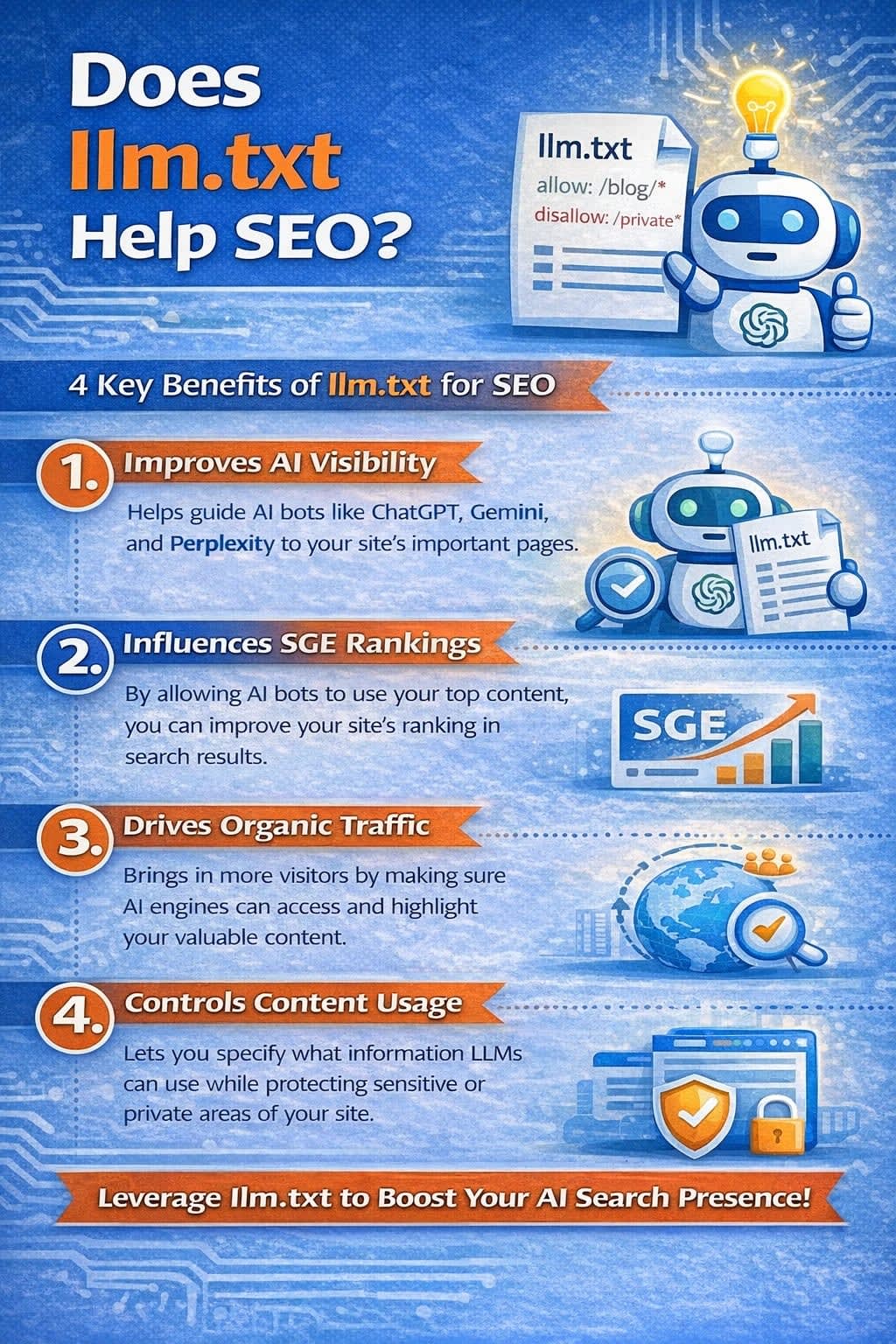
The short answer is no.
llm.txt does not improve search rankings, increase indexing, or directly influence how Google, Bing, or any other search engine evaluates your pages. It is not a ranking signal, a crawl directive, or part of any known search engine algorithm.
At the moment, llm.txt has no measurable impact on traditional SEO performance.
Google does not read llm.txt when crawling or ranking pages. Bing does not use it as a ranking factor. Adding the file will not change your positions, your impressions, or your organic traffic.
This point is important because much of the current discussion around llm.txt incorrectly treats it as an optimization technique.
It is not.
Why llm.txt Does Not Affect Rankings
Search engines and AI systems operate on different pipelines.
Google’s ranking systems depend on Googlebot, indexing systems, and ranking algorithms that evaluate content based on relevance, authority, links, user signals, and hundreds of other factors. llm.txt does not participate in any part of this process.
AI systems that generate answers do not retrieve content directly from llm.txt either. They retrieve documents from search engine indexes, licensed data sources, and internal retrieval systems. Those systems count on traditional SEO signals, not on permission files.
Even when an AI crawler reads llm.txt, it does not use that information to rank or prefer your content.
It only uses it to decide whether it may collect or reuse the content.
Why llm.txt Is Not an AI Ranking Signal Either
Some publishers assume that allowing access through llm.txt will increase their chances of being cited by ChatGPT, Perplexity, or Gemini.
That is not how these systems work.
AI retrieval systems first select candidates from search engine indexes and trusted data sources. Only after that do they evaluate authority, relevance, freshness, and entity signals.
llm.txt is not part of this selection process.
Allowing access through llm.txt does not make your content more relevant.
It does not make your site more authoritative.
It does not increase your probability of being retrieved.
It only determines whether your content is legally permitted to be collected or reused.
The Indirect Role of llm.txt May Play in the Future.
Although llm.txt does not help SEO today, it may influence eligibility in the future.
As regulation increases and licensing becomes more formalized, AI platforms will need clearer permission frameworks. Platforms will increasingly prefer content explicitly authorized for reuse, as it reduces legal risk.
In that environment, llm.txt may become a filter rather than a ranking factor.
It may not push your content higher.
But it may decide whether your content is allowed into the system at all.
Websites that block AI training or retrieval entirely may gradually disappear from AI answers, not because they rank poorly, but because they are no longer eligible to be used.
This is a subtle but important shift.
The Real SEO Impact of llm.txt
From a practical SEO perspective, llm.txt is unbiased.
It will not help you rank.
It will not hurt your rankings.
It will not increase traffic.
Its only real impact today is governance.
It gives you control over how your content may be collected and reused by AI systems. That control may become strategically valuable later, but it does not produce short-term SEO gains.
If your goal is visibility in Google or citations in AI answers, llm.txt is not the lever that matters.
Authority, topical depth, structure, links, entities, and freshness still dominate every retrieval system in use today.
Final Verdict
llm.txt does not help SEO in the traditional sense.
It is not an optimization file.
It is a permission file.
Its value is legal and strategic, not algorithmic.
For now, the best way to improve AI visibility is still to do what SEO has always required: publish authoritative content, build topical clusters, earn citations, and make your pages easy for computers to understand.
llm.txt does not replace any of that.
Does llm.txt Improve AI Visibility or Citations?
In its current form, llm.txt does not improve AI visibility or increase the likelihood that your content will be cited in AI-generated answers.
AI systems do not use llm.txt as a ranking or retrieval signal. They do not scan the file to decide which sources to trust, which pages to retrieve, or which passages to extract. Instead, they rely almost entirely on traditional search indexes, licensed datasets, and internal ranking systems that evaluate authority, relevance, freshness, and entity strength.
If your site appears in ChatGPT, Perplexity, Gemini, or Copilot today, it is because your content ranked well in underlying search systems and passed trust filters, not because llm.txt allowed access.
Allowing or blocking access through llm.txt does not make your site more visible.
Why Citations Are Chosen Without llm.txt
When an AI system generates an answer, it first retrieves candidate documents from trusted indexes such as Google or Bing, or from licensed publisher sources. These candidates are ranked using signals that closely resemble classic SEO: topical relevance, domain trust, link authority, brand recognition, and content quality.
Only after a page is selected does the system check whether it can safely reuse the content.
llm.txt is not part of the selection phase.
It is part of the permission phase.
That means llm.txt can prevent reuse, but it cannot cause selection.
Your page must already be considered one of the best answers before llm.txt becomes relevant at all.
Why Allowing Access Does Not Increase Citations
Some publishers assume that explicitly allowing AI access through llm.txt will make platforms more likely to cite their content.
This assumption is understandable, but incorrect.
AI systems are not searching for content that can be reused.
They are searching for content that best answers the question.
Permission is checked only after the system has already decided which pages to use.
If your content is not authoritative enough to be retrieved, llm.txt will never be consulted.
And if your content is credible enough, llm.txt does not improve its chances.
It only decides whether reuse is allowed.
How llm.txt Can Reduce Visibility
While llm.txt does not improve visibility, it can reduce it.
If you block training and retrieval entirely, AI systems may stop using your content altogether. Over time, your brand may disappear from AI answers, not because your rankings fell, but because your content is no longer eligible for reuse.
This is one of the few cases where llm.txt directly affects visibility.
It does not create new citations.
But it can eliminate existing ones.
For publishers that rely on AI exposure for brand awareness or demand generation, overly restrictive rules can quietly remove an important distribution channel.
The Only Scenario Where llm.txt May Influence Visibility
The only realistic scenario where llm.txt could influence visibility is in the future, when permission becomes part of eligibility.
As licensing agreements expand and regulations tighten, AI platforms will increasingly favor content explicitly authorized for reuse. In that environment, platforms may exclude sources with unclear or restrictive permissions, even if they are otherwise authoritative.
In that case, llm.txt still would not improve rankings.
But it could decide whether your content is allowed into the system at all.
This is not an optimization benefit.
It is a compliance requirement.
What Actually Improves AI Citations Today
If your goal is to appear more often in AI answers, llm.txt is not the solution.
Citations are driven by the same factors that drive retrieval: topical authority, strong entities, editorial citations, clean structure, clear definitions, fresh content, and trust signals throughout the web.
AI systems repeatedly cite the same sources because they trust them, not because those sources allowed access through a file.
The path to AI visibility still runs through SEO.
When Should You Use llm.txt (And When You Shouldn’t)

Whether you should use llm.txt depends less on SEO and more on how you want your content to be used by AI systems.
For most websites, llm.txt is not required.
If your site publishes public blog content, educational resources, or marketing pages, adding llm.txt will not improve rankings, increase visibility, or change how search engines treat your content. In these cases, the file provides little practical benefit unless you have specific legal or licensing concerns.
However, there are situations where llm.txt becomes strategically important.
When llm.txt Makes Sense
llm.txt is most useful for publishers who need control over how their content is reused.
This includes news organizations, academic publishers, SaaS documentation portals, and websites that host licensed, proprietary, or paid material. In these environments, the risk is not SEO performance but unauthorized training and redistribution.
If your content is behind a paywall, subject to licensing agreements, or created for restricted audiences, llm.txt gives you a way to clearly declare that AI systems are not allowed to collect or reuse it.
It is also useful for companies that want to allow live retrieval but block training. This lets AI systems cite and reference content in their answers without ever permanently storing it in training data sets.
For large brands and publishers working with regulators or legal teams, llm.txt is becoming part of governance and compliance rather than optimization.
When llm.txt Is Usually Unnecessary
For most SEO-driven websites, llm.txt provides no meaningful advantage.
If your goal is traffic, rankings, or citations, the file will not help you achieve any of them. AI systems will continue to retrieve and rank your content based on traditional SEO signals regardless of whether llm.txt exists.
In many cases, adding llm.txt introduces unnecessary complexity.
If you accidentally block retrieval or training without understanding the consequences, you may reduce your long-term visibility in AI systems without gaining any benefit in return.
For blogs, affiliate sites, agency websites, and informational publishers, llm.txt is typically optional and low priority.
How to Create an llm.txt File (With Example)
Creating an llm.txt file is technically simple, but the implications of the rules you write inside it can be significant.
The file is placed in the root directory of your website at/llm.txt. This location is fixed. AI crawlers that support the standard will only look for the file at this exact address. If it is missing, the system usually assumes that access is allowed by default.
The file itself is a simple text document, similar in format to robots.txt. It contains a set of directives that identify which AI systems the rules apply to and what actions those systems are permitted to perform.
Although the syntax is still evolving, most implementations follow a simple structure that begins with a user-agent declaration and then lists permissions related to training, retrieval, and storage.
A Basic llm.txt Example
A minimal llm.txt file that allows retrieval but blocks training might look like this:
User-agent: *
Allow: /
Disallow-Training: /
This tells any AI crawler that it may access the site for retrieval and answering questions, but it may not collect the content for training models.
A more restrictive version that blocks both training and retrieval might look like this:
User-agent: *
Disallow: /
Disallow-Training: /
This declares that AI systems should neither retrieve nor train on any content from the site.
In practice, most publishers who use llm.txt prefer a measured approach that allows retrieval but restricts training.
Read More On: My Link Building Plan: How I Build Links That Google Trusts
How Path-Level Rules Work
llm.txt can also apply rules to certain sections of a website.
This is useful for sites that publish both public and proprietary content under the same domain. For example, a SaaS company might allow AI access to its blog but block access to internal documentation and customer dashboards.
A simplified version of that rule might look like this:
User-agent: *
Allow: /blog/
Disallow: /app/
Disallow-Training: /
This allows retrieval from the blog section while blocking access to the application area and blocking any training on the site’s content.
Because the standard is still evolving, not all crawlers interpret path-level rules consistently. This makes testing and monitoring especially important.
Uploading and Testing the File
Once the file is created, it must be uploaded to the root of your domain so that it is accessible at https://yourdomain.com/llm.txt.
After uploading, you can verify that the file is publicly reachable by opening the URL directly in a browser. If the file returns a 404 error or redirects, crawlers will not be able to read it.
There is currently no universal testing tool for llm.txt similar to Google’s robots.txt tester. The only reliable way to confirm behavior is to monitor crawler logs and watch how specific AI bots interact with your site over time.
Important Limitations to Understand
llm.txt does not technically block access.
It does not prevent a crawler from fetching a page. It only communicates permission. Compliance depends entirely on whether the AI platform chooses to respect the file.
This also means llm.txt does not override existing crawling behavior. If a crawler ignores the standard, the file has no effect.
In addition, llm.txt does not remove content that has already been collected. It only affects future crawling and future data usage.
Should You Care About llm.txt?
llm.txt does not help SEO today. It does not improve rankings, increase traffic, or make your content more likely to appear in AI answers. All major AI systems still rely on traditional SEO signals such as authority, relevance, links, and topical depth.
However, llm.txt signals an important shift. As AI regulation and licensing expand, permission may become part of eligibility. In the future, some content may disappear from AI systems not because it ranks poorly, but because it is not authorized for reuse.
For most websites, llm.txt is optional. If your goal is visibility and growth, focus on building authority and publishing top-notch content. llm.txt is a governance tool, not an optimization tactic.
Check out our other blogs:
Where Does ChatGPT Get Its Data? How AI Finds and Uses Web Content