
What Is CRO SEO?
If you’re pouring time and money into SEO but still not seeing results where it really counts conversions you might be missing a critical piece of the puzzle. That piece is CRO SEO.
CRO SEO is the strategic combination of Conversion Rate Optimization (CRO) and Search Engine Optimization (SEO).
Instead of just focusing on driving traffic (like traditional SEO), CRO SEO ensures that the right visitors not only find your site but also take meaningful actions once they get there like signing up, purchasing, or booking a call.
🧠 The Two Parts of the Equation:
- SEO gets your website in front of people by improving your visibility on search engines like Google.
- CRO takes that traffic and helps turn it into results by optimizing design, content, layout, CTAs, and user experience to increase conversion rates.
Rather than treating SEO and CRO as two separate strategies, CRO SEO unites them to create a conversion-focused traffic funnel.
It’s not just about ranking higher, it’s about making sure every visit has a real chance to convert.
Let’s dive in and explore more!
Why SEO Alone Isn’t Enough Anymore?
You’ve invested in SEO, climbed the rankings, and watched your traffic rise. But here’s the frustrating part: traffic isn’t turning into conversions.
Your analytics show visitors are coming but they’re not buying, subscribing, or even sticking around.
This is the core limitation of traditional SEO: It focuses on getting people to your site, but not necessarily guiding them toward action once they arrive.
Read More On: 10 Best SEO Resellers: Reviewed by Experts
The Traffic Trap
Many businesses fall into what we call the “traffic trap” where SEO efforts bring in tons of users, but the conversion rate stays painfully low. That’s because SEO is built to optimize for algorithms, not for human behavior.
Some common results of this disconnect:
- High bounce rates
- Low time on site
- Poor engagement metrics
- Abandoned carts and ignored CTAs
In other words, SEO alone brings attention, not action.
Also read: Affordable SEO Services for Businesses: 2025 Guide
Enter CRO: The Missing Piece
This is where Conversion Rate Optimization (CRO) becomes essential. CRO is about optimizing your website for user experience, trust, clarity, and intent so that the visitors SEO brings in are more likely to convert.
SEO might get someone to your blog. CRO ensures that blog leads them to your product.
Why Do You Need Both?
To truly grow your business, SEO and CRO must work together.
- SEO answers: Can people find us?
- CRO answers: Will they take action once they do?
Without CRO, SEO is just a traffic strategy. With CRO, it becomes a growth strategy.
How CRO Complements SEO at Every Funnel Stage?
Driving traffic to your site is just the beginning. To truly maximize the return on that traffic, you need to align your SEO efforts with each stage of the customer journey and that’s exactly where CRO (Conversion Rate Optimization) steps in.
Let’s break down the typical marketing funnel and see how CRO enhances SEO at every level.
A. Top of Funnel (Awareness)
SEO’s Role:
At this stage, people are searching for information — not your product. SEO helps you appear in search results for educational or general queries (e.g., “how to improve website traffic”).
CRO’s Contribution:
CRO ensures that once visitors land on your content, they stay engaged. This could mean:
- Clear page structure
- Clean UX design
- Internal linking to guide the journey
- Engaging lead magnets (like ebooks, free tools, or email signups)
Goal: Turn casual readers into engaged prospects by offering value and encouraging the next step.
B. Middle of Funnel (Consideration)
SEO’s Role:
Now users are comparing solutions. SEO brings them in via targeted content think product comparisons, use cases, or long-tail keywords like “best SEO tools for small businesses.”
CRO’s Contribution:
CRO now works to build trust and reduce friction. Tactics may include:
- Persuasive CTAs
- Testimonials and social proof
- Comparison tables
- Live chat or interactive FAQs
Goal: Make it easy for visitors to say, “Yes, this looks like the right fit for me.”
C. Bottom of Funnel (Conversion)
SEO’s Role:
Searchers now use intent-driven keywords (e.g., “buy SEO software” or “sign up for CRO audit”). Your optimized landing pages show up but that doesn’t guarantee conversions.
CRO’s Contribution:
CRO is now focused on removing the final barriers. This includes:
- Clear, benefit-driven CTAs
- Short, distraction-free forms
- Exit-intent popups
- Strong value propositions and trust signals
Goal: Convert whether that’s a sale, a signup, or a demo request.
Think of SEO as the fuel that drives visitors to your site, and CRO as the engine that converts those visits into business results.
When aligned across the funnel, they become a powerful, scalable system for attracting, engaging, and converting the right audience.
Check out this: Top 7 Best CMS for SEO: Pros, Cons & Expert Picks
Common Mistakes When Separating CRO and SEO
Many businesses treat SEO and CRO as completely separate efforts, often handled by different teams with different goals. SEO focuses on rankings and traffic.
CRO focuses on user behavior and conversions. On their own, both strategies have value but when they’re not aligned, it creates friction, inefficiency, and missed growth opportunities.
Here are some common pitfalls companies fall into when they silo these two strategies:
Mistake #1: Optimizing for Search Engines, Not Humans
SEO efforts often prioritize keyword stuffing, long content, or overly technical structure all to please algorithms. But without CRO, these pages may end up:
- Overwhelming users with information
- Ignoring calls to action (CTAs)
- Failing to guide the visitor’s next step
Result: High rankings but low engagement and poor conversions.
Mistake #2: Treating Traffic as the End Goal
If your team celebrates organic traffic increases but ignores bounce rate or lead generation, you’re missing the point. Traffic without purpose is just noise.
Without CRO:
- Pages may lack compelling CTAs
- Landing pages might not align with user intent
- Visitor behavior goes unoptimized
Result: You spend money and time attracting visitors who don’t take action.
Mistake #3: Making CRO Changes That Hurt SEO
When CRO and SEO teams don’t collaborate, CRO tests can sometimes damage SEO performance. For example:
- Removing content to streamline a page (hurts keyword relevance)
- Hiding content in tabs or accordions (impacts indexing)
- Overusing popups or dynamic elements (hurts mobile experience and Core Web Vitals)
Result: Better conversion rates on fewer visitors because your visibility tanked.
Mistake #4: Ignoring User Intent Behind Keywords
Not all traffic is created equal. CRO helps interpret user intent behind SEO keywords. Without this layer of insight, your content may rank well but speak to the wrong audience or miss the conversion moment entirely.
Result: Mismatch between content and customer expectations.
The Fix? Integration.
SEO and CRO should not be in silos. When content strategists, SEOs, and CRO specialists work together, you create pages that attract, engage, and convert, all in one seamless journey.
Key CRO SEO Metrics That Matter
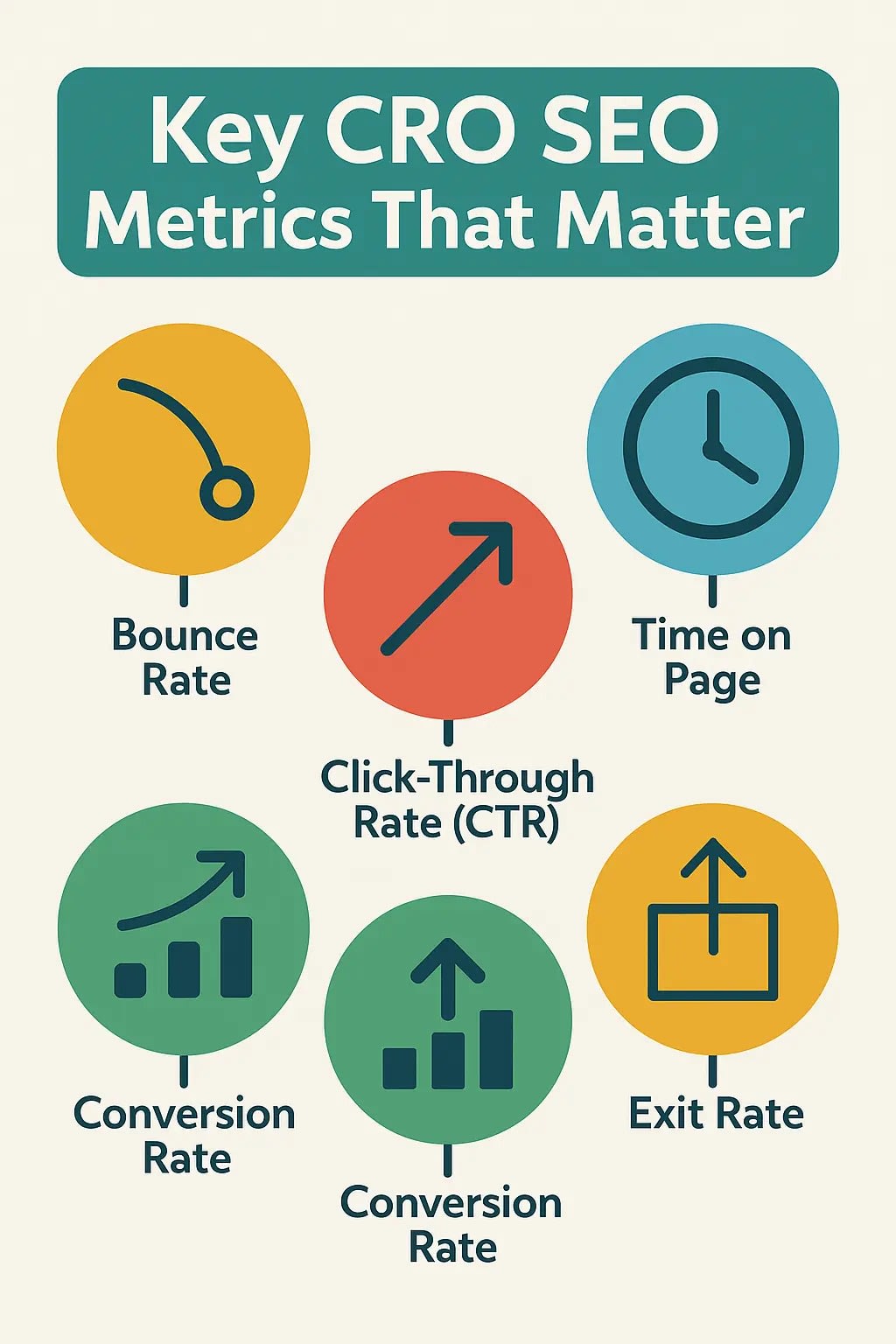
To successfully combine CRO and SEO, you need to measure what actually moves the needle not just what makes your dashboard look good.
While SEO often focuses on keyword rankings and traffic volume, CRO brings in the layer of user behavior and intent.
Here are the core CRO SEO metrics that reveal whether your site is attracting the right visitors and turning them into real business results.
1. Bounce Rate
What it tells you: The percentage of users who land on your site and leave without interacting.
- High bounce rate? Your page might not match search intent, load too slowly, or lack a clear CTA.
- CRO SEO focus: Align content with intent, improve load speed, and guide users toward the next step.
2. Click-Through Rate (CTR)
What it tells you: How often people click your site link in search results.
- Low CTR? Your title or meta description isn’t compelling or relevant.
- CRO SEO focus: Optimize meta tags like you would a headline clear, benefit-driven, and emotionally engaging.
3. Time on Page
What it tells you: How long visitors stay on a page.
- Short duration? The content may not be engaging, scannable, or relevant.
- CRO SEO focus: Use visuals, bullet points, and logical flow to keep attention and guide readers forward.
4. Conversion Rate
What it tells you: The percentage of users who complete a desired action (purchase, sign-up, download, etc.).
- Low conversion rate? There may be friction in your design, unclear CTAs, or weak value propositions.
- CRO SEO focus: A/B test layouts, headlines, and CTAs to optimize for results not just visits.
5. Exit Rate
What it tells you: The percentage of users who leave your site from a specific page.
- High exit rate on key pages? It might signal a dead end in your funnel.
- CRO SEO focus: Add internal links, next-step CTAs, or personalized offers to re-engage users.
Bonus: Use These Metrics Together
These metrics are far more powerful when analyzed in combination. For example:
- A page with high CTR but high bounce rate? Likely a disconnect between search snippet and content.
- High time on page but low conversions? Your CTA might be unclear or too far down.
Tracking these KPIs helps you build a CRO SEO strategy that doesn’t just look good on paper — it performs in the real world.
Check out our recent drop: Outsource Backlink Building for Fast SEO Wins
Real-World Examples of CRO SEO in Action
While the theory behind CRO SEO sounds promising, what really proves its value are real-world results. When brands successfully combine SEO and CRO strategies, they don’t just get more traffic they get more of the right traffic that actually converts.
Here are a few real-world examples that show how CRO SEO, when done right, leads to measurable impact.
Example 1: E-commerce Store Boosts Revenue by 38%
The Challenge:
A mid-sized online clothing retailer was ranking well for competitive keywords like “summer dresses” and “casual wear,” but their sales weren’t growing at the same pace as traffic.
The Fix:
- CRO: Added product filters, clearer CTAs, and customer reviews to product pages.
- SEO: Optimized product descriptions and internal linking to improve relevance and discoverability.
The Result:
- +22% increase in average session duration
- +38% increase in product page conversions
- +15% drop in bounce rate
Lesson: Better UX and targeted content helped convert organic traffic into actual revenue.
Example 2: SaaS Company Reduces Bounce Rate by 30%
The Challenge:
A B2B SaaS company was getting a steady stream of organic traffic to its blog, but most visitors bounced before engaging with the product.
The Fix:
- CRO: Added inline CTAs, exit-intent popups, and an interactive product quiz.
- SEO: Restructured content to better match user search intent and added schema for featured snippets.
The Result:
- 30% drop in blog bounce rate
- 2x increase in free trial sign-ups from blog pages
- 18% increase in organic traffic from long-tail queries
Lesson: Aligning SEO with user behavior turned passive readers into active leads.
Example 3: Education Site Doubles Email Signups
The Challenge:
An online learning platform had strong SEO rankings for educational content but struggled to grow its email list.
The Fix:
- CRO: Embedded lead magnets (checklists, study guides) into high-ranking blog posts.
- SEO: Re-optimized those posts with updated keywords and better internal linking.
The Result:
- 108% increase in email signups
- 20% increase in return visits
- 40% growth in organic leads over 3 months
Lesson: Strategic content upgrades combined with solid SEO drove both engagement and lead generation.
These examples show that when SEO brings in the right traffic and CRO removes friction, the result is real, scalable growth.
Whether you’re an e-commerce brand, a SaaS company, or a content-driven business, merging these strategies can unlock your website’s full potential.
Please take a moment to go through this one too: Why Blog Design Can Make or Break Your Growth in 2025?
How to Start Building CRO SEO Strategy?
Integrating CRO into your SEO isn’t about scrapping what you’ve already built, it’s about enhancing it.
If your site is already attracting organic traffic, then you’ve got the first half of the equation. Now it’s time to optimize that traffic for conversions.
Here’s how to start building a CRO SEO strategy that drives both visibility and results:
Step 1: Map the User Journey
Start by understanding the path visitors take from discovery to conversion.
- Identify top-performing pages by traffic (via Google Analytics/Search Console).
- Track where users are dropping off and which CTAs aren’t working.
- Define clear goals for each page (e.g., email sign-up, product click, contact form submission).
Tool tip: Use heatmaps (Hotjar, Microsoft Clarity) and behavior flow reports in GA4 to visualize drop-off points.
Step 2: Optimize Content for Both Search and Conversion
Your content needs to both rank and convert.
- Use SEO best practices: keyword targeting, optimized headers, internal links.
- Add CRO elements: benefit-driven CTAs, social proof, trust badges, and lead magnets.
- Keep copy clear, skimmable, and aligned with search intent.
Tool tip: Use tools like Surfer SEO or Clearscope for content optimization, and Unbounce or ConvertKit for CTA testing.
Step 3: Improve Page Speed and User Experience
A slow, clunky site kills conversions, no matter how good your SEO is.
- Optimize images, scripts, and hosting for fast loading times.
- Make sure your design is mobile-friendly and ADA-compliant.
- Minimize distractions and keep forms short and focused.
Tool tip: Use PageSpeed Insights, GTmetrix, or Core Web Vitals in Search Console to monitor UX metrics.
Step 4: Set Up A/B Testing
You don’t need to guess what works, you can test it.
- Test headlines, button colors, form placements, CTA wording, etc.
- Prioritize high-traffic pages where small changes can have big impacts.
- Run tests long enough to gather statistically meaningful results.
Tool tip: Use platforms like Google Optimize (free), VWO, or Optimizely.
Step 5: Track the Right Metrics
Regularly monitor both SEO and CRO KPIs to understand what’s working.
Track:
- Organic traffic & rankings
- Bounce rate & time on page
- Click-through rate (CTR)
- Conversion rate & goal completions
Tool tip: Use GA4 + Search Console + CRM tools (like HubSpot or ConvertFlow) to create a full-funnel view.
Step 6: Align Your Teams and Processes
CRO and SEO work best when content, design, development, and marketing teams collaborate.
- Build joint workflows for content and CRO testing
- Share insights between teams
- Make conversion optimization a shared performance metric
You don’t need to overhaul your entire site overnight. Start by optimizing 1–2 high-traffic pages for both search intent and conversion. Once you’ve proven impact, expand the process site-wide.
CRO SEO is a long-term growth engine and every small win compounds over time.
Final Thoughts: CRO SEO as a Long-Term Growth Engine
CRO SEO isn’t just a tactic it’s a mindset shift.
It’s about moving beyond vanity metrics like rankings and traffic, and focusing instead on what actually drives growth: conversions, engagement, and customer action.
When SEO and CRO work together, your site doesn’t just attract visitors it guides them, nurtures them, and converts them.
This isn’t a trend or a temporary hack, it’s the future of performance marketing.
Businesses that adopt a CRO SEO approach create a self-sustaining growth engine:
- SEO brings in consistent, qualified traffic
- CRO ensures that traffic leads to measurable results
- Together, they turn your website into a scalable revenue channel
So whether you’re running a blog, e-commerce store, SaaS platform, or service-based business, integrating CRO into your SEO strategy is one of the smartest, most sustainable moves you can make.
Don’t just rank, convert.
Don’t just grow traffic, grow business.
Deep dive into aligning conversion rate optimization with SEO strategies: Too Good to Be True? Is Vector Marketing Legit?