
Getting quality backlinks is one of the most effective ways to strengthen a website’s authority and improve its search visibility. However, publishing content and waiting for other websites to link to it rarely produces consistent results.
A well-planned backlink outreach strategy gives you a more direct way to connect with relevant website owners, editors, bloggers, and content managers who may be willing to reference your content.
Backlink outreach is not about sending the same email to hundreds of websites and hoping someone responds. The strongest campaigns start with relevant prospects, offer genuine value, and explain clearly why linking to your content makes sense for their audience.
In this guide, I’ll explain how to build a backlink outreach strategy from the ground up. You’ll learn how to find relevant link prospects, qualify websites, identify the right contacts, write effective outreach emails, follow up without becoming spammy, and measure your results.
The goal is simple: build a repeatable outreach process that helps you earn relevant backlinks instead of relying on random link opportunities.
What Is Backlink Outreach?
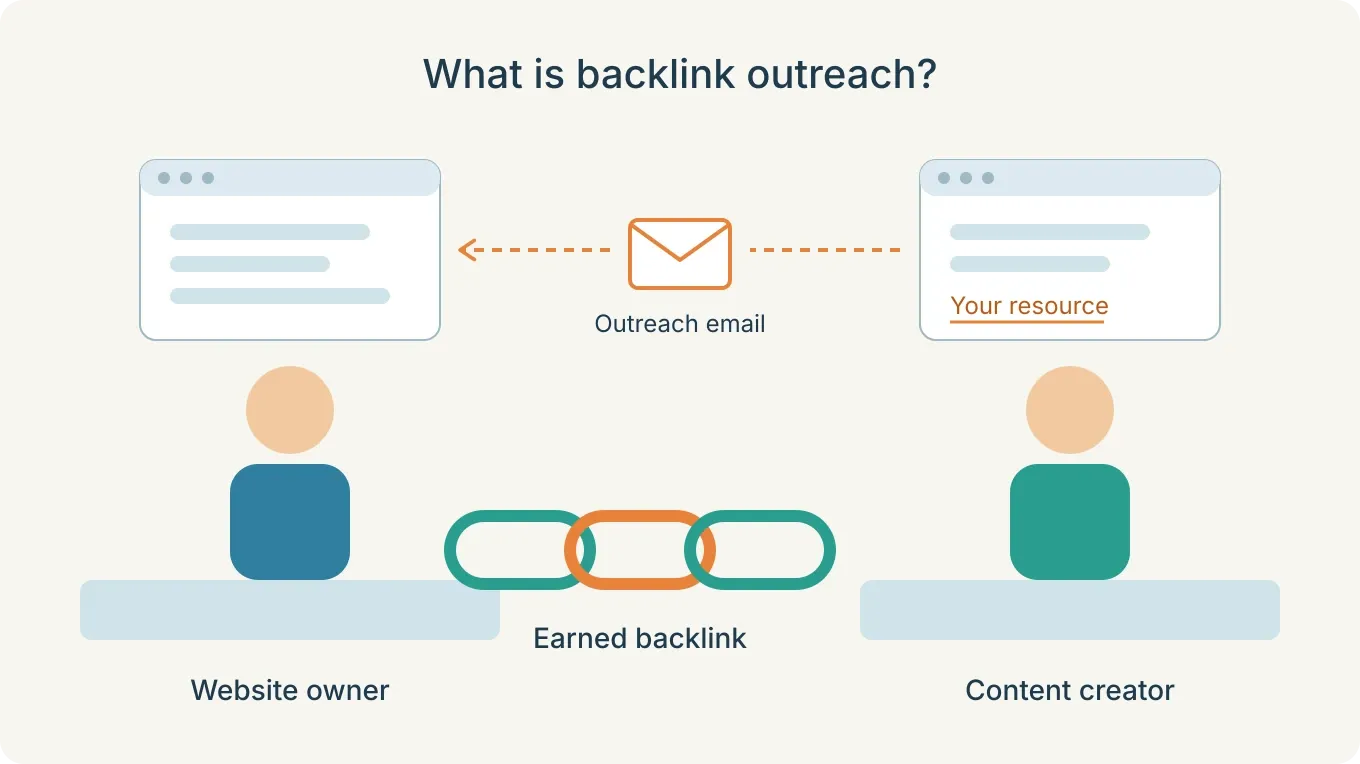
Backlink outreach is the process of contacting relevant website owners, editors, bloggers, and content managers to earn backlinks to your website.
Instead of waiting for other websites to discover your content, you proactively identify potential link opportunities and explain why your page would be useful to their audience.
The process is straightforward. You find websites relevant to your industry, identify pages where your content could add value, find the appropriate contact person, and send a personalized outreach message. If the website sees a genuine reason to reference your resource, you may earn a backlink.
The quality of the prospect matters as much as the quality of your email. A backlink from a website closely related to your topic can be more valuable than several unrelated links. That is why effective outreach focuses on relevance instead of simply increasing backlink volume.
Backlink Outreach vs. Guest Post Outreach
Guest post outreach is one type of backlink outreach. It involves contacting websites that accept contributed content and pitching an article that you can write for their audience.
General backlink outreach is broader. You can use it to promote existing articles, original research, tools, statistics, guides, or other useful resources that another website may want to reference.
Link Insertion Outreach
Link insertion outreach involves finding an existing article or resource where your page would be a relevant addition.
You contact the website owner or editor and suggest your resource as a useful reference. This works best when your page genuinely improves the existing content.
Broken Link Outreach
Broken link outreach involves finding links on relevant websites that lead to unavailable or outdated pages.
If you have a suitable resource that can replace the broken destination, you can contact the website and suggest your page as an alternative.
The value comes from solving a real problem for the website owner. Instead of simply asking for a backlink, you are pointing out an issue and offering a relevant replacement.
Digital PR Outreach
Digital PR outreach focuses on earning links by promoting newsworthy information, original research, expert insights, data, or other content that publishers may want to reference.
For example, if you publish original research about SEO trends, industry websites may cite your findings in their own articles. This can generate backlinks and referral traffic.
The common thread across these methods is relevance. A successful backlink outreach strategy starts with the question, "Which websites could genuinely benefit from this resource?"
How to Build a Backlink Outreach Strategy
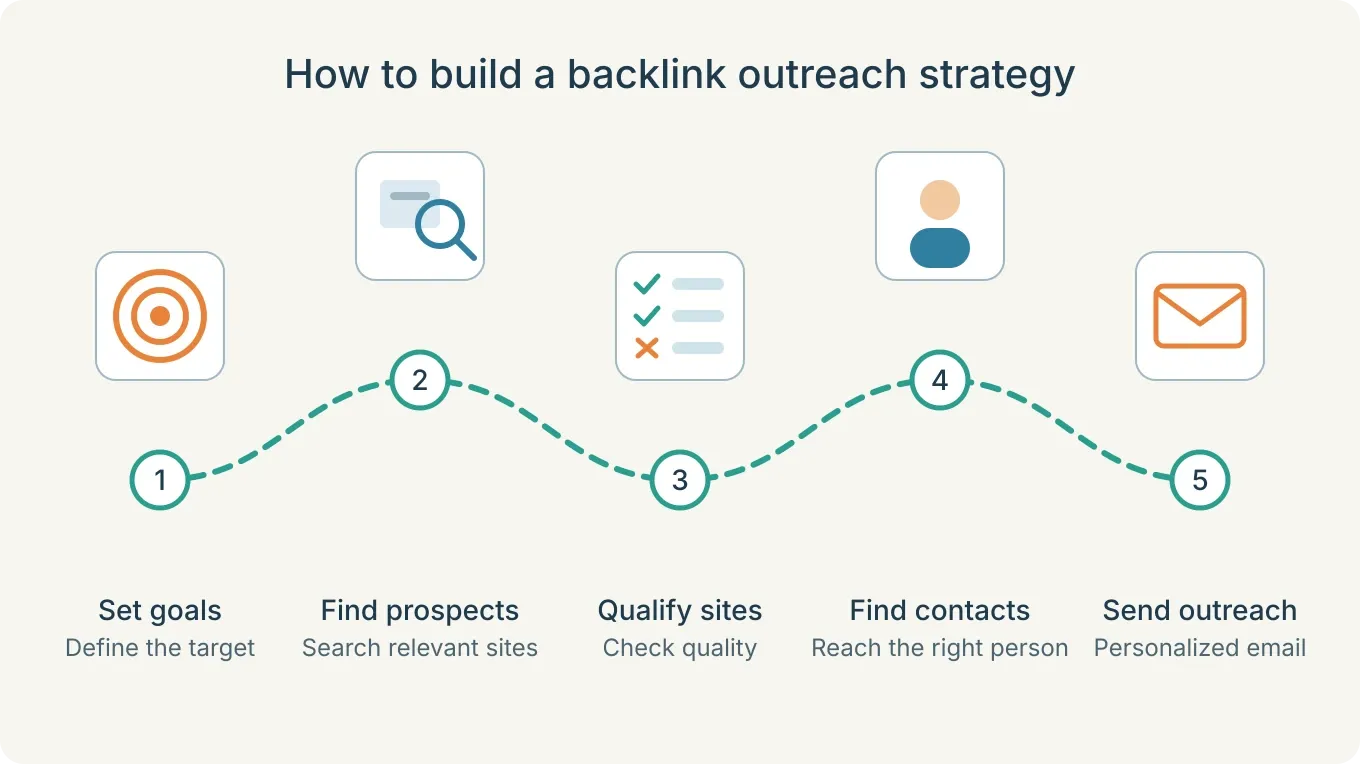
A successful backlink outreach strategy starts with a clear process. Before sending a single email, you need to know which pages you want to promote, which websites are worth contacting, and why those websites would have a reason to link to your content.
The goal is not to build the largest prospect list possible. The goal is to build a list of relevant websites where your content has a realistic chance of earning a link.
1. Define Your Link Building Goals
Start by deciding what you want your outreach campaign to accomplish.
You might want to increase referring domains, strengthen the authority of a specific page, improve rankings for a target keyword, promote a new piece of content, or build relationships with websites in your industry.
Your goal should influence the type of outreach you use.
For example, if you want to promote a detailed SEO guide, you could look for existing articles discussing the same topic and identify places where your guide could provide additional value.
If you have published original research, your campaign could focus on journalists, bloggers, and industry websites that regularly cite data.
Having a specific goal also makes it easier to measure whether your outreach is working.
2. Find Relevant Link Prospects
Once you know what you want to promote, start finding websites that could realistically link to it.
Look for websites that publish content related to your industry, serve a similar audience, or regularly reference resources from other businesses and publishers.
For an SEO website, relevant prospects could include SEO blogs, marketing publications, SaaS websites, agencies, industry resources, and websites that publish educational content about search marketing.
Relevance should be your first filter. A website does not become a good prospect simply because it has a high domain rating or a large number of backlinks.
A relevant website with an appropriate audience can be a stronger prospect than a high-authority website that has nothing to do with your topic.
3. Qualify Your Prospects
Finding a website is only the beginning. You also need to determine whether it is worth contacting.
Look at topical relevance, content quality, organic visibility, audience, existing outbound links, and overall credibility.
You should also check whether the website appears to accept the type of content or link placement you are proposing.
Avoid building a campaign around websites that exist primarily to sell links or publish large amounts of unrelated content.
The strongest prospect lists usually contain fewer websites, but each prospect has a clear reason for being included.
4. Find the Right Contact
After qualifying a website, identify the person most likely to handle your request.
Depending on the website, this could be the founder, editor, content manager, marketing manager, or website owner.
Using the right contact improves the chance that your message reaches someone who can actually evaluate your proposal.
Sending a detailed content pitch to a generic support address, for example, may not produce the response you want.
Take a few minutes to understand who manages the website and what type of content they publish. That information can also help you personalize your outreach message.
5. Create a Personalized Outreach Email
Your outreach email should explain three things quickly: why you are contacting the person, what you are offering, and why it could benefit their website or audience.
Avoid writing an email that focuses entirely on what you want.
Instead of saying, "Please give me a backlink to my website," explain how your resource could improve an existing article, provide additional information for readers, replace an outdated reference, or support a topic the website already covers.
Keep the message concise. Website owners and editors receive plenty of outreach emails, so a clear and relevant message has a better chance of being read.
Personalization should go beyond adding the recipient's first name. Mention a specific article, resource, or opportunity that demonstrates you have actually reviewed the website.
Backlink Outreach Email Templates
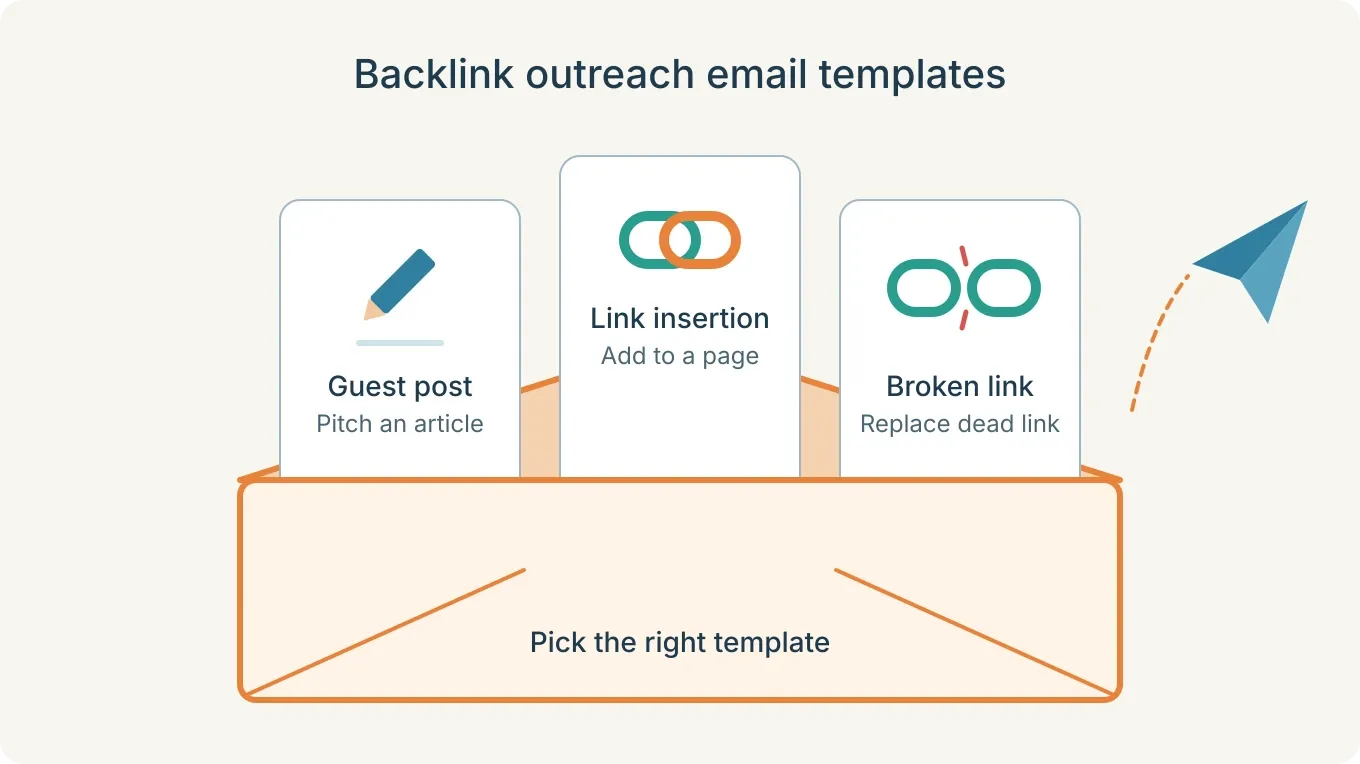
A good backlink outreach email should be short, relevant, and easy to understand. The recipient should know why you contacted them, what resource you are referring to, and what you are asking them to consider.
Avoid turning the email into a sales pitch. The purpose is to start a relevant conversation and show that your resource could genuinely improve their existing content.
Guest Post Outreach Template
Guest post outreach works best when you research the website before contacting the editor.
Subject: Content idea for your blog
Hi [Name],
I was reading your content on [specific topic] and noticed that you cover [related subject] in detail.
I have an idea for an article that could fit your audience: "[Proposed Article Title]." The article would cover [brief description of the angle] and provide practical information that complements your existing content.
If you are open to guest contributions, I’d be happy to put together an original article for your review.
Best,
Shahid
The important part is personalization. Mentioning a specific article or topic shows that you have reviewed the website rather than adding the recipient to a mass email campaign.
Link Insertion Outreach Template
Link insertion outreach is appropriate when you already have a useful resource that fits naturally into an existing article.
Subject: Useful resource for your article
Hi [Name],
I came across your article on [topic] and found the section about [specific section] particularly useful.
I recently published a resource covering [topic/resource]. It provides [specific value or information] and may be useful as an additional reference for readers.
If you think it fits the article, here is the resource: [URL]
Either way, thanks for putting together such a useful guide.
Best,
Shahid
The key is to explain why the resource belongs on the page. Avoid asking for a backlink without establishing a clear connection between your content and the article.
Broken Link Outreach Template
Subject: Broken link on your [topic] page
Hi [Name],
I was reading your page about [topic] and noticed that the link to [resource/page] appears to be broken.
I have a similar resource that covers [brief description of your resource] and could work as an alternative for your readers.
You can find it here: [URL]
I thought I’d point it out in case you want to update the page.
Best,
Shahid
Do not use broken link outreach simply as an excuse to promote an unrelated page. The replacement resource should genuinely serve the same purpose as the unavailable link.
How to Improve Your Backlink Outreach Response Rate
Getting replies is one of the biggest challenges in backlink outreach. You can have a strong resource and a well-researched prospect list, but poor outreach messaging can still result in very few responses.
The solution is not simply sending more emails. A better approach is to improve the quality and relevance of every message you send.
Personalize the Outreach
Personalization should go beyond using the recipient's first name.
Mention a specific article, resource, statistic, or topic from their website. Show that you understand what they publish and why your resource is relevant to their audience.
This makes the message feel like a genuine recommendation rather than a bulk outreach email.
Keep Your Emails Short
Most outreach emails do not need several paragraphs explaining your company, website, or SEO strategy.
Get to the point quickly. Explain what you found, why you are contacting the person, and what you would like them to consider.
Focus on the Value of the Link
Do not make the entire email about what you want.
Explain what the website owner or their readers gain from adding your resource.
Your page might provide original data, a useful example, additional context, a better explanation, or information missing from the existing article.
The stronger the value proposition, the easier it is for the recipient to justify adding your link.
Use Relevant Subject Lines
Your subject line should make the purpose of the email clear without sounding promotional.
Examples include:
"Resource for your SEO guide"
"Possible addition to your article"
"Broken link on your SEO page"
Avoid exaggerated claims, clickbait, and vague subject lines.
Follow Up Without Becoming Spammy
A single unanswered email does not necessarily mean the prospect is not interested. People miss emails, become busy, or intend to respond later and forget.
A short follow-up can give your original message another chance.
For example:
"Hi [Name], just following up on my message below. Would this resource be useful for your article on [topic]?"
If there is still no response, move on.
How Many Follow-Ups Should You Send?
One or two follow-ups are a reasonable starting point for most backlink outreach campaigns.
The purpose of a follow-up is to bring your original email back to the recipient's attention, not to pressure them into accepting your request.
A simple sequence could look like this:
First, send your personalized outreach message.
Second, wait several days and send a short reminder.
Third, if appropriate, send one final message after another few days.
After that, move on to the next prospect.
Keep Follow-Ups Short
There is no need to rewrite your entire pitch in every follow-up.
A simple message is usually enough:
"Hi [Name], just following up on my message below about [resource/topic]. Would this be a useful addition to your article on [topic]?"
Know When to Stop
Not every prospect will respond, and that is normal.
If someone does not reply after your initial message and follow-ups, treat the prospect as inactive and focus your time elsewhere.
If someone clearly asks you not to contact them again, respect that request.
A good backlink outreach strategy is built around relevance and relationships. The goal is to find websites that genuinely want your resource, not to convince every prospect to give you a backlink.
Common Backlink Outreach Mistakes
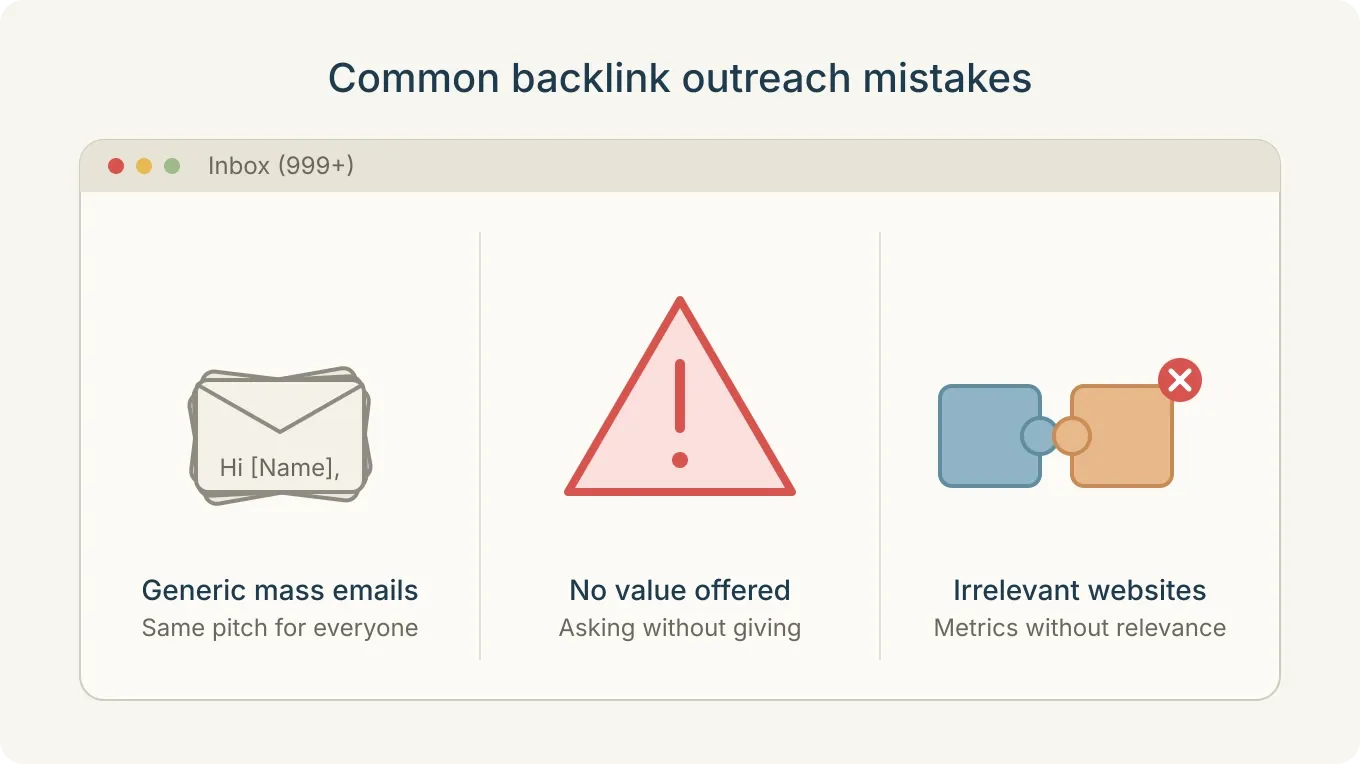
A backlink outreach campaign can fail even when you have good content and a solid prospect list. In many cases, the problem comes from the way the outreach is planned or executed.
Sending Generic Outreach Emails
Sending the same email to every prospect makes it obvious that the recipient is part of a mass campaign.
A strong template can still be used, but relevant details should be customized for each website.
Targeting Irrelevant Websites
A website can have strong metrics and still be a poor backlink prospect.
Your prospects should have a logical connection to your topic, industry, audience, or resource.
Relevance should come before the number of potential links.
Asking for a Backlink Without Providing Value
Website owners are not obligated to link to your content. You need to give them a reason to consider it.
Your resource might provide original research, a useful example, additional context, updated information, or a better explanation of something already covered.
Promoting Weak Content
Outreach cannot compensate for poor content.
If you are asking websites to reference an article that offers little information or does not provide anything useful, your campaign will struggle.
Before starting outreach, review the page you want to promote and make sure it genuinely deserves attention.
Failing to Personalize the Pitch
Adding a person's name to an email is not meaningful personalization by itself.
A stronger approach is to explain why you selected that particular website. Reference an article they published, a relevant section, or a broken link that your page can replace.
Overpromising or Using Manipulative Tactics
Avoid exaggerated claims, misleading subject lines, and promises you cannot deliver.
Keep your pitch factual. Explain what the resource contains and why it could be useful.
Giving Up After One Email
Silence does not always mean rejection. A reasonable follow-up can bring your message back to the recipient's attention.
At the same time, follow-ups should have limits. If a prospect does not respond after your initial message and a small number of follow-ups, move on.
Focusing on Quantity Instead of Quality
Sending thousands of emails does not automatically create a successful backlink outreach campaign.
A smaller list of highly relevant prospects can produce better results than a huge database of websites with little connection to your content.
How to Track Your Backlink Outreach Campaign
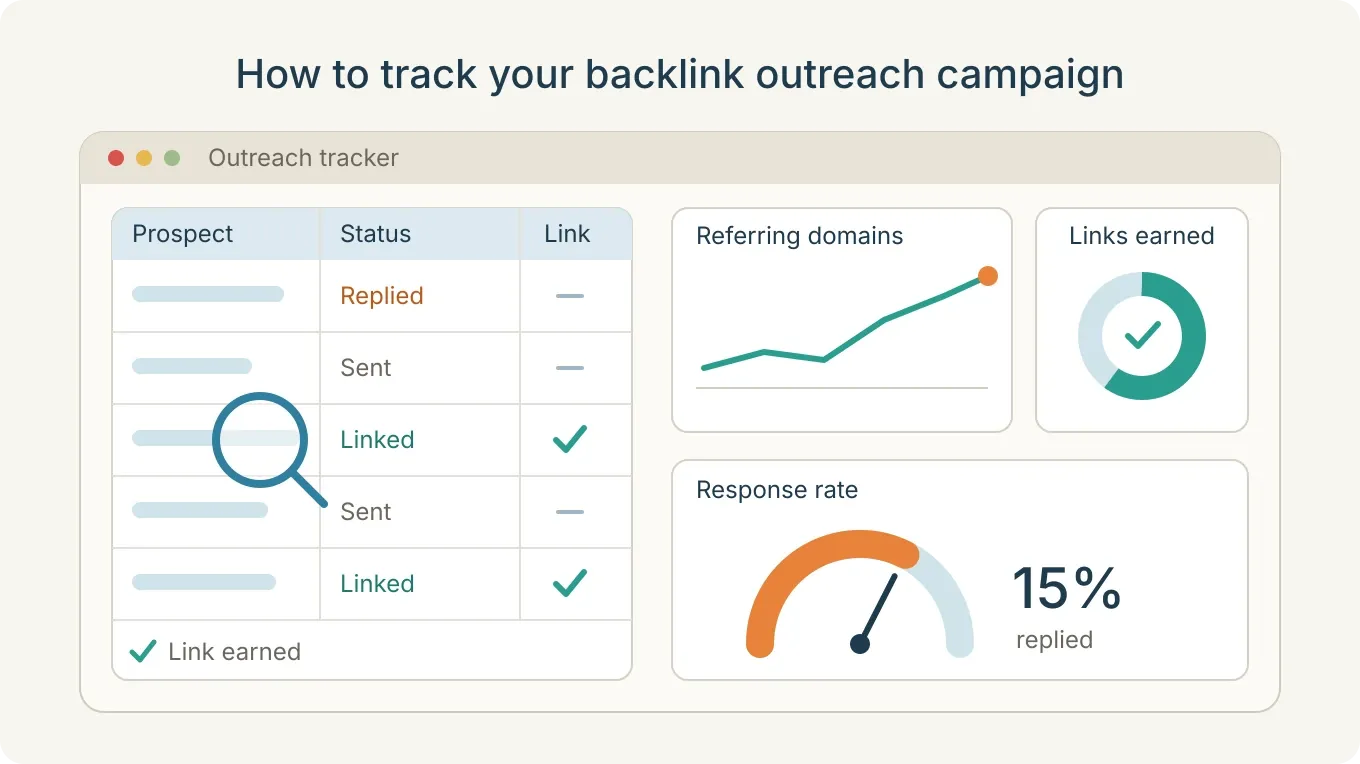
A backlink outreach campaign should be measured like any other SEO activity. Without tracking, it is difficult to know which prospects, outreach messages, and link building methods are producing results.
A simple spreadsheet can be enough for a small or medium-sized campaign.
Track Your Outreach Prospects
Record the website name, target URL, contact person, contact email, outreach method, date contacted, follow-up date, response status, and final outcome.
This prevents duplicate outreach and gives you a clear view of where every prospect stands.
Measure Your Response Rate
Your response rate shows how many people replied compared with the number of emails you sent.
For example, if you contact 100 relevant prospects and receive 15 replies, your response rate is 15 percent.
A low response rate can indicate problems with your prospect selection, subject line, personalization, offer, or outreach email.
Track Positive Responses
Not every response is equally valuable.
Track positive responses separately so you can understand how often your outreach creates genuine link opportunities.
Measure Links Earned
Track the target page, referring website, date the link was acquired, and the page where the backlink was placed.
You can then compare results across different outreach methods.
Track Referring Domains
The number of unique websites linking to your domain is another useful metric.
Ten links from one website are not equivalent to ten links from ten different relevant websites. Tracking referring domains helps you understand whether your campaign is expanding the range of websites that reference your content.
Review Results and Improve the Process
If a campaign generates very few replies, review the prospect list and outreach message.
If you receive plenty of replies but few links, look at the quality of your content or the offer you are making.
Over time, this creates a repeatable system. You can identify the types of websites that respond well, the content that attracts links, and the outreach approaches that consistently produce results.
Final Thoughts
A successful backlink outreach strategy is built on relevance, useful content, and consistent execution.
You do not need to contact thousands of websites to build a strong backlink profile. You need to identify the right prospects and give them a genuine reason to reference your content.
Start by defining your link building goals. Then find websites that are relevant to your topic, qualify those prospects, identify the right contacts, and create personalized outreach messages.
Your follow-up process matters too. Give prospects enough time to respond, send a limited number of useful follow-ups, and move on when there is no interest.
Most importantly, track the results of your campaigns. Monitor response rates, positive conversations, backlinks earned, and referring domains. Use that information to identify what works and improve your next campaign.
Backlink outreach becomes more effective when you treat it as an ongoing process rather than a one-time campaign. Build useful resources, develop relationships with relevant publishers, and refine your approach based on real results.
If you want help developing a backlink outreach strategy for your website, contact Shahid Shahmiri to discuss your SEO and link building goals.
Frequently Asked Questions
What is a backlink outreach strategy?
A backlink outreach strategy is a structured process for finding relevant websites and contacting their owners, editors, or content managers to earn backlinks. It typically involves prospect research, qualification, personalized outreach, follow-ups, and performance tracking.
How do I find websites for backlink outreach?
Start by searching for websites that publish content related to your industry, topic, or target audience. Look for relevant articles, resource pages, industry publications, blogs, and other websites where your content could provide genuine value.
The strongest prospects are not necessarily websites with the highest authority metrics. Relevance, content quality, audience fit, and the likelihood of a natural link are also important.
How do I write a backlink outreach email?
Keep your email short and personalized. Explain why you selected the website, identify the relevant resource or article, explain how your content could help their readers, and make your request clear.
Avoid generic messages that could have been sent to hundreds of websites.
How many follow-ups should I send for backlink outreach?
One or two follow-ups are a reasonable starting point for most campaigns. Give the recipient enough time to respond between messages and keep each follow-up concise.
If there is still no response after your follow-ups, move on to another prospect rather than repeatedly contacting the same person.
Does backlink outreach still work for SEO?
Yes, backlink outreach can be an effective way to earn relevant backlinks when it is based on useful content and genuine website relevance.
The quality of the prospect and the value of the resource matter more than sending a large number of outreach emails.
What makes a backlink outreach campaign successful?
A strong campaign combines relevant prospects, useful content, personalized outreach, reasonable follow-ups, and consistent tracking.
The goal should not be to obtain as many backlinks as possible. The goal is to earn relevant links from websites where your content genuinely adds value.
Read this article in: