
Finding the right SEO keyword is not always about choosing the broadest phrase with the highest search volume. A broad keyword can attract a large audience, but it may not tell you exactly what the searcher wants. This is where keyword modifiers become useful.
Keyword modifiers are words or phrases added to a core keyword to make the search term more specific. They can narrow the topic, clarify search intent, identify a particular audience, or indicate what a person is looking for.
For example, instead of targeting only “SEO services,” you could work with variations such as “local SEO services,” “affordable SEO services,” or “SEO services for small businesses.”
The core keyword stays the same, but the added words provide additional context.
This gives you more ways to understand what people are searching for and build content around specific search needs. Keyword modifiers can also help you discover long-tail keyword opportunities that may be more focused than a broad search term.
In this guide, I’ll explain what keyword modifiers are, the different types you can use, how to find them, how to apply them to SEO, and the mistakes to avoid when using them.
What Are Keyword Modifiers in SEO?
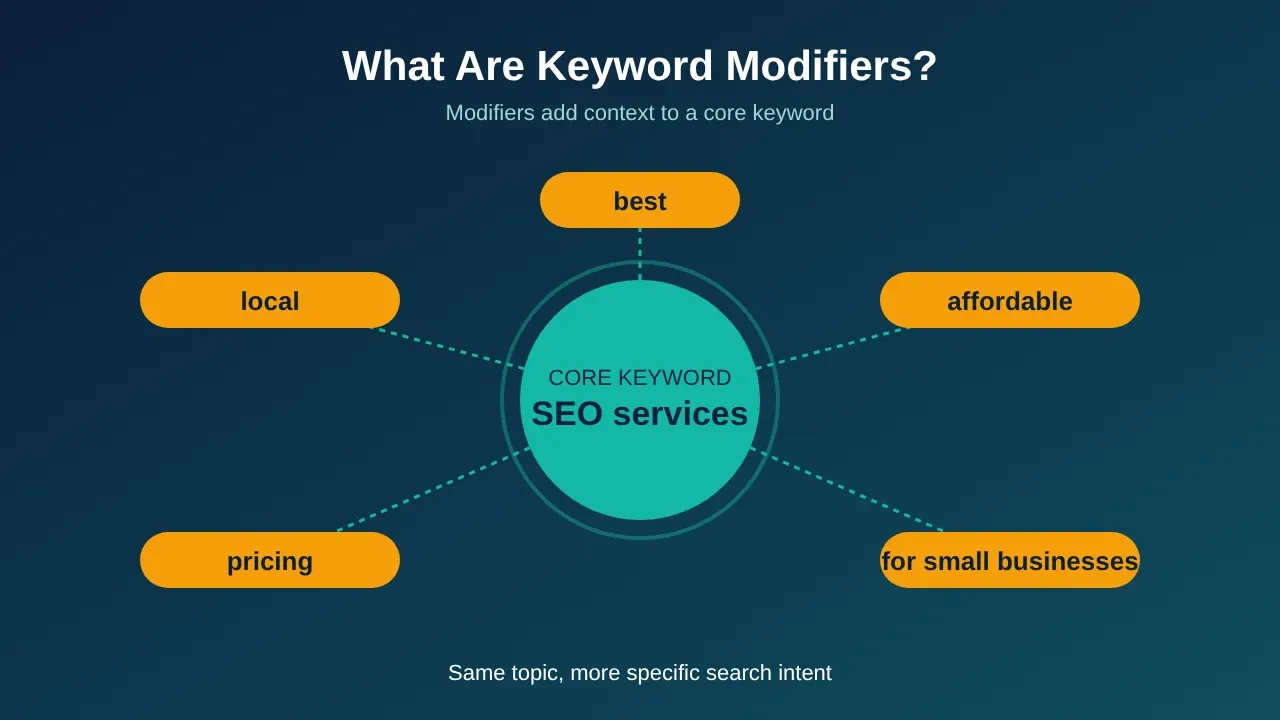
Keyword modifiers are words or phrases added to a core keyword to make it more specific. The core keyword represents the main topic, while the modifier adds context that helps define what the searcher is actually looking for.
For example, consider the keyword “SEO services.” On its own, the phrase is broad. Adding different modifiers creates more specific searches:
SEO services
affordable SEO services
local SEO services
SEO services for small businesses
SEO services pricing
The core keyword remains “SEO services,” while the added words change the focus of each search.
This distinction matters because different modifiers can reflect different types of search intent. Someone searching for “SEO services” may still be researching their options. Someone searching for “SEO services pricing” is looking for cost information, while someone searching for “local SEO services” has narrowed the search to a particular type of service.
Base Keywords vs. Modified Keywords
A base keyword is the primary phrase you start with when researching a topic. It is usually broader and can have several possible interpretations.
A modified keyword takes that base phrase and adds words that provide additional context.
For example:
Base keyword: SEO agency
Modified keywords:
best SEO agencySEO agency for small businesseslocal SEO agencyaffordable SEO agencySEO agency in Dubai
Each variation keeps the original topic but introduces a different requirement or intent.
The purpose of using keyword modifiers is not to create as many keyword variations as possible. The goal is to identify meaningful variations that represent distinct searches and useful content opportunities.
When researching keywords, I therefore look beyond the main phrase and examine the words people add to it. Those additional terms can reveal more specific topics, audiences, locations, questions, and commercial needs that a broad keyword may hide.
Types of Keyword Modifiers
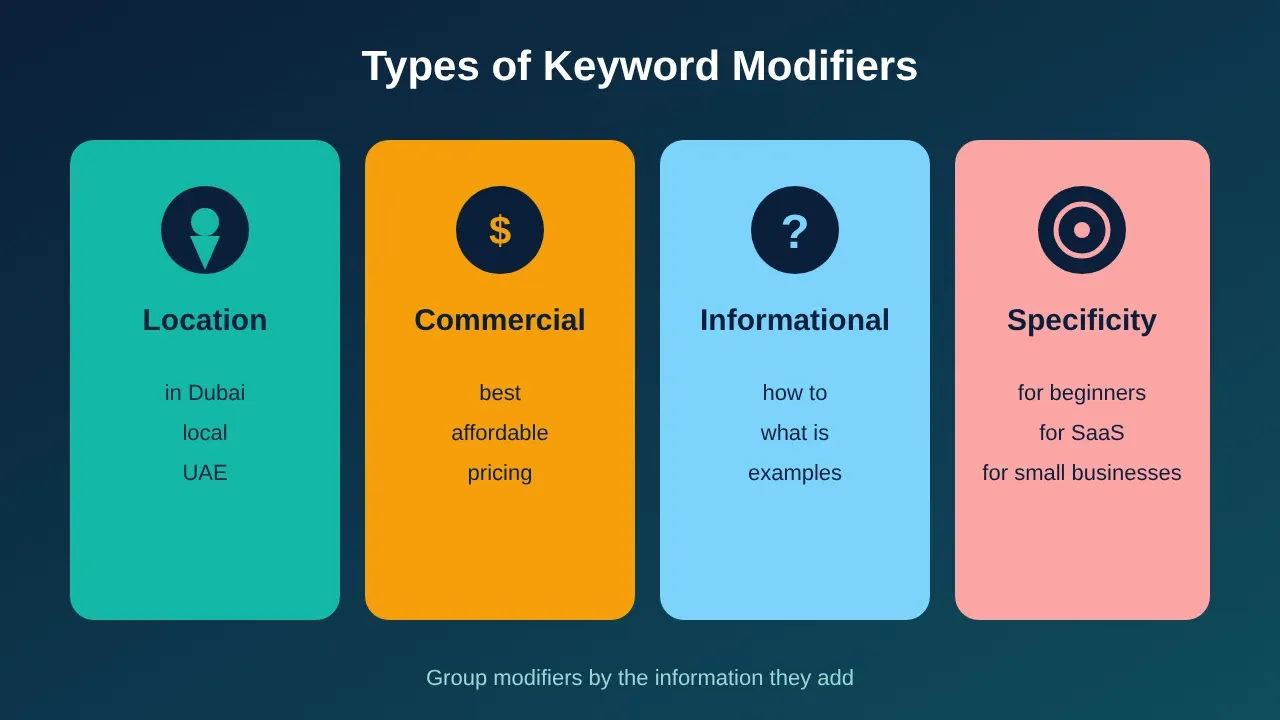
Keyword modifiers can be grouped by the type of information they add to the core keyword. Understanding these categories makes keyword research more structured because you can look for modifiers based on intent, audience, location, or specificity.
Location-Based Modifiers
Location-based modifiers add a geographic element to a keyword. They are especially useful when the searcher is looking for a business, service, or resource in a particular area.
For example:
Base keyword: SEO agency
Modified keywords:
SEO agency in DubaiSEO agency in Abu Dhabilocal SEO agencySEO company UAE
The location modifier changes the scope of the search. Instead of looking for an SEO agency anywhere, the searcher is identifying providers in a specific market.
Commercial Modifiers
Commercial modifiers can indicate that someone is comparing options, evaluating a service, or showing interest in making a purchase or hiring decision.
Examples include:
best SEO agencyaffordable SEO agencySEO agency pricingSEO services packagesSEO consultant
For example, someone searching for “SEO agency” is using a broad term. Someone searching for “best SEO agency for small business” has provided much more information about what they want.
Informational Modifiers
Informational modifiers are commonly used when the searcher wants to learn something, solve a problem, or understand a topic.
Examples include:
how to do keyword researchwhat are keyword modifierskeyword modifier exampleskeyword research tipshow to find SEO keywords
These modifiers can help identify article topics, guides, tutorials, and FAQ opportunities.
Specificity Modifiers
Some modifiers narrow a keyword by adding information about the audience, industry, service, product, or use case.
For example:
SEO for SaaS companiesSEO for small businessestechnical SEO for ecommercekeyword research for beginnerslocal SEO for dentists
The more specific version can represent a different search need from the broader keyword. This is why I would not treat every keyword variation as a simple synonym. The modifier can change the audience, purpose, and content required to satisfy the search.
How to Find Keyword Modifiers
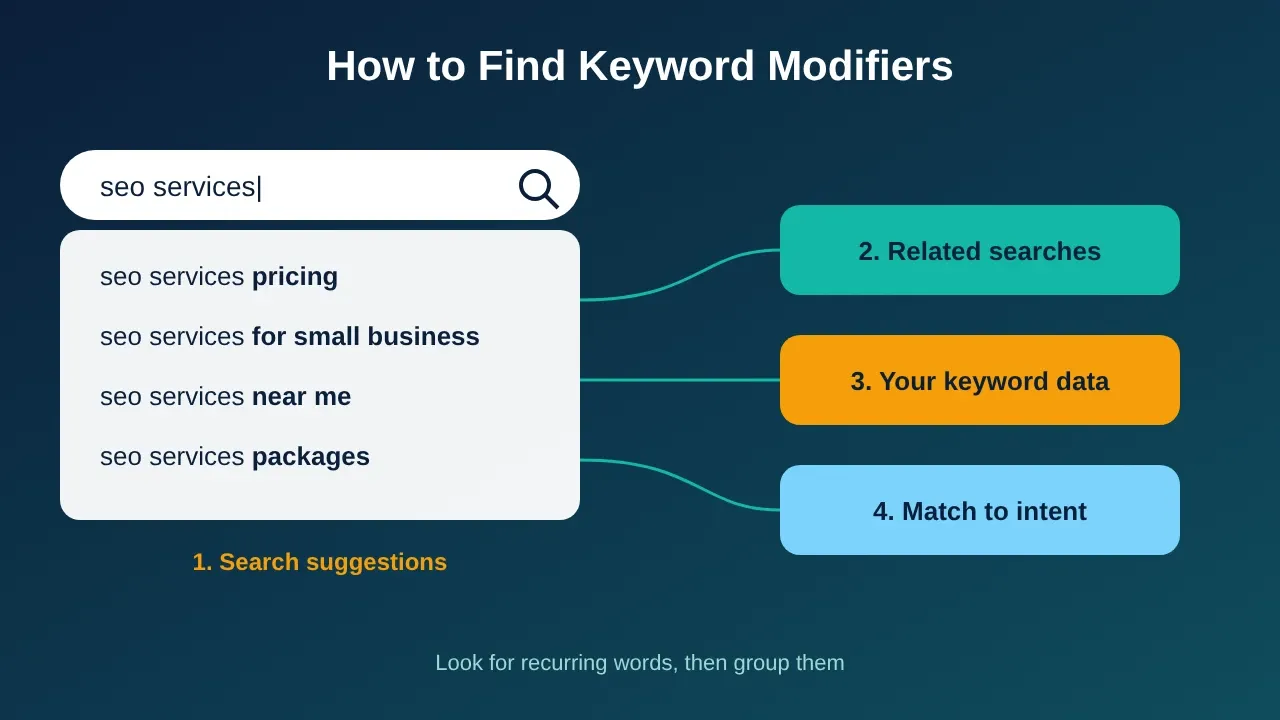
Finding keyword modifiers starts with your existing keyword list. Instead of researching every keyword from scratch, look at the core terms and identify the words people add to make those searches more specific.
A practical starting point is to take one broad keyword and expand it into variations based on intent, location, audience, service, and questions.
For example, if the core keyword is:
SEO services
You can investigate variations such as:
local SEO servicesaffordable SEO servicesSEO services for small businessesSEO services pricinghow to choose SEO services
Each variation adds a different type of information to the original keyword. These variations can then be evaluated to determine whether they represent a useful topic or search opportunity.
Use Search Suggestions
Google's search suggestions can help you identify modifiers that people commonly add to a search. Start typing your core keyword and examine the suggestions that appear.
For example, entering keyword research may surface variations around tools, processes, costs, guides, or specific audiences. These additions can become potential modifiers for further keyword research.
Look at Related Searches
Related searches can provide another source of keyword variations. They can show how users refine or expand their original query.
Rather than copying every variation, look for recurring words and phrases. If the same type of modifier appears across several related searches, it may indicate a useful direction for your content research.
Analyze Your Existing Keyword Data
Your own keyword data can also reveal modifiers worth targeting. Look for recurring terms that appear alongside your main keywords.
For example, modifiers related to location, pricing, services, tools, examples, guides, or specific industries can reveal groups of related searches.
The key is to organize these variations instead of treating them as one large keyword list. Grouping similar modifiers makes it easier to decide which terms belong on the same page and which deserve separate content.
Match the Modifier to Search Intent
Not every keyword variation deserves its own page. Before creating content, check what the modifier actually changes about the search.
A modifier such as “pricing” suggests a different need from “how to.” A modifier such as “for small businesses” identifies a different audience from a general keyword.
The modifier should therefore help you understand the searcher's need, not simply give you another keyword to insert into an article.
How to Use Keyword Modifiers for SEO
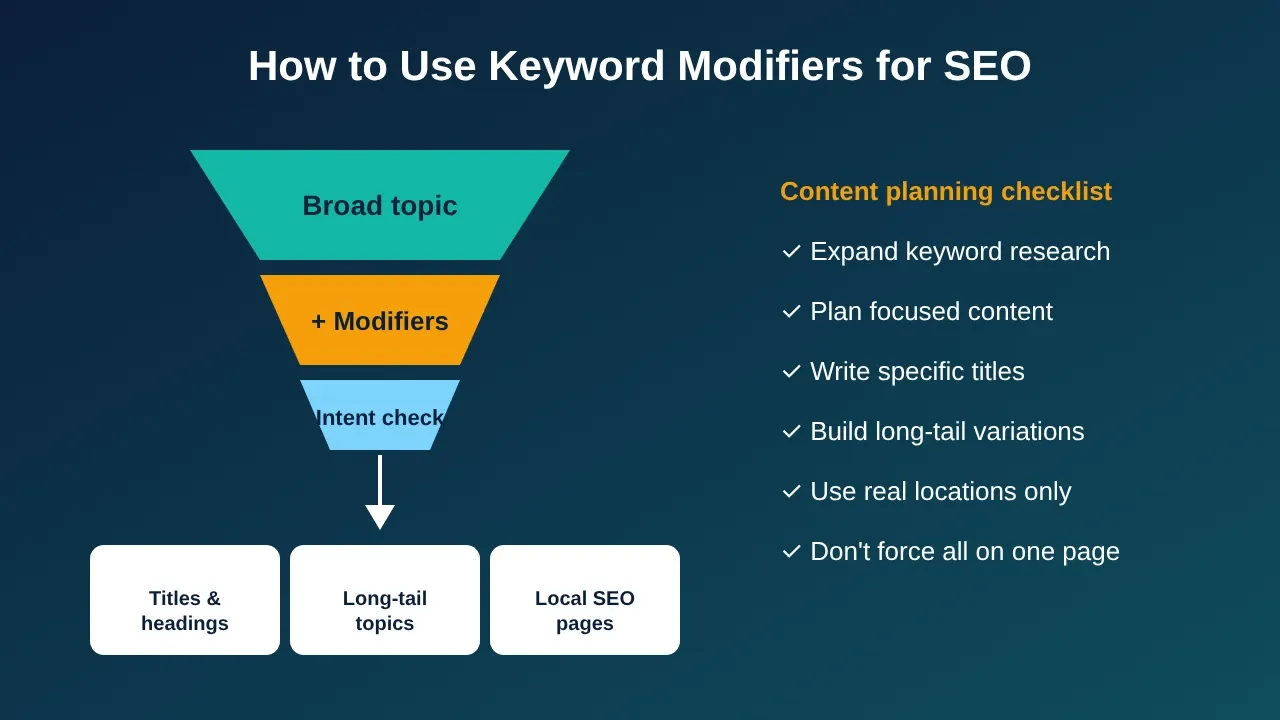
Finding keyword modifiers is only the first step. The next step is deciding where those modifiers belong in your SEO strategy. A useful modifier should help you create content that matches a specific search need, rather than simply giving you another variation to repeat throughout a page.
Use Keyword Modifiers to Expand Keyword Research
Start with a broad keyword and identify the different ways a searcher might make that query more specific.
For example:
Base keyword: SEO audit
Modified keywords:
technical SEO auditSEO audit for small businessesSEO audit checklistSEO audit toolsfree SEO audit
These variations can reveal different topics and search intentions. Some may work well as supporting keywords on one page, while others may be specific enough to justify separate content.
Use Modifiers in Content Planning
Keyword modifiers can help you move from a broad topic to more focused content ideas.
Suppose your main topic is keyword research. Adding different modifiers can produce topics such as:
keyword research for beginnerskeyword research toolskeyword research checklistkeyword research for local SEOkeyword research examples
Instead of publishing several pages that cover essentially the same topic, examine the intent behind each modifier first. If two variations require substantially different answers, separate content may make sense. If they can be answered comprehensively on the same page, they can often be handled together.
Use Modifiers in Titles and Headings
A relevant modifier can make a title or heading more specific and aligned with the topic being covered.
For example, instead of a general title such as:
Keyword Research Guide
you could use:
Keyword Research for Beginners: A Practical Guide
The modifier “for beginners” immediately establishes the intended audience.
The same principle applies to headings. If a section focuses specifically on local search, a heading such as “How to Find Keywords for Local SEO” gives the section a clear purpose.
The modifier should always match the actual content. Adding a keyword variation simply for SEO does not make a page more useful.
Use Modifiers for Long-Tail Keywords
Keyword modifiers are particularly useful when building long-tail keyword variations. A long-tail query usually contains more specific wording than the broader topic.
For example:
SEO
can become:
SEO for SaaS companies
and then:
SEO for early-stage SaaS companies
Each additional modifier narrows the subject.
This can help you identify specific content opportunities that would be hidden if you only researched broad keywords.
Use Modifiers for Local SEO
Location modifiers are useful when your target audience searches for services or businesses in a particular geographic area.
For example:
SEO consultant
can become:
SEO consultant in Dubai
or:
local SEO consultant
The modifier gives the keyword additional geographic or local intent.
For local SEO, the important point is to use genuine location and service relevance. Creating pages for locations that you do not actually serve can result in thin or repetitive content.
Avoid Forcing Every Modifier Into One Page
A common mistake is trying to target every keyword variation on a single page.
The goal is not to include as many modifiers as possible. The goal is to identify which variations represent meaningful search needs and then map them to the most appropriate content.
If several modifiers share the same intent, they may belong together. If they represent different audiences or questions, separate pages may provide a better experience.
Keyword modifiers are most useful when they help you understand what the searcher wants, not when they are treated as words that must appear a certain number of times.
Keyword Modifier Examples
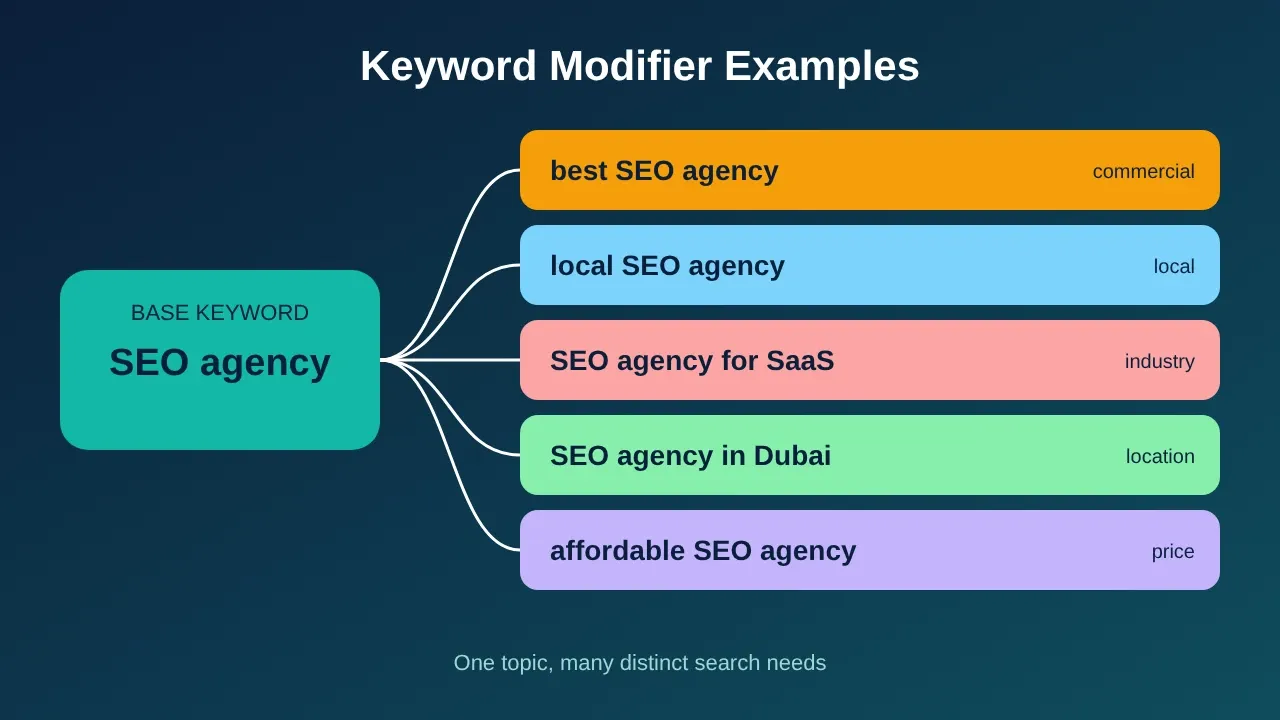
Keyword modifiers become easier to understand when you see how a broad keyword can be narrowed into more specific searches. The examples below show how different modifiers can change the focus of a keyword while keeping the original topic intact.
Example 1: SEO Services
Base keyword: SEO services
Possible modified keywords include:
local SEO servicesaffordable SEO servicesSEO services for small businessesSEO services pricing
Each modifier adds a different layer of intent. “Local” introduces geographic intent, “affordable” introduces a pricing consideration, “for small businesses” defines the audience, and “pricing” indicates that the searcher wants cost information.
Example 2: Keyword Research
Base keyword: keyword research
Possible variations include:
keyword research toolskeyword research for beginnerskeyword research exampleskeyword research checklist
Here, the modifiers identify what the searcher wants from the topic. One person may be looking for software, another may need beginner guidance, while another may want practical examples or a process they can follow.
Example 3: SEO Audit
Base keyword: SEO audit
Possible variations include:
technical SEO auditSEO audit checklistSEO audit toolsSEO audit for small businesses
The modifier changes the scope of the topic. A technical SEO audit focuses on technical issues, while an SEO audit checklist focuses on the process or items that should be reviewed.
Example 4: SEO Agency
Base keyword: SEO agency
Possible variations include:
best SEO agencylocal SEO agencySEO agency for SaaSSEO agency in Dubai
These modifiers provide information about the searcher's expectations, preferred location, or target industry.
Example 5: Content Marketing
Base keyword: content marketing
Possible variations include:
content marketing strategycontent marketing examplescontent marketing for SaaScontent marketing tools
The core subject stays the same, but each modifier creates a more focused topic.
The main lesson is that keyword modifiers should be evaluated based on what they add to the search query. A modifier that changes the audience, intent, location, or purpose can create a meaningful keyword opportunity. A modifier that adds little or no new meaning may not require separate content.
Common Keyword Modifier Mistakes
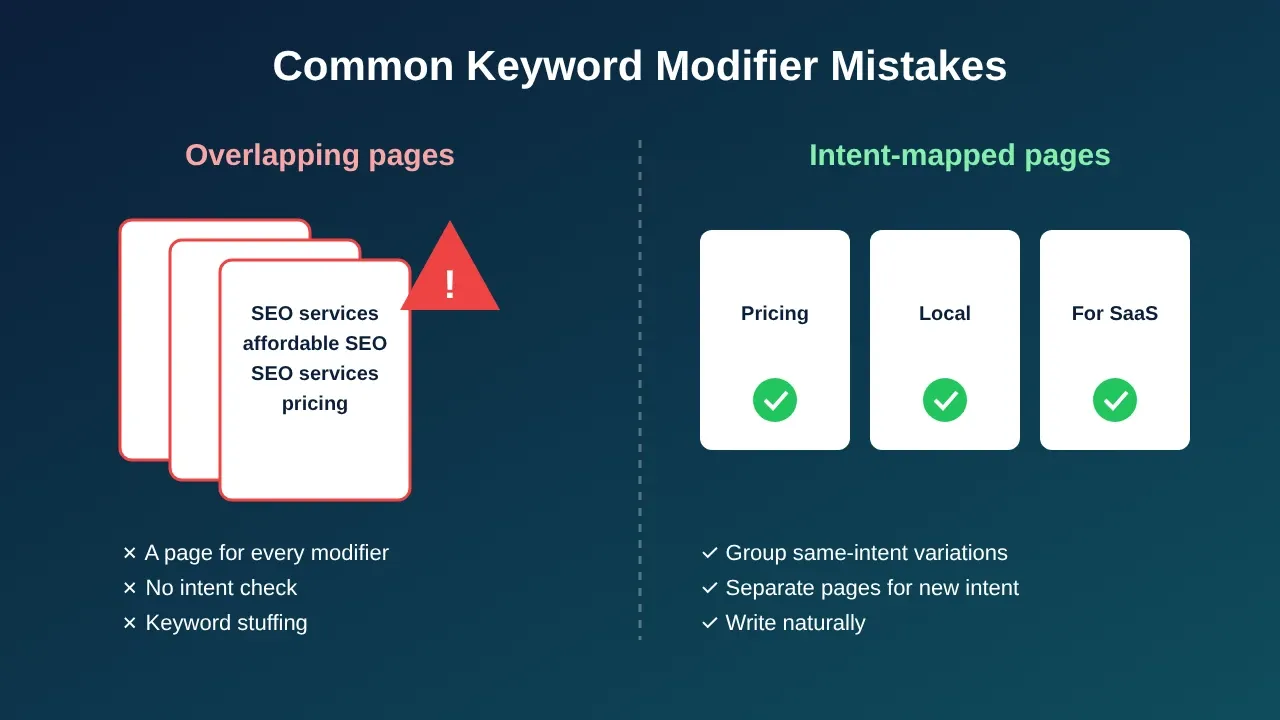
Keyword modifiers can help make SEO research more specific, but they can also create problems when they are used without considering search intent. The goal is not to collect as many keyword variations as possible. The goal is to identify variations that represent useful search needs.
Creating a Separate Page for Every Modifier
One common mistake is assuming that every modified keyword needs its own page.
For example, these keywords may appear different:
SEO servicesaffordable SEO servicesSEO services for small businesses
But they may still be closely related in intent.
Before creating separate pages, compare what the searcher expects from each query. If one page can answer the variations comprehensively, keeping them together may be more useful than creating several pages with overlapping content.
Adding Modifiers Without Checking Intent
A modifier can change the purpose of a search.
For example:
keyword research
and
keyword research tools
are related, but they do not necessarily require the same content. The first is a broader topic, while the second specifically indicates interest in tools.
The modifier should therefore influence the content you create. Do not add a modifier to a title simply because it contains a keyword variation you want to target.
Keyword Stuffing
Another mistake is repeating keyword modifiers excessively throughout a page.
If you are targeting a phrase such as “keyword research tools,” there is no need to force the exact phrase into every heading or paragraph. Write naturally and use related terminology where it genuinely supports the topic.
Search engines need enough context to understand the page, but readers need useful information rather than repeated keyword variations.
Ignoring the Audience
Some modifiers identify a specific audience.
For example:
SEO for small businesses
is more specific than:
SEO
The audience modifier should influence the content. A page targeting small businesses should address their particular challenges, resources, and goals rather than simply replacing the broad keyword with a longer phrase.
Treating Every Modifier as a New Keyword Opportunity
Not every variation deserves attention.
Some modifiers may have little meaningful difference from the original keyword. Others may have very different intent and deserve dedicated content.
I would evaluate each modifier based on three questions:
Does it change the search intent?
Does it identify a meaningful audience, location, or need?
Can the resulting content provide a substantially useful answer?
If the answer is yes, the modifier may represent a worthwhile SEO opportunity. If not, it may simply be another variation of an existing keyword.
Final Check Before Publishing
Before building content around a keyword modifier, review the existing pages targeting similar terms. This helps prevent unnecessary overlap and gives you a clearer idea of whether the modifier belongs on an existing page or deserves its own content.
Final Thoughts
Keyword modifiers can turn broad SEO terms into more specific search opportunities. By adding words that define intent, location, audience, service, or topic, you can better understand what people are actually looking for.
The key is to use keyword modifiers as a research and content planning tool, not as a reason to create dozens of nearly identical pages. Some variations can be covered together, while others may represent a distinct search intent that deserves dedicated content.
When researching a keyword, start with the core term, identify meaningful modifiers, group related variations, and then evaluate the intent behind each group. This gives you a clearer path from keyword research to useful content.
For SEO work that requires deeper keyword research, content planning, and strategy, contact Shahid Shahmiri.
Frequently Asked Questions
What are keyword modifiers?
Keyword modifiers are words or phrases added to a core keyword to make the search more specific. They can indicate factors such as search intent, location, audience, service type, or topic.
Why are keyword modifiers important for SEO?
Keyword modifiers can help you identify more specific search queries and understand what users want from a search. They can also help with content planning and long-tail keyword research.
What are examples of keyword modifiers?
Common examples include words such as best, affordable, local, pricing, for beginners, for small businesses, tools, and examples. The appropriate modifier depends on the core keyword and the searcher's intent.
How do I find keyword modifiers?
You can start with a broad keyword and look for related variations through search suggestions, related searches, keyword research data, and your existing keyword list. Focus on modifiers that add meaningful context to the original keyword.
Should every keyword modifier have its own page?
No. Closely related modifiers can often be addressed on the same page. A separate page is more appropriate when the modifier represents a substantially different search intent, audience, or topic.
Are keyword modifiers the same as long-tail keywords?
Not exactly. A keyword modifier is a word or phrase added to a core keyword, while a long-tail keyword is generally a more specific search query. Keyword modifiers can be used to create long-tail keyword variations.
How should I use keyword modifiers in content?
Use relevant modifiers naturally in titles, headings, body content, and keyword research. The content should focus on satisfying the search intent rather than repeating the modifier unnecessarily.
Can keyword modifiers help with local SEO?
Yes. Location-based modifiers can make keywords more specific to a geographic area. For example, adding a city or region to a service keyword can indicate local search intent. The location should be relevant to the business and the audience being served.
Read this article in: