
Getting more visitors is one of the first goals for almost every website owner. But getting 10,000 visits isn't necessarily better than getting 1,000 visitors who are genuinely interested in what you offer. This is why website owners researching buy website traffic SearchSEO should look beyond traffic volume and consider where visitors come from, what they do after arriving, and whether the campaign supports a broader SEO strategy.
SearchSEO positions its service around search-based traffic. According to its website, users can set up projects around specific keywords, target countries, and traffic volumes, with visits generated through search-result interactions.
That makes it different from generic traffic packages that simply promise a fixed number of visitors.
However, buying traffic isn't the same as earning organic rankings. Before spending money, you should understand how the traffic is generated, what you're trying to achieve, how you'll measure it, and whether the visitors are relevant to your business.
What Does It Mean to Buy Website Traffic From SearchSEO?
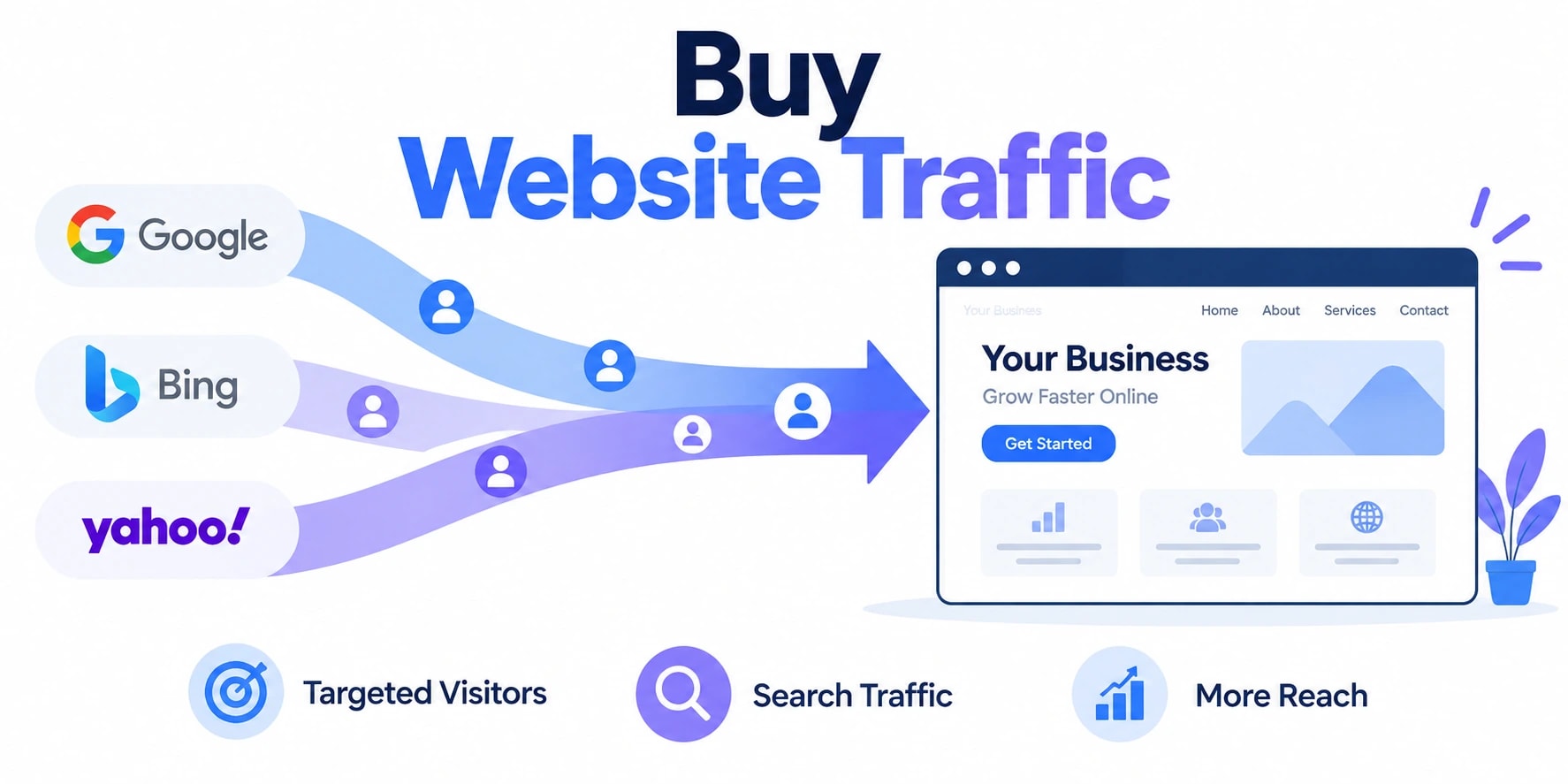
Buying website traffic from SearchSEO means paying for a service designed to generate search-based visits to selected website pages and keywords. SearchSEO says its system sends users through search results to the target site and allows campaign settings such as keywords, countries, click volume, and visit behavior.
The important distinction is that purchased visits and organic SEO growth aren't the same thing. Treat traffic as a marketing input that needs to be measured, rather than as a guaranteed ranking shortcut.
What Is SearchSEO?
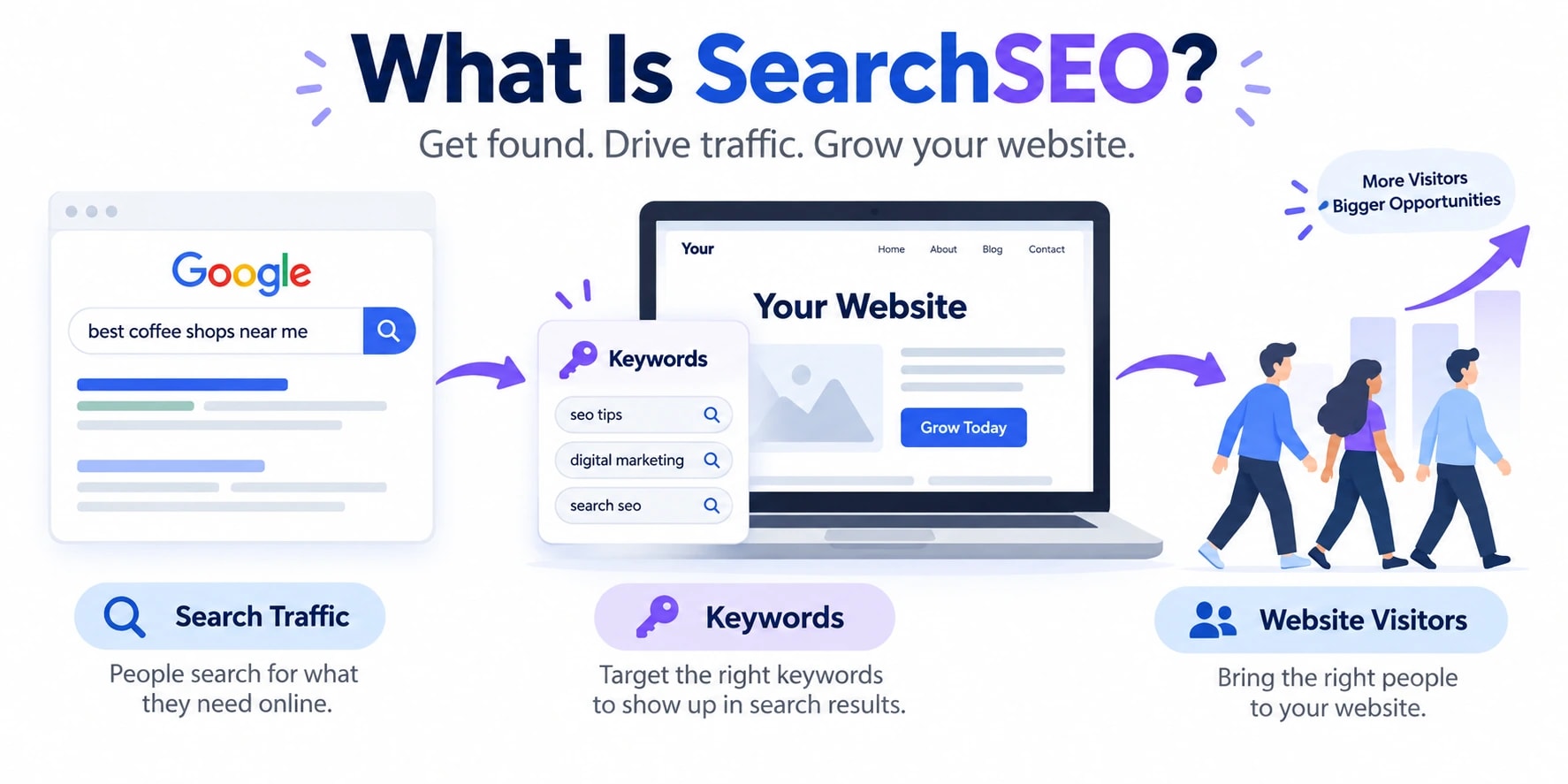
SearchSEO is an SEO traffic platform focused on generating search-related visits and clicks. Its current website describes a process where users select a website, keywords, geographic targeting, and desired traffic volume. The platform then describes traffic being generated through searches and clicks on search results.
SearchSEO also promotes features related to Google and Bing traffic, keyword-focused campaigns, and analytics monitoring.
If you're considering the service, don't rely solely on promotional claims. Before purchasing, check:
What type of traffic you'll receive
Which countries can be targeted
How the traffic is generated
Whether you can choose specific keywords
How campaign volumes are controlled
What reporting is provided
How the traffic appears in your analytics
What the current terms and pricing are
What happens if traffic quality doesn't match your expectations
These questions matter because "website traffic" can mean very different things depending on the provider.
A package delivering thousands of automated or irrelevant visits has a different business value from traffic generated around searches that are closely related to your content.
What Does It Mean to Buy Website Traffic?
When you buy website traffic, you're paying another platform or provider to send visitors to your website.
Traditional paid traffic includes channels such as search advertising, display advertising, social advertising, sponsored content, and referral campaigns. SEO traffic services can use different approaches.
The basic idea is simple:
Traffic source → visitor → landing page → engagement → desired action
The difficult part is making sure each stage makes sense.
Traffic sources
Before purchasing traffic, identify its source. Ask whether visitors come from:
Search engines
Advertising networks
Referring websites
Social platforms
Direct visits
Other traffic networks
The source affects what the traffic means in your analytics.
Geographic targeting
If you sell services in the UK, traffic from countries where you don't operate may have little commercial value.
Targeted website traffic should match the audience you want to reach. Geographic targeting can therefore matter as much as the total number of visitors.
Device targeting
Your customers may primarily use smartphones, desktops, or tablets. If your website converts poorly on mobile, sending more mobile visitors won't solve the underlying problem.
Search-based traffic
Search-based campaigns are designed around keywords and search behavior. SearchSEO says its campaigns allow users to specify keywords and target countries before traffic is delivered.
This can make keyword-level testing more relevant for SEO-focused campaigns than simply purchasing generic visitors.
Why Do Businesses Buy Website Traffic?
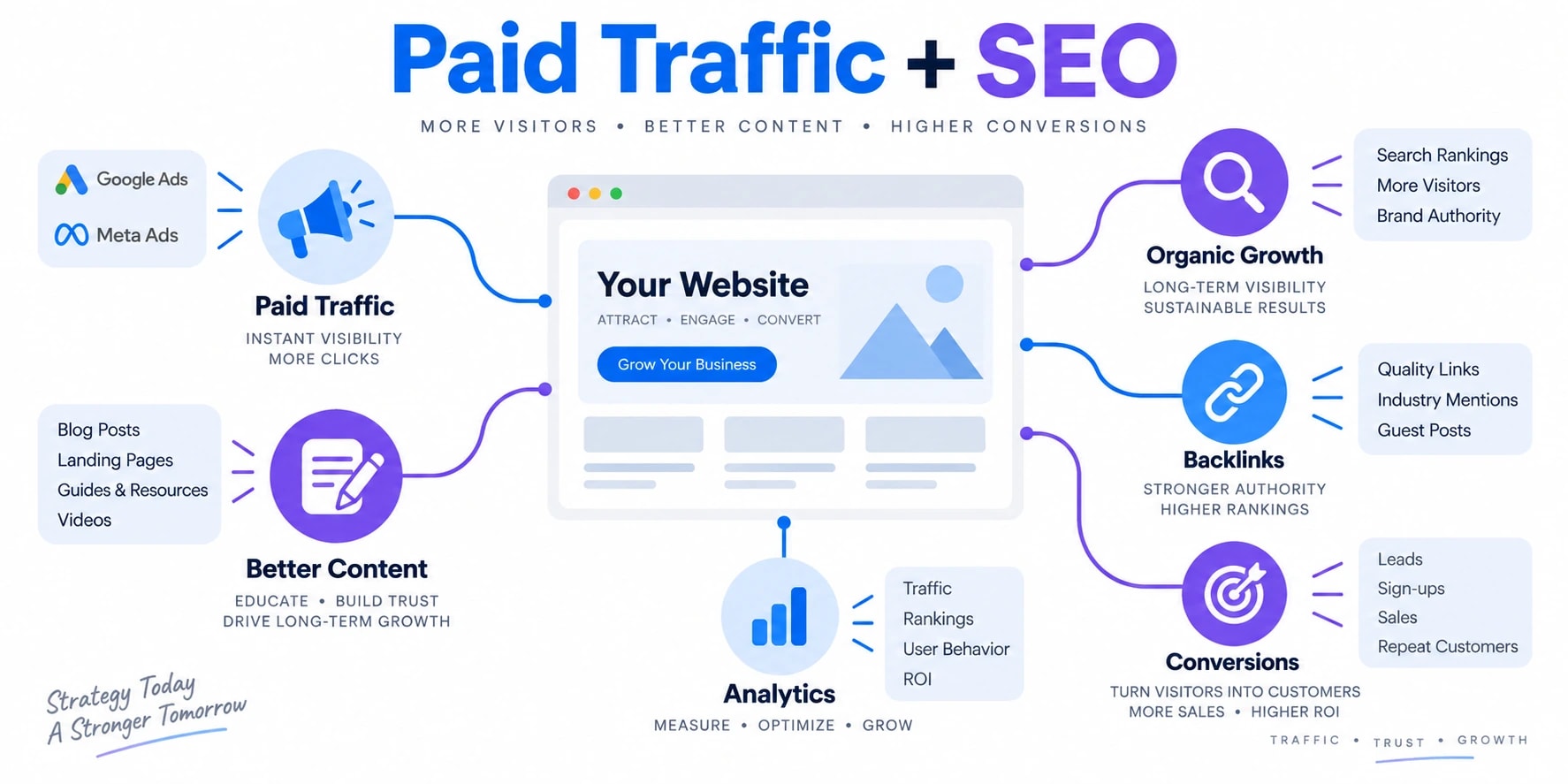
There are legitimate reasons to purchase traffic.
1. Getting initial visitors
A new website can have good content but little exposure. Paid campaigns can provide visitors while the site works toward building organic visibility.
2. Testing landing pages
Suppose you've created a new service page. You can use paid traffic to collect behavioral data and identify problems with the page.
If visitors leave immediately, the issue may be the traffic, the page, the offer, or the mismatch between the two.
3. Testing content
Traffic can help you understand which topics attract attention and which pages encourage visitors to continue browsing.
4. Increasing exposure
Paid traffic can expose content or offers to an audience that may not discover them through organic search immediately.
5. Collecting behavioral data
Analytics can show where visitors come from, which pages they visit, how long they engage, and whether they complete key events.
Google Analytics defines an engaged session as one lasting longer than 10 seconds, containing a key event, or involving at least two page or screen views.
6. Supporting marketing campaigns
Paid traffic can work alongside email marketing, social media, content marketing, SEO, and other acquisition channels.
The important point is that buying visitors shouldn't become a replacement for building a website that deserves long-term traffic.
Can Buying Website Traffic Improve SEO?
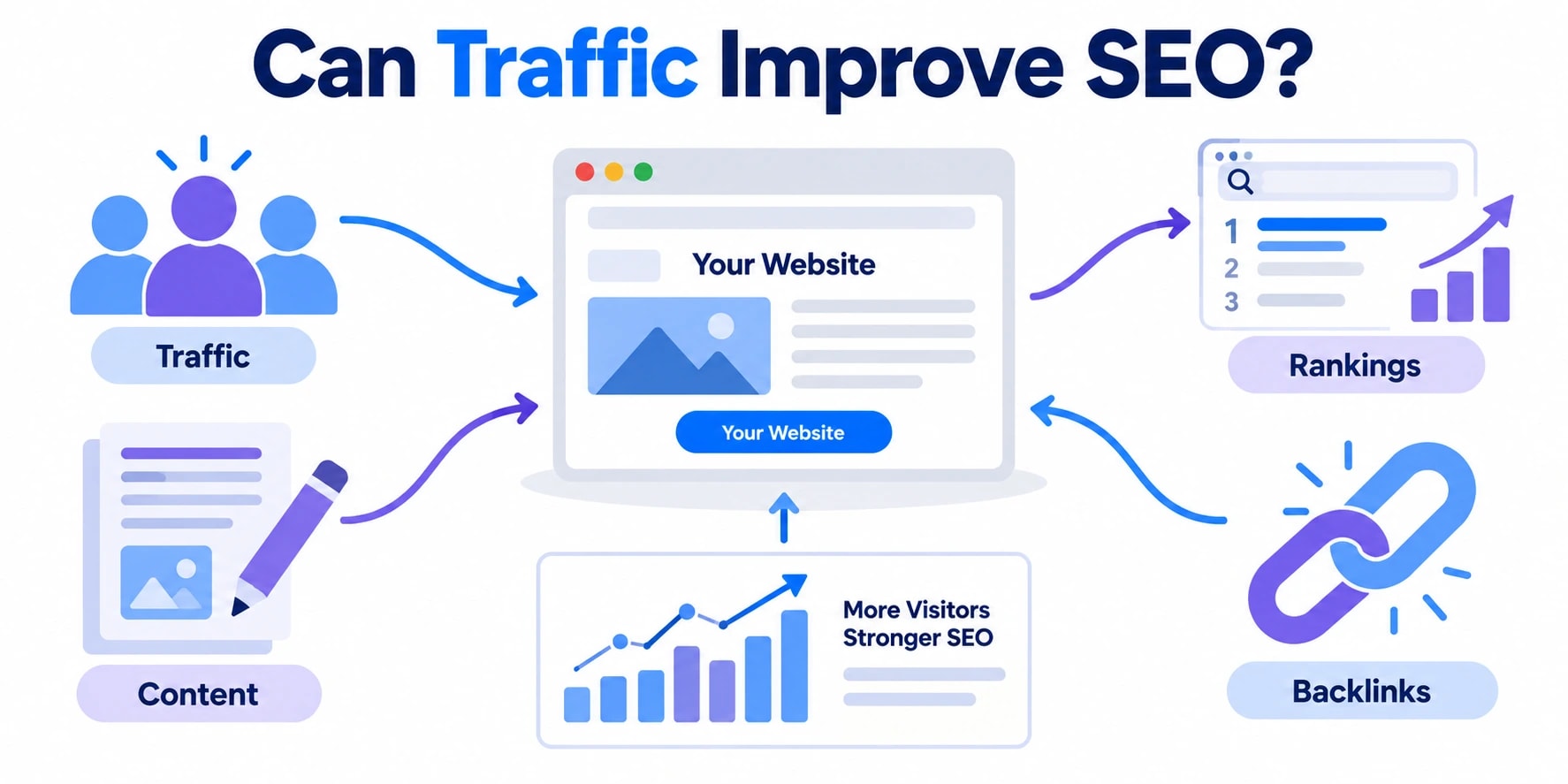
This is where website owners need to be careful.
Buying traffic isn't the same thing as buying Google rankings.
More sessions in Google Analytics don't automatically mean better organic rankings. SEO involves multiple areas, including content relevance, technical accessibility, links, site structure, user experience, and search visibility.
SearchSEO specifically markets its service around improving search-related signals, including clicks and CTR.
However, those are claims made by the provider. Website owners should measure their own results rather than assuming that purchased traffic will produce ranking improvements.
There is also an important distinction between using traffic as part of marketing and attempting to manipulate search results.
A sensible SEO strategy still requires:
Useful, original content
Search intent alignment
Strong internal linking
Relevant backlinks
Good page experience
Clear website navigation
Conversion-focused landing pages
Consistent content improvements
Paid traffic can provide additional data or exposure, but it shouldn't be treated as a substitute for these fundamentals.
Buy Website Traffic SearchSEO vs Organic SEO Traffic
Factor | SearchSEO / Paid SEO Traffic | Organic SEO Traffic |
|---|---|---|
Source | Purchased campaign | Unpaid search visibility |
Speed | Can begin quickly | Usually takes longer |
Cost | Requires ongoing budget | Requires investment in content and SEO |
Control | Campaign settings can provide targeting options | Depends on rankings and search demand |
Long-term value | Depends on campaign and results | Can continue after content ranks |
Targeting | Can be configured around selected keywords or locations | Determined by search queries and rankings |
Scalability | Can increase campaign volume | Depends on ranking growth and demand |
Conversion potential | Depends heavily on audience relevance | Often strong when intent matches the page |
SEO relationship | Can support testing or SEO-focused campaigns | Core source of search visibility |
The two approaches don't necessarily need to compete.
A website can use paid campaigns to test pages or audiences while continuing to invest in organic SEO.
What Should You Check Before Buying Website Traffic?
Don't buy a traffic package based only on the number of visitors promised.
Use this checklist instead.
Check the traffic source
Ask exactly where the visitors originate.
A provider should be able to explain the source clearly enough for you to understand what you're paying for.
Check audience relevance
Traffic from people who have no reason to care about your website isn't useful simply because it appears in Analytics.
Check geographic targeting
Make sure the available locations match your target market.
Ask about bot and fraud protection
Clarify how the provider distinguishes traffic from unwanted automated activity.
Check traffic quality
Look at engagement, page views, conversions, and other meaningful behavior rather than sessions alone.
Test analytics tracking
Before launching a large campaign, make sure your analytics setup is working correctly.
Review reporting
You should be able to understand what you're paying for and evaluate the results.
Check pricing and terms
Read the current pricing, refund terms, campaign limitations, and cancellation conditions before purchasing.
Be cautious of unrealistic SEO promises
Be particularly careful if a provider guarantees specific Google rankings, guaranteed traffic conversions, or permanent SEO growth.
SEO results depend on many factors outside a traffic provider's control.
How to Measure the Quality of Purchased Traffic
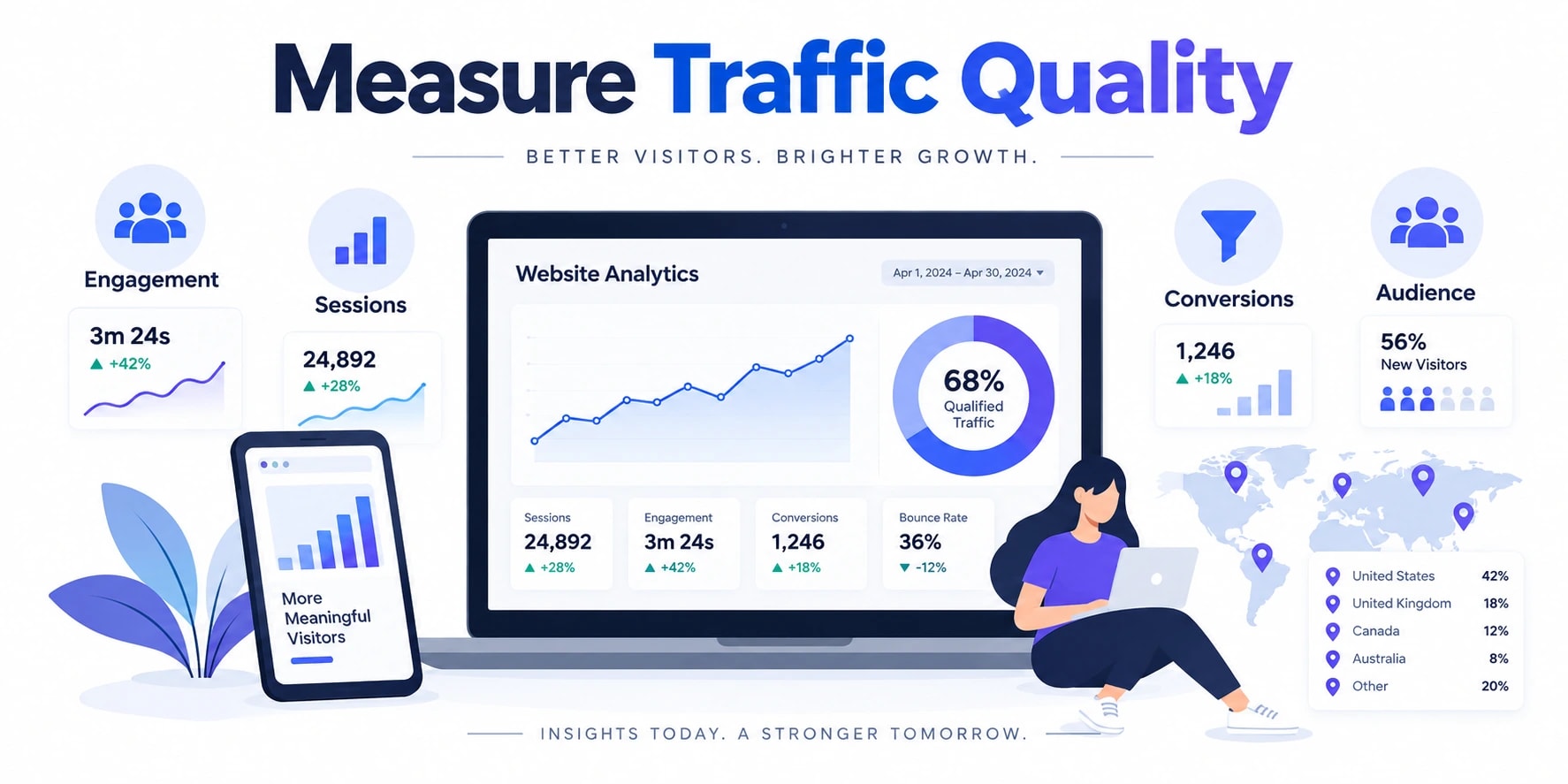
Once you buy web traffic, your job isn't finished. Measurement is what tells you whether the campaign has business value.
Google Analytics provides several useful metrics for evaluating acquisition and engagement.
Sessions
Sessions tell you how many visits began on your website.
Useful, but not enough by themselves.
Engaged sessions
An engaged session meets Google's criteria for meaningful interaction, such as lasting more than 10 seconds, producing a key event, or generating at least two page or screen views.
Engagement rate
Engagement rate shows the percentage of sessions that were engaged sessions.
Average engagement time
This helps you understand how long visitors actively engage with your site.
Pages per session
This can help reveal whether visitors explore more than one page, although it should be interpreted alongside other metrics.
Conversion rate
For most businesses, this is more important than raw traffic.
A conversion could be:
A purchase
Contact form submission
Phone call
Newsletter signup
Demo request
Account registration
Download
Returning visitors
Returning users can provide another indication that visitors found enough value to come back. Google Analytics distinguishes returning users from new users based on previous sessions.
Geographic and device data
Check whether the visitors match your intended audience.
If you target users in the United States but most of your traffic comes from elsewhere, investigate before scaling the campaign.
Traffic source and medium
Analytics can help you understand how users arrived and compare different acquisition sources.
The main lesson is simple: 10,000 visitors with no meaningful engagement can be less useful than 500 relevant visitors who read your content and become customers.
How to Use Purchased Traffic Without Replacing SEO
If you're using SEO traffic services, combine them with a broader strategy.
1. Define the campaign goal
Don't start with "I want 10,000 visitors."
Start with:
"I want to test this landing page."
Or:
"I want to understand whether this keyword attracts the right audience."
2. Choose a relevant audience
Focus on keywords and locations that match your business.
3. Send visitors to useful pages
Don't automatically send every visitor to your homepage.
A visitor searching for a specific topic should ideally land on the page that answers that query.
4. Track behavior
Set up Analytics and relevant key events before starting.
5. Test landing pages
Compare headlines, layouts, calls to action, content depth, and other elements.
6. Improve content based on data
If visitors consistently leave a particular page quickly, investigate why.
Google recommends using engagement reports to identify low-engagement channels and pages and then checking whether the content matches the marketing that brings visitors there.
7. Continue investing in organic SEO
Keep publishing useful content, improving existing pages, building relevant links, and fixing technical problems.
8. Compare traffic quality against conversions
The ultimate question isn't "How many visitors did I receive?"
It's "What did those visitors do?"
Common Mistakes When Buying Website Traffic
Buying the cheapest traffic
Cheap traffic can be attractive, but price doesn't tell you whether visitors are relevant.
Focusing only on visitor numbers
A traffic graph going up can look impressive while producing no business results.
Choosing irrelevant audiences
More traffic from the wrong audience doesn't solve an acquisition problem.
Expecting instant Google rankings
SEO doesn't work like purchasing a fixed number of visitors and receiving a guaranteed ranking in return.
Not tracking conversions
If you don't define and track meaningful actions, it's difficult to calculate campaign value.
Sending everyone to the homepage
Match the landing page to the visitor's intent.
Ignoring unusual traffic patterns
Sudden unexplained spikes, unusual locations, or extremely low engagement should be investigated.
Buying traffic without a goal
Before spending money, decide what you're testing or trying to improve.
Is Buying Website Traffic Safe for SEO?
There isn't a useful one-word answer.
The more important questions are what kind of traffic you're buying, how it's generated, how it relates to your marketing goals, and whether you're using it as part of a legitimate strategy or attempting to manipulate search results.
SearchSEO says its system uses residential IPs and search-based interactions and describes its traffic as designed to resemble organic search visits.
Those statements come from SearchSEO itself, so they should be evaluated alongside your own campaign data and the provider's current documentation.
Don't assume that traffic volume automatically improves SEO.
If you're considering a service specifically for ranking manipulation, understand the distinction between marketing traffic and attempts to influence search-engine signals. Your safest long-term approach is to build an SEO strategy around valuable content and a technically sound website, regardless of whether you also experiment with paid traffic.
When Should You Buy Website Traffic?
Paid traffic may make sense when you have a clear reason for purchasing it.
For example, you might use it to:
Test a new landing page
Evaluate audience interest
Support a product launch
Generate initial exposure
Gather behavioral data
Test specific keywords
Supplement an existing SEO campaign
Compare different landing pages
It may make less sense when your website has fundamental problems.
If your pages are slow, difficult to navigate, poorly written, irrelevant to search intent, or missing a clear conversion path, sending more visitors won't fix those issues.
Fix the foundation first.
Then use paid traffic as one part of your acquisition strategy.
Final Thoughts
The phrase buy website traffic SearchSEO represents a specific type of traffic-buying search, but the decision shouldn't come down to visitor numbers alone.
Search-based traffic can be useful for testing campaigns, gathering data, increasing exposure, and supporting broader marketing efforts. SearchSEO currently promotes keyword-focused campaigns designed around search-result clicks and provides controls for factors such as keywords, geography, and traffic volume.
At the same time, paid traffic shouldn't be confused with sustainable organic SEO. Strong content, technical SEO, relevant links, useful landing pages, and a good user experience remain important parts of long-term search visibility.
Before you buy website traffic, define your goal, verify the traffic source, start with a controlled campaign, and monitor engagement and conversions.
Don't ask only, "How many visitors did I get?"
Ask, "Were they relevant, did they engage, and did the traffic help me achieve my actual business goal?"
That shift from traffic volume to traffic quality is what makes a traffic campaign easier to evaluate and improve.
Frequently Asked Questions
1. Is it safe to buy website traffic?
It depends on the source and purpose of the traffic. Before purchasing, investigate the traffic method, audience, targeting, reporting, and provider terms. Avoid assuming that purchased visits automatically improve SEO.
2. Does buying traffic improve Google rankings?
There is no guarantee that buying traffic will improve rankings. SearchSEO markets its service as a way to influence SEO-related signals, but website owners should measure actual results rather than treating the service as a guaranteed ranking solution.
3. Can I buy organic website traffic?
You can purchase services marketed as organic or search-based traffic, but "paid" and "organic" describe different acquisition concepts. A paid service generating search-like visits isn't the same as naturally earning an organic ranking.
4. What is targeted website traffic?
Targeted website traffic refers to visitors selected or directed based on characteristics such as keyword, geography, audience, device, or campaign intent.
5. How do I know if website traffic is real?
Review traffic sources, engagement, geographic patterns, device information, session behavior, and conversions. No single metric proves traffic quality.